


The Chinese Nationalist Party (KMT) has called on members to pay “a special party fee” of NT$2,000 per person in order to “save [the party] from demise,” with KMT Chairwoman Hung Hsiu-chu (洪秀柱) said to be ready to pay her share tomorrow to set an example.
The KMT said it would launch events calling for the “special party fee” to protect its survival and a “NT$1,000 donation” drive on the eve of Retrocession Day on Tuesday “in order to defend the Republic of China’s (ROC) constitutional system of freedom, democracy and rule of law.”
Hung is to lead the party’s central leadership, city and county chapter officials and Huang Fu-hsing (黃復興) military veterans’ branch officials to pay the special party fees tomorrow while attending a “safeguard the ROC Constitution and donate NT$1,000” event that is to be held in New Taipei City tomorrow night, which is public-oriented, as opposed to the call for special party fees made to members.
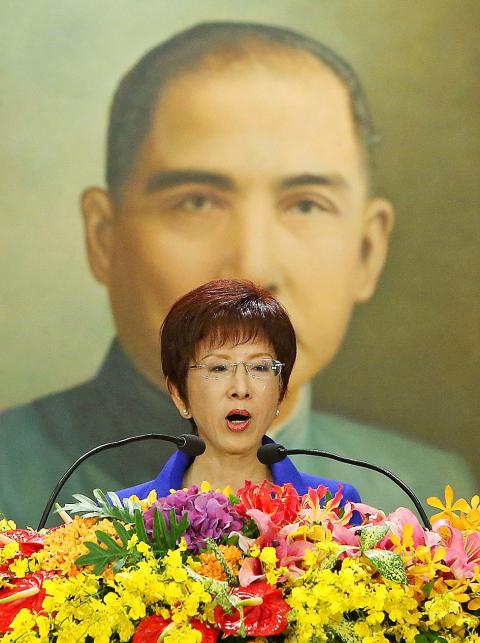
PHOTO: CNA
The party said it hopes that members and the public can support the KMT to “hold out the hand of justice” and “check a Democratic Progressive Party [DPP] regime that is marching toward fascism and green terror.”
The special party fee has been set at a minimum of NT$2,000, although members can donate as much as they want, the party said.
Members who contribute during a stipulated period — from Tuesday through Dec. 25 — would receive a letter from the party chairwoman and a reprint of the certificate for the Revolutionary Party when it was founded by Sun Yat-sen (孫中山) in 1914 following the failed Second Revolution against Yuan Shikai (袁世凱) in 1913, “which is to symbolize the spirit of the [ROC’s] founding father in the Second Revolution by supporting the KMT in supervising an unjust and unconstitutional regime,” the KMT said.
Members of the public who participate in the NT$1,000 donation activity would be thanked with a reprint of the “receipt of the just pay of the Chinese Revolutionary Army” published by the Tongmenghui in 1911, a year before the founding of the ROC, which was issued so that revolutionary army soldiers could collect their pay.
It has been reported that some party workers have complained that the “special party fees” campaign calls for “reluctant donations” from party members, and have asked party headquarters to pay them their salaries before they donate.
KMT Culture and Communications Committee deputy director Hu Wen-chi (胡文琦) said that the event is simply an expression of the idea that the KMT can “save the party ourselves” and is not compulsory, adding that there would be no consequences for members who do not make contributions.
Additional Reporting by Shih Hsiao-kuang


China has reserved offshore airspace in the Yellow Sea and East China Sea from March 27 to May 6, issuing alerts usually used to warn of military exercises, although no such exercises have been announced, the Wall Street Journal (WSJ) reported yesterday. Reserving such a large area for 40 days without explanation is an “unusual step,” as military exercises normally only last a few days, the paper said. These alerts, known as Notice to Air Missions (Notams), “are intended to inform pilots and aviation authorities of temporary airspace hazards or restrictions,” the article said. The airspace reserved in the alert is

South Korea is planning to revise its controversial electronic arrival card, a step Taiwanese officials said prompted them to hold off on planned retaliatory measures, a South Korean media report said yesterday. A Yonhap News Agency report said that the South Korean Ministry of Foreign Affairs is planning to remove the “previous departure place” and “next destination” fields from its e-arrival card system. The plan, reached after interagency consultations, is under review and aims to simplify entry procedures and align the electronic form with the paper version, a South Korean ministry official said. The fields — which appeared only on the electronic form
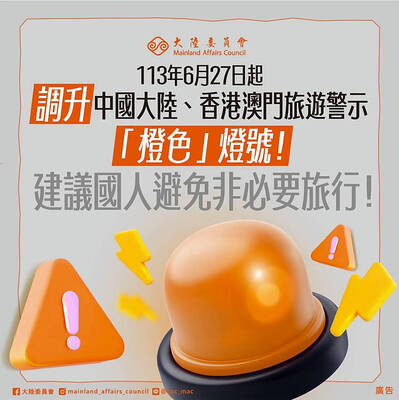
More than 6,000 Taiwanese students have participated in exchange programs in China over the past two years, despite the Mainland Affairs Council’s (MAC) “orange light” travel advisory, government records showed. The MAC’s publicly available registry showed that Taiwanese college and university students who went on exchange programs across the Strait numbered 3,592 and 2,966 people respectively. The National Immigration Agency data revealed that 2,296 and 2,551 Chinese students visited Taiwan for study in the same two years. A review of the Web sites of publicly-run universities and colleges showed that Taiwanese higher education institutions continued to recruit students for Chinese educational programs without

A bipartisan group of US senators has introduced a bill to enhance cooperation with Taiwan on drone development and to reduce reliance on supply chains linked to China. The proposed Blue Skies for Taiwan Act of 2026 was introduced by Republican US senators Ted Cruz and John Curtis, and Democratic US senators Jeff Merkley and Andy Kim. The legislation seeks to ease constraints on Taiwan-US cooperation in uncrewed aerial systems (UAS), including dependence on China-sourced components, limited access to capital and regulatory barriers under US export controls, a news release issued by Cruz on Wednesday said. The bill would establish a "Blue UAS


 RSS
RSS