

Vanderbilt University Center for US-Japan Studies and Cooperation director James Auer yesterday said that if “the credibility of using Taiwanese, Japanese and American resolve when challenged by China is not clearly demonstrated, Beijing may get overconfident and attempt to achieve its hegemonic goals militarily.”
At a symposium hosted in Taipei by the Taiwan National Security Institute to discuss the South China Sea dispute and Asian-Pacific peace and security, Auer said the seamless navy-to-navy cooperation between the US and Japan during the Cold War resulted in a victory in the Pacific by deterrence.
“The victory was made possible because, despite the huge numbers of Soviet submarines, the US and Japanese navies maintained control of the seas of the western Pacific,” he added.

Photo: Liao Chen-huei, Taipei Times
“The post-Cold War question for Tokyo and Washington is, in my opinion, whether the Japanese and US navies can similarly deter China from aggressive acts of war as they did vis-a-vis the Soviet Pacific Fleet in the 1980s; a related question is: How can Taiwan most meaningfully and most cost effectively provide for its self-defense?” Auer said.
He said that despite China’s ambitions to restore a China-centric tributary system, if Taiwan, the US and Japan are “determined enough, geography and Chinese behavior argue against Chinese hegemony given the proximity of Japan, Taiwan, the Philippines, Vietnam, Indonesia, Australia and India,” as all these nations are concerned over China’s aggressive moves and claims.
He said that while China is now able to operate in the East and South China seas and beyond for trade, its geography actually limits its capabilities with the first and second island chains (the first chain is mainly composed of the Kuril Islands, the Japanese archipelago, Ryukyu Islands, Taiwan, the northern Philippines and Borneo and from the Kamchatka Peninsula to the Malay Peninsula, and the second island chain refers to the Ogasawara Islands, Japan’s Volcano Islands and the Mariana Islands, which is US territory) in place, unless major Pacific powers “needlessly allow China to violate international law by taking control of Taiwan” and other territories controversially claimed by China and “by limiting or prohibiting freedom of navigation in the South China Sea.”
If the Japan Maritime Self-Defense Force and the US Navy demonstrate capability, for example “in the case of Chinese initiation of the use of military force against Taiwan, to deny China’s use of the sea inside the first island chain, to defend the sea and air space of the first island chain and to dominate the sea and maritime areas outside the chain, their ability to do so would be a meaningful deterrent to Chinese illegal aggression,” Auer said.
Taiwan should bolster its self-defense, he said.
While Taiwan cannot match China’s military expenditure, it has to “think bigger and act smarter” by “fostering interoperability with American and Japanese defense forces” and “utilizing relatively cheap new high technology to challenge Chinese tactical dominance,” which, he said could be in the fields of robotics, artificial intelligence, additive manufacturing, nanoenergetics and their convergence as, suggested by US National Defense University research fellow Thomas Hammes.
Auer said a US-led Pacific strategy is “urgently needed” and hoped for by China’s neighbors, but “unfortunately, in my opinion, [it] is currently lacking, owing to a lack of leadership.”
President Tsai Ing-wen (蔡英文) said at the symposium that her administration has expressed “great goodwill” to China in her inauguration speech on May 20, and that promise is unchanged.
“We will not bow to pressure, and at the same time, we do not want to, are not willing to and will not go back to the old approach of antagonism,” she said.
Auer said in 1963 on a naval expedition to Taiwan he met a Republic of China Army major and asked about the “return to the mainland” slogan exhorted by the then-KMT regime.The major, who was a Taiwanese officer, said while most military officers were Chinese who came to Taiwan with Chiang Kai-shek (蔣介石) in 1949, virtually all of the soldiers were Taiwanese, who had guns but no ammunition.
If the order to “return” were given they would “receive ammunition from the officers, shoot the officers and return to their homes — in Taiwan,” the major said.
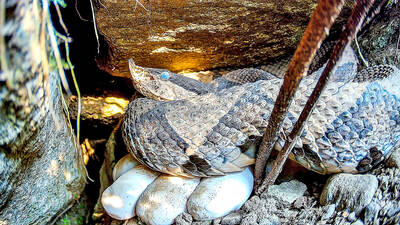
NATURE TAKES ITS COURSE: The agency’s head said he felt a sense of loss watching red-banded snakes eat the babies, as they had decided on non-intervention The Forestry and Nature Conservation Agency yesterday released a documentary on a hundred-pace viper that had incubated 16 eggs, all of which hatched, but only a baby viper escaped after they were attacked by red-banded snakes. The agency’s Taichung branch last year launched the viper reproduction monitoring project soon after forest rangers Lin Chun-yu (林俊佑) and Chou Chia-cheng (周家成) spotted a pregnant hundred-pace viper in a grass-covered burrow near a parking lot in Tbulan Village (松鶴部落). The Atayal village, in Taichung’s Heping District (和平), is headed by Ecyang Yapu, who was positive about the project and assisted in access control and power
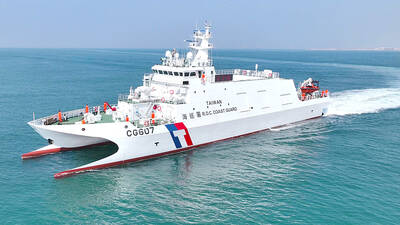
The Coast Guard Administration (CGA) yesterday said that it had deployed vessels to “monitor” Chinese ships operating in waters off the east coast. The CGA said it dispatched vessels in response to a China Coast Guard announcement that it had carried out another “routine law-enforcement patrol” in waters off the east coast. “The CGA firmly rejects China’s cognitive warfare campaign of ‘law enforcement in name, jurisdictional expansion in practice,’” it said on X. As of 11am yesterday, two China Coast Guard ships were “loitering and drifting” about 105 nautical miles (195km) and 74 nautical miles east of Green Island (綠島) respectively, it said. It
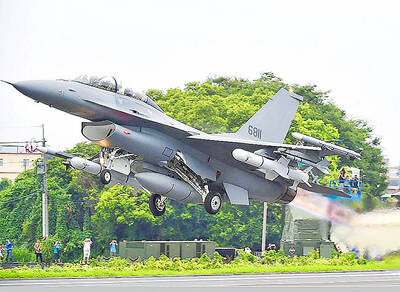
A sharp rise in compensation to be paid by air force officers who leave before completing their required service could indicate an increase in pilots leaving the military early, an analyst said on Friday, warning that the trend could worsen a shortage of experienced personnel. Chieh Chung (揭仲), a researcher at the Association for Strategic Foresight, issued the warning even though the number of volunteer military personnel is expected to increase next year. The planned headcount for volunteer military personnel, covering officers, noncommissioned officers (NCO) and enlisted soldiers, is 158,223 for next year, up 4,258 from 153,965 this year, Chieh said. The increase
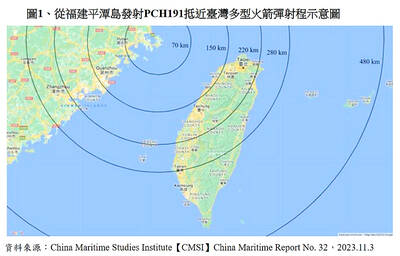
Potential improvements to munitions used by China’s long-range rocket-artillery units could extend their range to cover the entire Miyako Strait, which might give the Chinese People’s Liberation Army (PLA) the ability to secure the strategic waterway, the Mainland Affairs Council (MAC) said in a report. The PLA’s long-range rocket-artillery units deployed along the Taiwan Strait are concentrated along the coast of Fujian Province, including Changle, Pingtan and Shishi, the quarterly report on China said. The artillery brigades of the PLA’s 71st, 72nd and 73rd group armies have been deployed, with preparations for potential battlefield operations under way since August 2022, the report


 RSS
RSS