


President Tsai Ing-wen (蔡英文) yesterday expressed the hope for deepening Taiwan-US cooperation on trade, security and international participation as she acknowledged the achievements of outgoing American Institute in Taiwan (AIT) Chairman Raymond Burghardt over the past decade.
Tsai made the remarks during a meeting at the Presidential Office with Burghardt, who is on his 20th and final visit to Taiwan as chairman of the AIT, which represents US interests in Taiwan in the absence of diplomatic ties.
“Last year, during my visit to the US, and this year when I transited at Los Angeles, Ambassador Burghardt accompanied me throughout the entire trip. This not only bears testament to the friendly relations between Taiwan and the US, but also demonstrates Burghardt’s long-standing efforts in promoting relations between the two sides,” Tsai said.
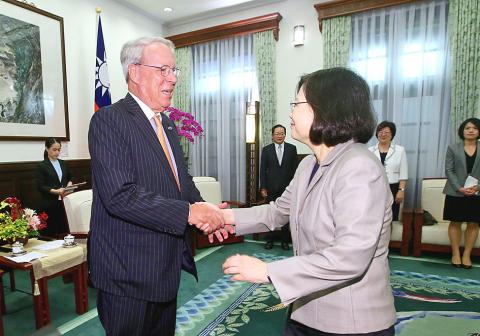
Photo: CNA
Tsai also conveyed her appreciation to Burghardt for having spent 12 years of his more than 40 years as a diplomat on furthering Taipei-Washington relations, saying Burghardt would always be welcome in Taiwan.
The US is Taiwan’s most significant strategic partner, with both sides sharing a close and special relationship in political, security, economic and cultural areas based on shared values and interests, Tsai said.
In addition to calling for further economic partnership, Tsai also expressed the hope that Washington can take more concrete actions to support Taipei’s bid to join he US-led Trans-Pacific Partnership in the second round of negotiations.
Tsai concluded her speech by thanking the US for selling weapons to Taiwan and assisting the nations in its quest for greater participation in the international community.
Burghardt said he had been to the Presidential Office multiple times, when he was received by former presidents Lee Teng-hui (李登輝), Chen Shui-bian (陳水扁) and Ma Ying-jeou (馬英九).
“I have a feeling I will be back in Taiwan, but this will be the last time in an official capacity. It brings back a lot of good memories and interesting memories,” Burghardt said.
Earlier yesterday, the AIT posted on Facebook a video featuring Burghardt’s farewell message to Taiwanese.
“Over these 40-plus years, I have witnessed Taiwan’s remarkable transition to a vibrant democracy and a global economic powerhouse. Taiwan is an important partner of the US,” Burghardt said in the video.
Burghardt said he has been impressed by the tremendous progress that Taiwan and the US have made to expand their cooperation and friendship, adding he is glad to be able to play a small role in helping that relationship deepen and grow.
Bilateral cooperation and friendship between Taipei and Washington are expected continue to grow stronger, said Burghardt, who is to retire from his post at the end of this month.
The position, which has been occupied by Burghardt since February 2006, is reportedly to be filled by James Moriarty, a former senior director for Asia at the US National Security Council during the administration of former US president George W. Bush.
Burghardt served as director of the AIT in Taiwan from 1999 to 2001.
Asked about the timetable for the institute’s announcement for Burghardt’s successor, AIT spokeswoman Sonia Urbom said they are working on final procedural issues and expect that there would be an official announcement soon.

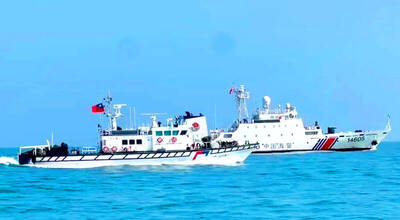
The military has spotted two Chinese warships operating in waters near Penghu County in the Taiwan Strait and sent its own naval and air forces to monitor the vessels, the Ministry of National Defense (MND) said. Beijing sends warships and warplanes into the waters and skies around Taiwan on an almost daily basis, drawing condemnation from Taipei. While the ministry offers daily updates on the locations of Chinese military aircraft, it only rarely gives details of where Chinese warships are operating, generally only when it detects aircraft carriers, as happened last week. A Chinese destroyer and a frigate entered waters to the southwest
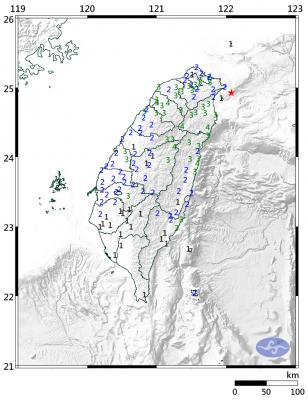
A magnitude 6.1 earthquake struck off the coast of Yilan County at 8:39pm tonight, the Central Weather Administration (CWA) said, with no immediate reports of damage or injuries. The epicenter was 38.7km east-northeast of Yilan County Hall at a focal depth of 98.3km, the CWA’s Seismological Center said. The quake’s maximum intensity, which gauges the actual physical effect of a seismic event, was a level 4 on Taiwan’s 7-tier intensity scale, the center said. That intensity level was recorded in Yilan County’s Nanao Township (南澳), Hsinchu County’s Guansi Township (關西), Nantou County’s Hehuanshan (合歡山) and Hualien County’s Yanliao (鹽寮). An intensity of 3 was
Instead of focusing solely on the threat of a full-scale military invasion, the US and its allies must prepare for a potential Chinese “quarantine” of Taiwan enforced through customs inspections, Stanford University Hoover fellow Eyck Freymann said in a Foreign Affairs article published on Wednesday. China could use various “gray zone” tactics in “reconfiguring the regional and ultimately the global economic order without a war,” said Freymann, who is also a nonresident research fellow at the US Naval War College. China might seize control of Taiwan’s links to the outside world by requiring all flights and ships entering or leaving Taiwan
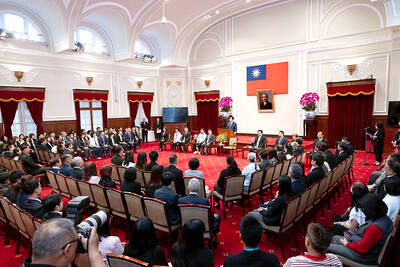
The next minimum wage hike is expected to exceed NT$30,000, President William Lai (賴清德) said yesterday during an award ceremony honoring “model workers,” including migrant workers, at the Presidential Office ahead of Workers’ Day today. Lai said he wished to thank the awardees on behalf of the nation and extend his most sincere respect for their hard work, on which Taiwan’s prosperity has been built. Lai specifically thanked 10 migrant workers selected for the award, saying that although they left their home countries to further their own goals, their efforts have benefited Taiwan as well. The nation’s industrial sector and small businesses lay


 RSS
RSS