


Liberty Times (LT): Since being tasked with organizing the Universiade by Taipei Major Ko Wen-je (柯文哲), what progress and changes have been made to the event?
Su Li-chiung (蘇麗瓊): To start with, Mayor Ko was very quick in choosing a venue for the Games.
Second, the Universiade is an ongoing process. Many action plans have been revised — 800 initial action plan items were split into 2,068 items. Take volunteers for example. There are three considerations: organizing student volunteers, organizing volunteers from the general public and how to put volunteers to use. All of these items are to be handled by a separate action plan.
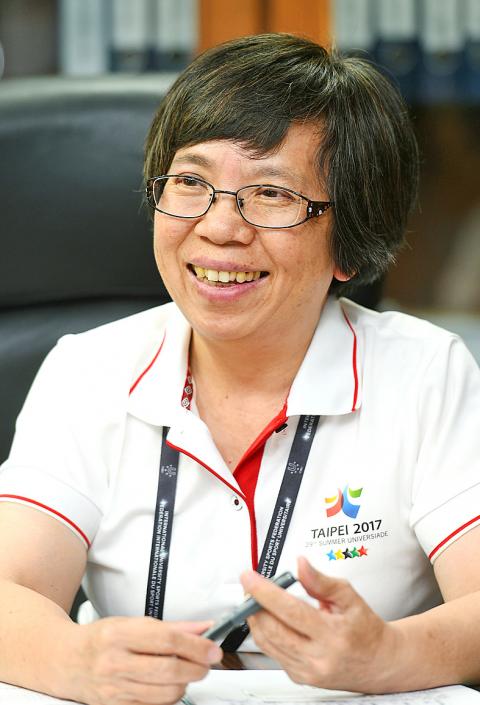
Photo: Chang Chia-ming, Taipei Times
Third, there is the issue of confirming the event’s budget. Former Taipei mayor Hau Lung-pin (郝龍斌) initially estimated that the Games would cost NT$19.8 billion (US$627.54 million at the current exchange rate), but this figure was later adjusted to NT$17.2 billion.
The most important consideration has been Mayor Ko’s approach to finances. He said we should not “arbitrarily inflate the budget,” but rather give it careful consideration and be more prudent in our planning. For example, when acquiring equipment for the athletes’ village, the mayor set a guiding principle: If it can come from a sponsor, get it from a sponsor; if it cannot come from a sponsor, rent it; and if it cannot be rented, only then buy it. Even then, if something is purchased, it must be usable after the Games have concluded. So when we were buying equipment — such as beds, desks and chairs — for the committee office and the athletes’ village, we asked a number of people if these things could be sold at a discount to other public offices or donated to charity organizations.
The Taipei City Government has always had control measures, such as delaying the procurement of new computers until next year. It will wait until use of the athletes’ village is completed to then reallocate computers to departments that need them. It also plans to perform a pragmatic assessment of promises made to the International University Sports Federation and reduce costs.
The village is comprised of east and west buildings, which Hau originally planned to connect with an 8m-wide foot bridge, with elevators at either end. After further consideration, it was decided that plan was too wasteful for short-term use. Therefore, the bridge’s width is to be reduced to 4m and the elevators are to be replaced by inclined walkways. This type of pragmatic planning allows for better use of resources. Ideally, we will hold this event and provide great service, but without increasing the city’s financial burden too much.
LT: What is the progress on construction and renovation of venues and the athletes’ village?
Su: There are a total of 53 venues and 62 facilities. Taipei is to host the most with 19 venues and 23 facilities; New Taipei City six venues and seven facilities; Taoyuan four venues and five facilities; Hsinchu City one venue; and Hsinchu County three venues and four facilities.
People are concerned that construction has fallen behind schedule, but that is not actually the case. Some venues can be completed in just two or three months. If we build things too soon, it will cause trouble for schools — they will be concerned that things will break before the Games, and then what can they do? Initially, time for construction was overestimated for these structures because of safety considerations, but there are only four venues that require more than six months to be built, and those have already been contracted.
Due to the economic circumstances of all the regions, a chance for renewed facilities such as this is hard to come by.
The athletes’ village is already under construction, and it is far ahead of schedule.
LT: You were previously involved with organizing the 2009 World Games in Kaohsiung. What part of that experience have you been able to draw on in preparation for the Taipei Universiade?
Su: The Kaohsiung World Games and the Taipei Universiade are very different.
First, there was no athletes’ village in Kaohsiung — the Universiade’s athletes’ village will be a first for Taiwan.
Second, sports to be featured at the Universiade are the official sports of the Olympics. Conversely, the sports of the Kaohsiung World Games do not appear at the Olympics.
They are completely different: Even the standards for the arena are different. Events in Kaohsiung included petanque [a French type of bowling] and competitive frisbee — games that the public can easily participate in. This was an advantage for promoting the World Games. However, events at the Universiade are all athletic, skill-based competitions. It is not easy for members of the public to participate in those competitions.
However, there are still areas in which I can draw from my experiences, such as effective use of volunteers and promotion of involvement by the public in the Games. We are using the same methods as we did in Kaohsiung to promote interest in the event among schools and officials by having each institution adopt an event that they can help to promote. And we are finding volunteers in the same way we did for the 2009 Summer Deaflympics and the 2010 Taipei International Flora Expo.
LT: Are you drawing upon your Kaohsiung experience to help overcome the current lack of interest in the Universiade?
Su: To warm up to an event a year before it is held is not an easy thing. The Kaohsiung World Games were also not that hot a year before they were held. In the beginning, ticket sales were horrible. It was more or less just businesses and organizations that were buying tickets for their adopted activities. In the beginning, when sales of the Kaohsiung event were bad, we had the idea of holding a raffle. However, nobody kept their ticket stubs, and in the end there were houses and cars that were left unclaimed. We learned from this experience: If we plan a raffle, we need to tell everyone at the start what we are doing.
At the Kaohsiung World Games, it was after the success of the opening ceremony that the box office suddenly exploded with activity. There was a huge amount of people buying tickets at the door. A big success, culturally speaking, was that the Taoist deity Santaizi (三太子, “Third Prince”) gained international recognition. Another success was the use of visual technologies in the opening ceremony such as image project, facades that changed color and a 3D projection of a tower next to the real tower. That was also the first time Kaohsiung residents saw a venue encircled by fireworks in their city; at the time it caused quite a sensation.
Of course, scheduling competitions is of great importance — if Taiwanese athletes win competitions on the first day, the whole nation will be drawn to the Games.
We are also taking the idea of a year-long countdown from the Kaohsiung World Games, and different agencies and schools have adopted events to promote the Games. For example, the Taipei Department of Economic Development is to help promote wushu (武術) — a modern exhibition of traditional Chinese martial arts — through performances and by educating the public on how competitions are judged. This, along with having star athletes participate in promotional activities, will help to generate interest in the sport.
LT: What do you hope the legacy of the Universiade will be for Taiwan?
Su: We hope to leave something behind for those who come after us in every aspect of organizing the Universiade. With the opening and closing ceremonies, we hope they will not be one-time affairs. We hope that they will become a tradition and will help to develop Taiwan’s cultural uniqueness.
The building and renovation of facilities is not being carried out for a single use; the plan is for them to continue to be used for commercial interests after the Games. To this end, the mayor has invited commercial organizations to visit facilities to understand their capabilities and to tender offers. He hopes this will help to make them useful to the public after the Games.
Finally, in regard to food at the facilities, not only will Taiwanese food be prioritized, but the facilities will continue to draw from the experience and food-testing methods used for the Games after their completion.
In terms of soft resources, the Games will leave behind some of the best management practices Taiwan has ever seen. In the future, no international competition held in Taiwan will need to start from scratch — we can draw from the experience of hosting the Universiade. There is also the impetus for Taiwan’s industries, such as the production of uniforms and that use materials and designs with incredible results. There will also be handbooks that feature English side-by-side with Chinese to help international attendees familiarize themselves with local products and Taiwanese fruit.
Finally, the athletes’ village cafeteria will allow international athletes the opportunity to learn how to make steamed soup dumplings, a local delicacy. These will help with the promotion of “Made in Taiwan” products.
Translated by William Hetherington
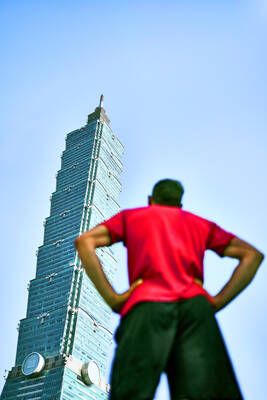
US climber Alex Honnold is to attempt to scale Taipei 101 without a rope and harness in a live Netflix special on Jan. 24, the streaming platform announced on Wednesday. Accounting for the time difference, the two-hour broadcast of Honnold’s climb, called Skyscraper Live, is to air on Jan. 23 in the US, Netflix said in a statement. Honnold, 40, was the first person ever to free solo climb the 900m El Capitan rock formation in Yosemite National Park — a feat that was recorded and later made into the 2018 documentary film Free Solo. Netflix previewed Skyscraper Live in October, after videos
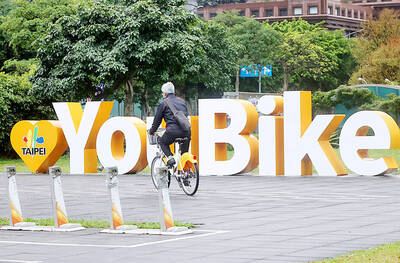
Starting on Jan. 1, YouBike riders must have insurance to use the service, and a six-month trial of NT$5 coupons under certain conditions would be implemented to balance bike shortages, a joint statement from transportation departments across Taipei, New Taipei City and Taoyuan announced yesterday. The rental bike system operator said that coupons would be offered to riders to rent bikes from full stations, for riders who take out an electric-assisted bike from a full station, and for riders who return a bike to an empty station. All riders with YouBike accounts are automatically eligible for the program, and each membership account
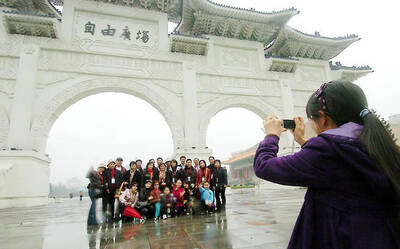
NUMBERS IMBALANCE: More than 4 million Taiwanese have visited China this year, while only about half a million Chinese have visited here Beijing has yet to respond to Taiwan’s requests for negotiation over matters related to the recovery of cross-strait tourism, the Tourism Administration said yesterday. Taiwan’s tourism authority issued the statement after Chinese-language daily the China Times reported yesterday that the government’s policy of banning group tours to China does not stop Taiwanese from visiting the country. As of October, more than 4.2 million had traveled to China this year, exceeding last year. Beijing estimated the number of Taiwanese tourists in China could reach 4.5 million this year. By contrast, only 500,000 Chinese tourists are expected in Taiwan, the report said. The report
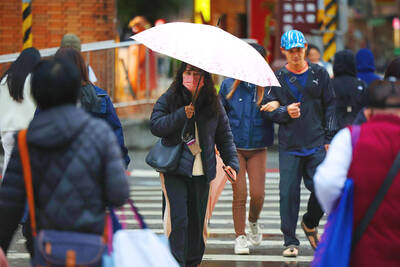
Temperatures are forecast to drop steadily as a continental cold air mass moves across Taiwan, with some areas also likely to see heavy rainfall, the Central Weather Administration (CWA) said. From today through early tomorrow, a cold air mass would keep temperatures low across central and northern Taiwan, and the eastern half of Taiwan proper, with isolated brief showers forecast along Keelung’s north coast, Taipei and New Taipei City’s mountainous areas and eastern Taiwan, it said. Lows of 11°C to 15°C are forecast in central and northern Taiwan, Yilan County, and the outlying Kinmen and Lienchiang (Matsu) counties, and 14°C to 17°C


 RSS
RSS