

Lee Tang-hua (李棠華), known as the father of acrobatic performance art in Taiwan, died on Wednesday afternoon at the Cardinal Tien Hospital in New Taipei City. He was 91.
According to the New Image Theater Group, for which Lee had been an artistic consultant in recent years, his family declined all requests for an interview, as they were making funeral arrangements.
The group posted a brief message on Facebook in memory of “the master.”
“The words carved on the numerous awards might seem blurry now, and the photographs of the acrobatic performances might already be yellowed, but that did not put a dent on the iridescent era of Lee Tang-hua acrobats. The performances drew hundreds of thousands of viewers both at home and overseas and made a mark in the nation’s diplomatic history. He will forever be remembered as the pride of all performance artists,” the message said.
Born in China’s Hunan Province, Lee lived in Hankou in Hubei Province before moving to Taiwan in 1949.
He said he had learned juggling when he was eight years old and established a performance troupe in Shanghai in 1945, later founding the Chinese Folk Arts Training Center in Taiwan.
The center was the first organization in the nation that trained acrobats for public performances.
Lee’s troupe served as goodwill ambassadors and performed in more than 30 countries around the world from the 1960s to the 1990s.
The Pittsburgh Post-Gazette on May 12, 1989, published a report about a performance.
“These freshly scrubbed young athletes from Taiwan — ages 8 through 16 — are well-schooled and disciplined in the incredibly strenuous art of Chinese acrobatics. They juggle and tumble with ease, diving over and under each other in fast-paced routines that were well-received by the American schoolchildren,” the report said.
“The peak, actually and figuratively, of the performance, is the human pyramid, which rose above the curtain. In fact, the stage at the Allegheny Middle School wasn’t big enough to show this troupe’s range of talents,” it said.
Some of the acrobats training or performing with Lee’s troupe went on to form their own troupes, such as New Image Theater Group manager Wang Kuan-hua (王光華). Others become members of the Troupe of Acrobatics at the National Taiwan College of Performing Arts.
Despite the numerous contributions Lee’s troupe made to the nation, Lee said in a statement he wrote five years ago that it pained him to see the waning development of acrobatics in Taiwan.
“I have been in the business for 75 years and have seen its rise and fall. Acrobatics in the nation cannot secure the massive amount of resources granted to other mainstream arts,” he wrote.
“Meanwhile, because of the grueling training, not many parents would like to send their children to acrobatics school, which has caused a succession crisis, while acrobats in foreign countries continue to perform at local circuses and in other countries around the world,” he said.
Lee said that he sincerely hoped that the next generation of passionate Taiwanese acrobats would rise up and accept the torch from those who went before them.
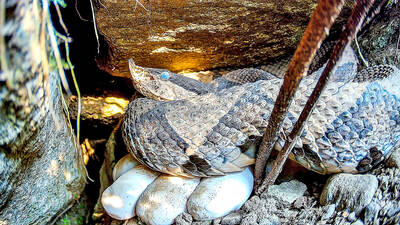
NATURE TAKES ITS COURSE: The agency’s head said he felt a sense of loss watching red-banded snakes eat the babies, as they had decided on non-intervention The Forestry and Nature Conservation Agency yesterday released a documentary on a hundred-pace viper that had incubated 16 eggs, all of which hatched, but only a baby viper escaped after they were attacked by red-banded snakes. The agency’s Taichung branch last year launched the viper reproduction monitoring project soon after forest rangers Lin Chun-yu (林俊佑) and Chou Chia-cheng (周家成) spotted a pregnant hundred-pace viper in a grass-covered burrow near a parking lot in Tbulan Village (松鶴部落). The Atayal village, in Taichung’s Heping District (和平), is headed by Ecyang Yapu, who was positive about the project and assisted in access control and power
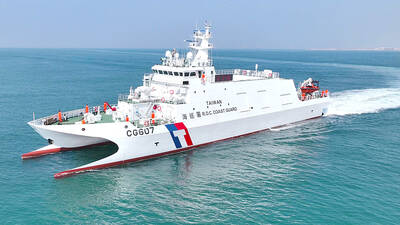
The Coast Guard Administration (CGA) yesterday said that it had deployed vessels to “monitor” Chinese ships operating in waters off the east coast. The CGA said it dispatched vessels in response to a China Coast Guard announcement that it had carried out another “routine law-enforcement patrol” in waters off the east coast. “The CGA firmly rejects China’s cognitive warfare campaign of ‘law enforcement in name, jurisdictional expansion in practice,’” it said on X. As of 11am yesterday, two China Coast Guard ships were “loitering and drifting” about 105 nautical miles (195km) and 74 nautical miles east of Green Island (綠島) respectively, it said. It
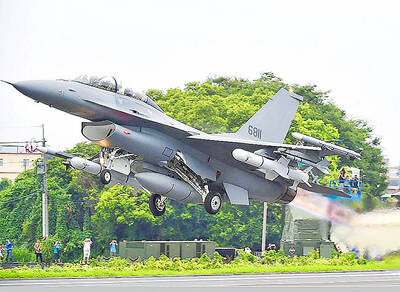
A sharp rise in compensation to be paid by air force officers who leave before completing their required service could indicate an increase in pilots leaving the military early, an analyst said on Friday, warning that the trend could worsen a shortage of experienced personnel. Chieh Chung (揭仲), a researcher at the Association for Strategic Foresight, issued the warning even though the number of volunteer military personnel is expected to increase next year. The planned headcount for volunteer military personnel, covering officers, noncommissioned officers (NCO) and enlisted soldiers, is 158,223 for next year, up 4,258 from 153,965 this year, Chieh said. The increase
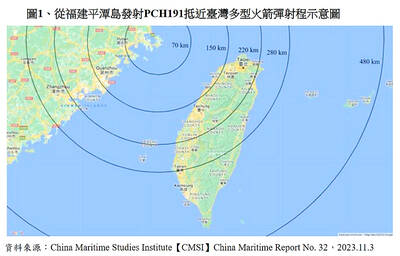
Potential improvements to munitions used by China’s long-range rocket-artillery units could extend their range to cover the entire Miyako Strait, which might give the Chinese People’s Liberation Army (PLA) the ability to secure the strategic waterway, the Mainland Affairs Council (MAC) said in a report. The PLA’s long-range rocket-artillery units deployed along the Taiwan Strait are concentrated along the coast of Fujian Province, including Changle, Pingtan and Shishi, the quarterly report on China said. The artillery brigades of the PLA’s 71st, 72nd and 73rd group armies have been deployed, with preparations for potential battlefield operations under way since August 2022, the report


 RSS
RSS