


Young people from the Taiwan Solidarity Union (TSU) and Taiwan Independence Flag Organization yesterday took part in a “flash mob” in Taipei to back demands for the use of “Taiwan” instead of “Chinese Taipei” for national teams participating in international competitions.
Armed with posters and placards that spelled “we want Team Taiwan to participate at all international competitions,” the group walked through the Huashan 1914 Creative Park, where they were mostly met with smiles and thumbs up by the throngs of people attending a beer festival, as well as arts and musical events. The signs also invited people to take photographs to post on Line, Facebook and other social networking sites.
Flash mob participants also handed out dark green stickers with the message “Taiwan is Taiwan” in Chinese and “Taiwan is not Chinese Taipei” in English.
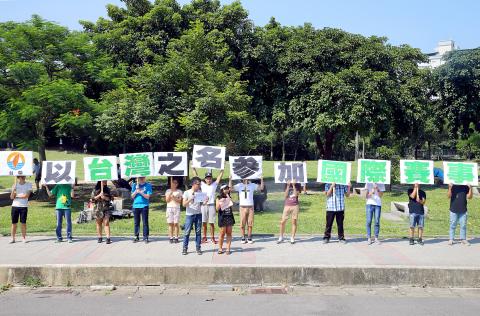
Photo: CNA
TSU Youth Department deputy director Hsu Ya-chi (許亞齊) said the “flash mob” action was aimed at raising awareness among young people of the name issue, encouraging people to cheer for “Team Taiwan” and Taiwanese athletes at all sports events and urging the government and sports bodies to drop the name “Chinese Taipei.”
“Taiwan is Taiwan, almost everyone in the world knows that, but sports governing bodies and the former administrations imposed the name ‘Chinese Taipei’ on us,” Hsu said. “It is the wrong name, and it downgrades Taiwan’s national sovereignty. Its continued use will make international community to believe that Taiwanese are all Chinese, which is a distortion of the facts.”
Hsu also demanded that Taipei Mayor Ko Wen-je (柯文哲) ensure that “Taiwan” is used by Taiwanese athletes and teams at next year’s Universiade in the city and not give in to pressure by pro-blue camp interest groups for the continued use of “Chinese Taipei.”
The group also called on sports bodies, including those for baseball, basketball and soccer, to start using the name “Team Taiwan,” adding that this should also be applied to competitions in other fields such as international video gaming tournaments, academic Olympics and cooking competitions.
TSU Youth Department head Ho Tsung-ying (侯宗穎) said use of the term “Chinese Taipei” began in 1981 and so for more than 35 years the term has been used to delude Taiwanese and the international community.
“Taipei is only one of many cities of Taiwan, so how can this term represent all the people of this nation?” Ho said.

LOUD AND PROUD Taiwan might have taken a drubbing against Australia and Japan, but you might not know it from the enthusiasm and numbers of the fans Taiwan might not be expected to win the World Baseball Classic (WBC) but their fans are making their presence felt in Tokyo, with tens of thousands decked out in the team’s blue, blowing horns and singing songs. Taiwanese fans have packed out the Tokyo Dome for all three of their games so far and even threatened to drown out home team supporters when their team played Japan on Friday. They blew trumpets, chanted for their favorite players and had their own cheerleading squad who dance on a stage during the game. The team struggled to match that exuberance on the field, with
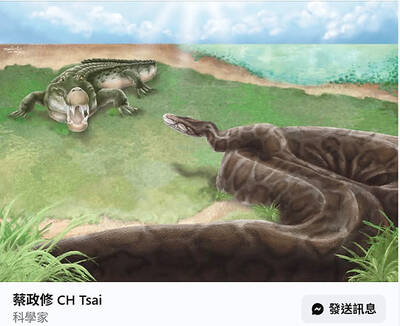
Taiwanese paleontologists have discovered fossil evidence that pythons up to 4m long inhabited Taiwan during the Pleistocene epoch, reporting their findings in the international scientific journal Historical Biology. National Taiwan University (NTU) Institute of Ecology and Evolutionary Biology associate professor Tsai Cheng-hsiu (蔡政修) led the team that discovered the largest snake fossil ever found in Taiwan. The single trunk vertebra was discovered in Tainan at the Chiting Formation, dated to between 400,000 and 800,000 years ago in the Middle Pleistocene, the paper said. The area also produced Taiwan’s first avian fossil, as well as crocodile, mammoth, saber-toothed cat and rhinoceros fossils, it said. Discoveries

Taiwanese paleontologists have discovered fossil evidence that pythons up to 4m long inhabited Taiwan during the Pleistocene epoch, reporting their findings in the international scientific journal Historical Biology. National Taiwan University (NTU) Institute of Ecology and Evolutionary Biology associate professor Tsai Cheng-hsiu (蔡政修) led the team that discovered the largest snake fossil ever found in Taiwan. A single trunk vertebra was discovered in Tainan at the Chiting Formation, dated to between 800,000 to 400,000 years ago in the Middle Pleistocene, the paper said. The area also produced Taiwan’s first avian fossil, as well as crocodile, mammoth, sabre-toothed cat and rhinoceros fossils, it said. Discoveries

Whether Japan would help defend Taiwan in case of a cross-strait conflict would depend on the US and the extent to which Japan would be allowed to act under the US-Japan Security Treaty, former Japanese minister of defense Satoshi Morimoto said. As China has not given up on the idea of invading Taiwan by force, to what extent Japan could support US military action would hinge on Washington’s intention and its negotiation with Tokyo, Morimoto said in an interview with the Liberty Times (sister paper of the Taipei Times) yesterday. There has to be sufficient mutual recognition of how Japan could provide


 RSS
RSS