


The National Communications Commission yesterday again rejected a Broadcasting Corp of China (BCC, 中廣) application to reduce its capital, saying that the company might hold illegal assets previously owned by the Chinese Nationalist Party (KMT).
Yesterday’s ruling was the third time the commission has denied the nation’s largest radio network over capital reductions. The two previous applications were rejected in 2011 and last year.
Commission spokesperson Wong Po-tsong (翁柏宗) said that BCC applied to reduce its capital from approximately NT$3.2 billion to NT$628 million (US$101.74 million to US$19.97 million).
The capital reduction would have been accomplished by transferring properties to a new asset management firm established by BCC, which holds mainly land and buildings.
Wong said the commission rejected the company’s latest application because the Ministry of Transportation and Communications had officially informed the commission of a court ruling that said the government owns some of BCC’s properties.
Had the commission approved the application, the ministry would not be able to claim the properties, illegally gained profits and other restitution from BCC, which was valued at NT$256 million, Wong said.
BCC has five national broadcasting licenses, Wong said, adding that the commission was concerned that the network’s operations would be affected if its capital were to be sharply reduced and transferred to a newly established asset management firm.
Many people suspect BCC of holding illegal assets previously owned by the KMT’s Hua Hsia Investment Holding Co after the network’s sale to New Party founder and former UFO radio president Jaw Shaw-kong (趙少康) in 2007, Wong said.
“While the commission is not the government agency in charge of identifying illegal assets owned by political parties, it also needs clarification on this issue from the Committee of Illegal Party Asset Settlement,” he said.
The commission had rejected the first two applications mainly because of settlements and pending lawsuits the BCC had with the ministry, but this was the first time the commission listed “potential illegal party assets” as a reason for rejection.
The Supreme Court in 2014 ruled in a 10-year lawsuit that BCC should return eight properties to the government.
BCC has also been asked to return two of its five national broadcasting licenses to the government, which are to be reassigned to the Hakka Affairs Council and the Council of Indigenous Peoples, Wong said.
The agencies have plans to establish radio stations to serve Hakka speakers and Aboriginal communities respectively, he said, adding that both are in the process of drafting operational plans.
The plans must be reviewed by the commission before the councils can secure operating licenses, Wong said.
“The two BCC licenses were granted because the government needed radio stations to block Chinese Communist Party propaganda transmissions. As that role is no longer needed, the commission needs those licenses back,” he said.
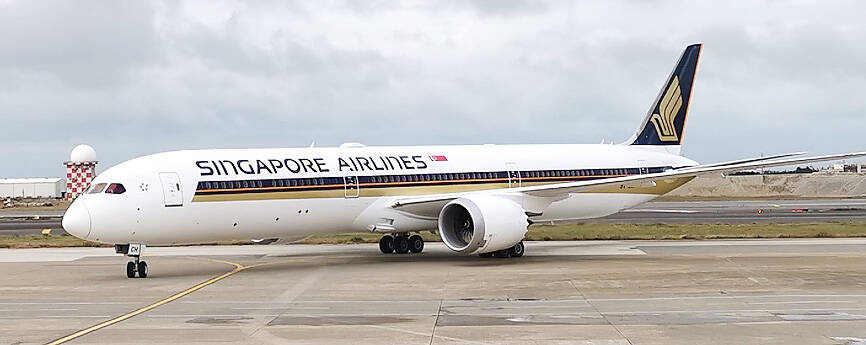
INCREASED CAPACITY: The flights on Mondays, Wednesdays, Fridays and Sundays would leave Singapore in the morning and Taipei in the afternoon Singapore Airlines is adding four supplementary flights to Taipei per week until May to meet increased tourist and business travel demand, the carrier said on Friday. The addition would raise the number of weekly flights it operates to Taipei to 18, Singapore Airlines Taiwan general manager Timothy Ouyang (歐陽漢源) said. The airline has recorded a steady rise in tourist and business travel to and from Taipei, and aims to provide more flexible travel arrangements for passengers, said Ouyang, who assumed the post in July last year. From now until Saturday next week, four additional flights would depart from Singapore on Monday, Wednesday, Friday
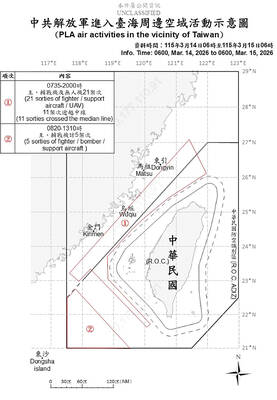
The Ministry of National Defense yesterday reported the return of large-scale Chinese air force activities after their unexplained absence for more than two weeks, which had prompted speculation regarding Beijing’s motives. China usually sends fighter jets, drones and other military aircraft around the nation on a daily basis. Interruptions to such routine are generally caused by bad weather. The Ministry of National Defense said it had detected 26 Chinese military aircraft in the Taiwan Strait over the previous 24 hours. It last reported that many aircraft on Feb. 25, when it spotted 30 aircraft, saying Beijing was carrying out another “joint combat

Taiwan successfully defended its women’s 540 kilogram title and won its first-ever men’s 640 kg title at the 2026 World Indoor Tug of War Championships in Taipei yesterday. In the women’s event, Taiwan’s eight-person squad reached the final following a round-robin preliminary round and semifinals featuring teams from Ukraine, Japan, Thailand, Vietnam, the Basque Country and South Korea. In the finals, they swept the Basque team 2-0, giving the team composed mainly of National Taiwan Normal University students and graduates its second championship in a row, and its fourth in five years. Team captain
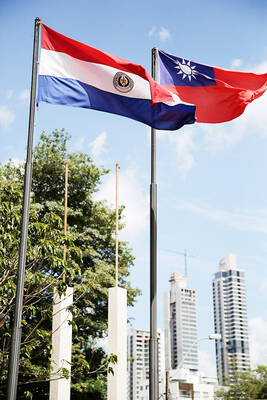
When Paraguayan opposition lawmaker Leidy Galeano returned from an all-expenses-paid tour of six Chinese cities late last year, she was convinced Paraguay risked missing out on major economic gains by sticking with longtime ally Taipei over Beijing — a message that participants on the trip heard repeatedly from Chinese officials. “Everything I saw there, I wanted for my country,” said Galeano, a member of the newly-formed Yo Creo party whose senior figures have spoken favorably about China. This trip and others like it — which people familiar with the visits said were at the invitation of the Chinese consulate in Sao Paulo


 RSS
RSS