


Pro-localization groups yesterday held a news conference to urge President Tsai Ing-wen (蔡英文) to withdraw her nominations for the Judicial Yuan’s top two posts, saying the nominees’ backgrounds make them incompatible with her administration’s aims of transitional justice and judicial reform.
Public Functionary Disciplinary Sanction Commission Chief Commissioner Hsieh Wen-ting (謝文定) has been nominated to be Judicial Yuan president, and Judicial Yuan Secretary-General Lin Chin-fang (林錦芳) to be vice president.
The nominations would hamper judicial reform because Hsieh was a party to human rights violations during the Chinese Nationalist Party (KMT) authoritarian era, while Lin has a history of intervening in the judicial process, Taiwan Society chairman Chang Yeh-sen (張葉森) told the news conference in Taipei.
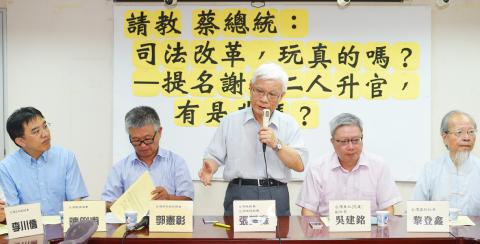
Photo: Chang Chia-ming, Taipei Times
Hsieh was a lead prosecutor in cases arising from the Chungli Incident, the Kaohsiung Incident and the murders of democracy activist Lin I-hsiung’s (林義雄) mother and twin daughters.
The Chungli Incident was a demonstration in November 1977 against ballot-rigging in the Taipei County commissioner election, while the Kaohsiung Incident refers to a clash between security forces and democracy activists on Dec. 10, 1979.
Lin is accused of intervening in the judicial process by replacing the presiding judges in corruption cases involving former president Chen Shui-bian (陳水扁), of restricting litigants and lawyers from accessing court documents and launching an advisory jury system that has been criticized as a bid to minimize public involvement in the judicial process.
“Former president Ma Ying-jeou (馬英九) drew heavy criticism by nominating a military judge involved in the Kaohsiung Incident as a grand justice. However, we were surprised that the Democratic Progressive Party administration nominated someone who held a high-level judicial position during the Martial Law era to be president of the Judicial Yuan,” said Chen Li-fu (陳俐甫), director of the northern branch of the Taiwan Association of University Professors.
Appointing Hsien and Lin would be tantamount to reinstating and affirming an outdated and authoritarian system, which would compromise efforts to bring about transitional justice, Chen said.
“What Hsieh did was an example of the banality of evil. He was responsible for convicting innocent people of crimes they did not commit. How can an official who obeyed whatever order they were given be expected to initiate effective judicial reform?” National Taiwan University student Wu Yun-ching (吳昀慶) said.
“Hsien and Lin were accomplices in human rights violations by the then-authoritarian regime in the 1970s, and they did nothing to protect and promote human rights and freedom after the end of the Martial Law era,” Northern Taiwan Society deputy chairman Lee Chuan-hsin (李川信) said.
“They represent authoritarianism and are not fit to carry out judicial reforms and transitional justice,” Lee said.
More than 80 percent of the public do not trust the judiciary, and that is why Tsai’s pledge to implement judicial reform in her inaugural address won her praise, but Hsieh and Lin are the wrong people for the job, Eastern Taiwan Society vice president Winston Yu (余文儀) said.
The groups urged Tsai to reconsider the nominations, for lawmakers to boycott them and for a judicial reform congress planned for October to be delayed.

Taiwan has received more than US$70 million in royalties as of the end of last year from developing the F-16V jet as countries worldwide purchase or upgrade to this popular model, government and military officials said on Saturday. Taiwan funded the development of the F-16V jet and ended up the sole investor as other countries withdrew from the program. Now the F-16V is increasingly popular and countries must pay Taiwan a percentage in royalties when they purchase new F-16V aircraft or upgrade older F-16 models. The next five years are expected to be the peak for these royalties, with Taiwan potentially earning
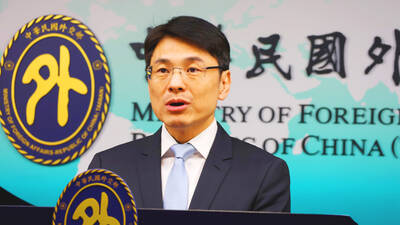
STAY IN YOUR LANE: As the US and Israel attack Iran, the ministry has warned China not to overstep by including Taiwanese citizens in its evacuation orders The Ministry of Foreign Affairs (MOFA) yesterday rebuked a statement by China’s embassy in Israel that it would evacuate Taiwanese holders of Chinese travel documents from Israel amid the latter’s escalating conflict with Iran. Tensions have risen across the Middle East in the wake of US and Israeli airstrikes on Iran beginning Saturday. China subsequently issued an evacuation notice for its citizens. In a news release, the Chinese embassy in Israel said holders of “Taiwan compatriot permits (台胞證)” issued to Taiwanese nationals by Chinese authorities for travel to China — could register for evacuation to Egypt. In Taipei, the ministry yesterday said Taiwan
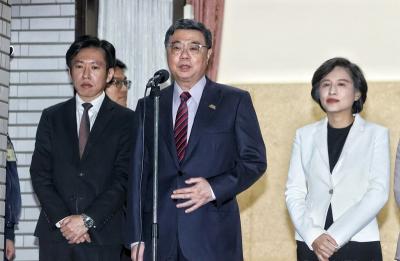
Taiwan is awaiting official notification from the US regarding the status of the Agreement on Reciprocal Trade (ART) after the US Supreme Court ruled US President Donald Trump's global tariffs unconstitutional. Speaking to reporters before a legislative hearing today, Premier Cho Jung-tai (卓榮泰) said that Taiwan's negotiation team remains focused on ensuring that the bilateral trade deal remains intact despite the legal challenge to Trump's tariff policy. "The US has pledged to notify its trade partners once the subsequent administrative and legal processes are finalized, and that certainly includes Taiwan," Cho said when asked about opposition parties’ doubts that the ART was
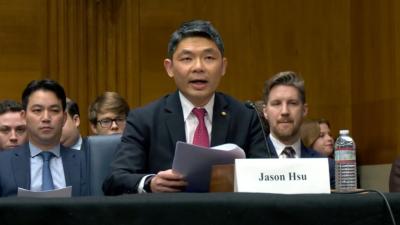
If China chose to invade Taiwan tomorrow, it would only have to sever three undersea fiber-optic cable clusters to cause a data blackout, Jason Hsu (許毓仁), a senior fellow at the Hudson Institute and former Chinese Nationalist Party (KMT) legislator, told a US security panel yesterday. In a Taiwan contingency, cable disruption would be one of the earliest preinvasion actions and the signal that escalation had begun, he said, adding that Taiwan’s current cable repair capabilities are insufficient. The US-China Economic and Security Review Commission (USCC) yesterday held a hearing on US-China Competition Under the Sea, with Hsu speaking on


 RSS
RSS