


Aboriginal divisions over giving recognition to members of Pingpu Aboriginal communities were yesterday on full display at a Legislative Yuan forum, with Aboriginal legislators sparring over how such recognition should be accomplished, while many legislators declined to attend.
“The Status Act for Indigenous Peoples (原住民身分法) has us by the throat, making it impossible for us to do anything,” Democratic Progressive Party (DPP) Legislator Kolas Yotaka, who is Amis, said at a Legislative Yuan forum on restoring Pingpu status and rights hosted by the Pingpu Aboriginal Status and Rights Restoration Working Group and the Tainan Siraya Village Development Promotion Association.
“Pingpu” is a general term used for Aboriginal communities that inhabited lowland regions of western Taiwan, with strong assimilation pressure from Chinese immigrants over centuries causing them to largely lose their ancestral languages and lifestyles.
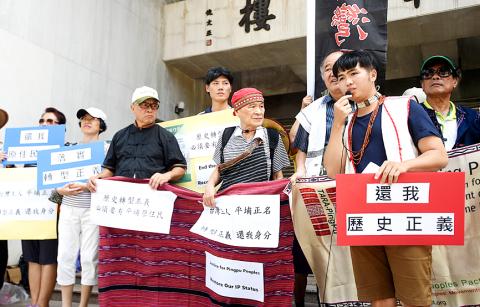
Photo: Fang Pin-chao, Taipei Times
While members of Pingpu communities have fought for official recognition for decades, only members of the Kavalan people have succeeded, winning recognition from the Executive Yuan in 2002.
Kolas called for the passage of a constitutional amendment to remove the distinction between officially recognized “plains” and “mountain” Aborigines, along with amendments to the Status Act for Indigenous Peoples and the passage of a new Pingpu status act to grant official recognition to members of Pingpu communities.
“After 30 years, there is finally a beam of sunlight — although I would not say there is a lot of sunlight,” she said, referring to campaign promises by President Tsai Ing-wen (蔡英文) of the DPP to push for official recognition of Pingpu communities and to issue an official apology to all Aborigines on Aug. 1.
“There has always been light, it was just blocked by clouds,” said New Power Party (NPP) Legislator Kawlo Iyun Pacidal, who is also Amis, adding that there was no need to pass new legislation, because the Status Act for Indigenous Peoples does not define the legal period within which “plains” Aboriginals can register their status.
“As we are already on the last lap, I do not think we should add more distance by taking on the passage of amendments or new Pingpu status legislation,” she said, adding that Pingpu communities could be recognized immediately if the Executive Yuan changes its interpretation of the legislation’s registration provisions.
Both legislators gained seats through their respective parties’ legislator-at-large tickets and are likely to be rivals in the next election cycle for seats in the nation’s multimember “plains” Aboriginal district, to which Pingpu Aborigines would likely be assigned if granted official recognition.
Non-partisan Solidarity Union Legislator May Chin (高金素梅), who is half-Atayal and represents “mountain Aborigines” in the Legislative Yuan, was also at the forum, while the DPP’s “plains” Aboriginal Legislator Chen Ying (陳瑩) declined to attend, as did several Chinese Nationalist Party (KMT) legislators who hold most multimember district seats.
“Aboriginal legislators should not worry about being able to hold onto their seats if Pingpu communities are recognized,” said National Dong Hua University professor Shih Cheng-feng (施正鋒), who claims to have partial Pingpu ancestry, adding that he estimated “at most” 200,000 Pingpu Aborigines would register if granted official recognition.
The nation currently boasts almost 500,000 Aborigines from officially recognized tribes, with the more than 200,000 members of the Amis people comprising the vast majority of eligible “plains” aboriginal voters.
“If Tsai just apologizes next month without doing anything substantial, she will just be putting on a deceptive show, because an apology should include promises to immediately address specific issues,” Shih said, calling for Tsai to immediately recognize members of Pingpu communities.
He added that Pingpu Aborigines should be entitled to special subsidies and other privileges enjoyed by members of officially recognized communities.
“Your identity is what should determine your rights — whether you live in a village or city, or have already become ‘overly sinicized’ has nothing to do with it,” he said, adding that using “sinicization” to deny Pingpu rights would imply other Aborigines could lose their rights if they become more assimilated.

Taiwanese can file complaints with the Tourism Administration to report travel agencies if their activities caused termination of a person’s citizenship, Mainland Affairs Council Minister Chiu Chui-cheng (邱垂正) said yesterday, after a podcaster highlighted a case in which a person’s citizenship was canceled for receiving a single-use Chinese passport to enter Russia. The council is aware of incidents in which people who signed up through Chinese travel agencies for tours of Russia were told they could obtain Russian visas and fast-track border clearance, Chiu told reporters on the sidelines of an event in Taipei. However, the travel agencies actually applied

Japanese footwear brand Onitsuka Tiger today issued a public apology and said it has suspended an employee amid allegations that the staff member discriminated against a Vietnamese customer at its Taipei 101 store. Posting on the social media platform Threads yesterday, a user said that an employee at the store said that “those shoes are very expensive” when her friend, who is a migrant worker from Vietnam, asked for assistance. The employee then ignored her until she asked again, to which she replied: "We don't have a size 37." The post had amassed nearly 26,000 likes and 916 comments as of this

New measures aimed at making Taiwan more attractive to foreign professionals came into effect this month, the National Development Council said yesterday. Among the changes, international students at Taiwanese universities would be able to work in Taiwan without a work permit in the two years after they graduate, explainer materials provided by the council said. In addition, foreign nationals who graduated from one of the world’s top 200 universities within the past five years can also apply for a two-year open work permit. Previously, those graduates would have needed to apply for a work permit using point-based criteria or have a Taiwanese company

The Shilin District Prosecutors’ Office yesterday indicted two Taiwanese and issued a wanted notice for Pete Liu (劉作虎), founder of Shenzhen-based smartphone manufacturer OnePlus Technology Co (萬普拉斯科技), for allegedly contravening the Act Governing Relations Between the People of the Taiwan Area and the Mainland Area (臺灣地區與大陸地區人民關係條例) by poaching 70 engineers in Taiwan. Liu allegedly traveled to Taiwan at the end of 2014 and met with a Taiwanese man surnamed Lin (林) to discuss establishing a mobile software research and development (R&D) team in Taiwan, prosecutors said. Without approval from the government, Lin, following Liu’s instructions, recruited more than 70 software


 RSS
RSS