


The Taiwan Strait might become more dangerous than ever if Republican presumptive presidential nominee Donald Trump is elected to the White House in November, a prominent Washington academic said.
Senior fellow in foreign policy at the Brookings Institution Michael O’Hanlon wrote that Trump’s policy ideas could push Taipei into secretly working on a nuclear weapon.
Writing in the Wall Street Journal, O’Hanlon said that Trump wants to withdraw US forces from Asia and let its allies Japan and South Korea defend themselves.
“He suggests that these two Asian powers might best develop their own nuclear weapons,” O’Hanlon wrote.
A former member of the external advisory board at the CIA, O’Hanlon wrote that Trump’s foreign policy ideas are fundamentally unsound.
“They would increase the risk of war between Japan and China,” he wrote.
“The biggest danger from Trump’s ideas on Asia is the risk of war in the Taiwan Strait,” O’Hanlon wrote. “Absent bases in Japan, the US cannot realistically deter Chinese military attacks on Taiwan and this reality could lead China to contemplate the use of force with much less hesitation than it has shown to date.”
He said that knowing this, Taiwanese leaders might seek to develop nuclear weapons of their own as a deterrent.
The Taipei Times was not able to reach Trump’s spokesperson for a comment, but a campaign insider with direct links to the candidate said that his Asia policies are still being refined.
The source asked not to be named because he was not authorized to speak for the campaign.
He said that Trump had not mentioned Taiwan to date, but that following the party convention later this month he would address Asian policies in greater detail.
O’Hanlon said in the Journal that the US has a “somewhat muddled approach” to deterring China from attacking Taiwan, but that it had worked so far.
He said China has repeatedly stated it would use force if Taiwan declares independence or pursues nuclear weapons.
“Taiwan’s leaders would face a huge dilemma if they should be informed by a President Trump that America’s security commitments to East Asia were soon to be dissolved. They might well decide to acquire the bomb,” O’Hanlon said.
He said that Taiwan might try to build a nuclear bomb clandestinely and declare its deterrent only when it had succeeded.
“Although Trump has not weighed in explicitly on Taiwan, there is little chance his strategic views would allow American forces the means to defend it,” O’Hanlon said.
“Lacking bases on Okinawa and other parts of Japan, and presumably not having added any bases in the Philippines or Vietnam, the US would have only two main types of conventional forces: the navy and long-range bombers,” he said.
In those circumstances, O’Hanlon said it would be very difficult for the US to help Taiwan break a Chinese blockade.
“Leaving Taiwan to rely exclusively on its own means to fend off a Chinese mainland roughly 60 times more populous and 20 times as wealthy would be dangerous,” he said. “It is the single most fraught consequence of Trump’s Asia policy.”

The military has spotted two Chinese warships operating in waters near Penghu County in the Taiwan Strait and sent its own naval and air forces to monitor the vessels, the Ministry of National Defense (MND) said. Beijing sends warships and warplanes into the waters and skies around Taiwan on an almost daily basis, drawing condemnation from Taipei. While the ministry offers daily updates on the locations of Chinese military aircraft, it only rarely gives details of where Chinese warships are operating, generally only when it detects aircraft carriers, as happened last week. A Chinese destroyer and a frigate entered waters to the southwest
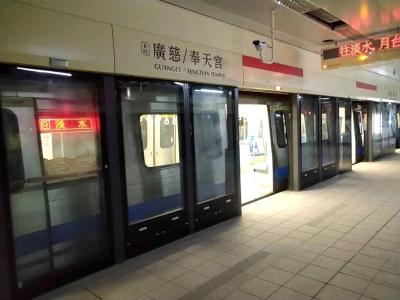
The eastern extension of the Taipei MRT Red Line could begin operations as early as late June, the Taipei Department of Rapid Transit Systems said yesterday. Taipei Rapid Transit Corp said it is considering offering one month of free rides on the new section to mark its opening. Construction progress on the 1.4km extension, which is to run from the current terminal Xiangshan Station to a new eastern terminal, Guangci/Fengtian Temple Station, was 90.6 percent complete by the end of last month, the department said in a report to the Taipei City Council's Transportation Committee. While construction began in October 2016 with an
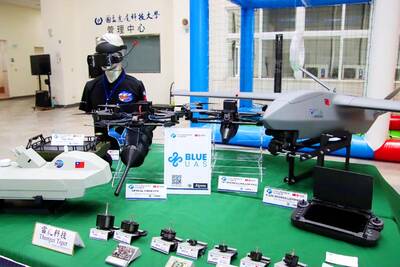
NON-RED SUPPLY: Boosting the nation’s drone industry is becoming increasingly urgent as China’s UAV dominance could become an issue in a crisis, an analyst said Taiwan’s drone exports to Europe grew 41.7-fold from 2024 to last year, with demand from Ukraine’s fight against Russian aggression the most likely driver of growth, a study showed. The Institute for Democracy, Society and Emerging Technology (DSET) in a statement on Wednesday said it found that many of Taiwan’s uncrewed aerial vehicle (UAV) sales were from Poland and the Czech Republic. These countries likely transferred the drones to Ukraine to aid it in its fight against the Russian invasion that started in 2022, it said. Despite the gains, Taiwan is not the dominant drone exporter to these markets, ranking second and fourth

Japanese Prime Minister Sanae Takaichi’s comment last year on Tokyo’s potential reaction to a Taiwan-China conflict has forced Beijing to rewrite its invasion plans, a retired Japanese general said. Takaichi told the Diet on Nov. 7 last year that a Chinese naval blockade or military attack on Taiwan could constitute a “survival-threatening situation” for Japan, potentially allowing Tokyo to exercise its right to collective self-defense. Former Japan Ground Self-Defense Force general Kiyofumi Ogawa said in a recent speech that the remark has been interpreted as meaning Japan could intervene in the early stages of a Taiwan Strait conflict, undermining China’s previous assumptions


 RSS
RSS