


Despite strong criticism from the Chinese Nationalist Party (KMT), more than 70 percent of Taiwanese approve of President Tsai Ing-wen (蔡英文) identifying herself as the “president of Taiwan” during her first overseas state visit, according to a survey released yesterday by the Taiwan Thinktank.
The telephone-based poll, conducted on Thursday and Friday, showed that 72.4 percent of respondents supported Tsai’s description of herself as “President of Taiwan (ROC) [Republic of China]” in a message she left in a guest book after touring sluice gates of the expanded Panama Canal on June 26, compared with 19.4 percent who thought otherwise.
A further breakdown of the data found that a high percentage — between 84 percent and 85 percent — of adults in the 20-39 age group were in favor of Tsai’s reference to herself as “president of Taiwan” rather than as “president of the ROC.”
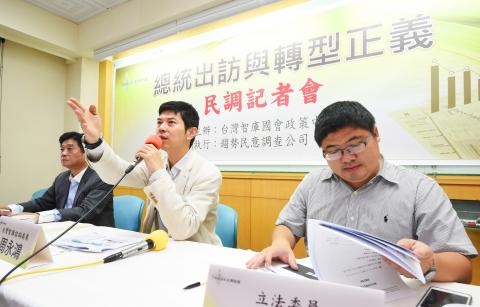
Photo: Lo Pei-der, Taipei Times
However, when asked whether Tsai should refer to herself as “president of Taiwan” or use the nation’s official title in future overseas visits, 44.7 percent of those polled opted for the latter, while 39.8 percent preferred the former.
“An analysis of the responses to the two questions indicated that most Taiwanese identify with both Taiwan and the ROC, but those who do not recognize Taiwan are relatively insistent on the president using the term ‘ROC,’” Taiwan Thinktank consultant Chou Yung-hong (周永鴻) told a news conference in Taipei.
Chou said that political affiliation seemed to play a significant factor in respondents’ preferred title for the president, with 65.4 percent of those polled who identified with the Democratic Progressive Party (DPP) favoring “president of Taiwan” and 77.4 percent of KMT-leaning respondents choosing “president of the ROC.”
Tsai on Saturday concluded her nine-day trip, during which she visited Panama and Paraguay, two of the nation’s diplomatic allies in Latin America, and made transit stops in Miami and Los Angeles.
Tsai’s identification of herself as “president of Taiwan” has been lambasted by the KMT as an act that belittled the nation, but the president said there was no need for a political interpretation of what she wrote.
Regarding some lawmakers’ calls for transitional justice for indigenous people to take precedence over the handling of the KMT’s alleged illicit assets, 48.5 percent of those polled disapproved of the proposal, while 33.7 percent supported the idea.
DPP Legislator Tsai Yi-yu (蔡易餘) said the poll suggested that even Aborigines agree that it is inappropriate to integrate the pursuit of transitional justice for their forebears with the issue of controversial KMT assets.
“As many as 61.9 percent of respondents living in Yilan, Hualien and Taitung counties, which have high concentrations of Aborigines, believed the two issues should be separated,” Tsai Yi-yu said.
The poll collected 1,246 valid samples and had a confidence level of 95 percent, with a margin of error of 2.8 percentage points.

Chinese spouse and influencer Guan Guan’s (關關) residency permit has been revoked for repeatedly posting pro-China videos that threaten national security, the National Immigration Agency confirmed today. Guan Guan has said many controversial statements in her videos posted to Douyin (抖音), including “the red flag will soon be painted all over Taiwan” and “Taiwan is an inseparable part of China,” and expressing hope for expedited reunification. The agency last year received multiple reports alleging that Guan Guan had advocated for armed reunification. After verifying the reports, the agency last month issued a notice requiring her to appear and explain her actions. Guan

GIVE AND TAKE: Blood demand continues to rise each year, while fewer young donors are available due to the nation’s falling birthrate, a doctor said Blood donors can redeem points earned from donations to obtain limited edition Formosan black bear travel mugs, the Kaohsiung Blood Center said yesterday, as it announced a goal of stocking 20,000 units of blood prior to the Lunar New Year. The last month of the lunar year is National Blood Donation Month, when local centers seek to stockpile blood for use during the Lunar New Year holiday. The blood demand in southern Taiwan — including Tainan and Kaohsiung, as well as Chiayi, Pingtung, Penghu and Taitung counties — is about 2,000 units per day, the center said. The donation campaign aims to boost

The Kaohsiung Tourism Bureau audited six hotels in an effort to prevent price gouging ahead of Korean band BTS’ concert tour in the city scheduled for Nov. 19, 21 and 22 this year. The bureau on Friday said that the audits — conducted in response to allegations of unfair pricing posted on social media — found no wrongdoing. These establishments included the local branches of Chateau de Chine, Hotel Nikko, My Humble House, and Grand Hai Lai, it said, adding that the Consumer Protection Commission would have penalized price gougers had the accusations been substantiated. The bureau said the Tourism Development Act
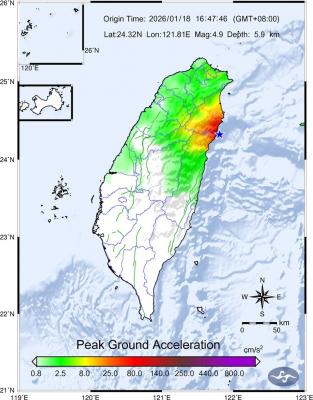
The Central Weather Administration (CWA) said a magnitude 4.9 earthquake that struck off the coast of eastern Taiwan yesterday was an independent event and part of a stress-adjustment process. The earthquake occurred at 4:47pm, with its epicenter at sea about 45.4km south of Yilan County Hall at a depth of 5.9km, the CWA said. The quake's intensity, which gauges the actual effects of a temblor, was highest in several townships in Yilan and neighboring Hualien County, where it measured 4 on Taiwan's seven-tier intensity scale, the CWA said. Lin Po-yu (林柏佑), a division chief at the CWA's Seismological Center, told a news conference


 RSS
RSS