

People with iPass electronic tickets now have access to all Taipei Mass Rapid Transit (MRT) stations, while people with EasyCards can now also ride on the Kaohsiung MRT.
Taipei Rapid Transit Corp (TRTC) yesterday said that all 1,337 gates at Taipei’s MRT stations now accept the iPass after upgrades to card readers and value-adding machines were completed last month.
Only one gate at every station had been open to iPass users before, it added.
TRTC said that under an electronic ticket integration policy, it began soliciting tenders from electronic ticket companies.
Four service providers — EasyCard, iPass, HappyCash and icash — won the bid, TRTC said.
Taipei’s MRT stations are to start accepting HappyCash and icash after the two firms pass a test regarding discounts offered to passengers transferring between the MRT stations and buses, it said.
Meanwhile, the chairmen of the four companies yesterday met at the Kaohsiung MRT system’s Zuoying Station to celebrate the launch of Kaohsiung’s integrated electronic ticket system.
Kaohsiung Rapid Transit Corp (KRTC) chairman Hau Chien-sheng (郝建生) said that the Kaohsiung MRT might not be the nation’s largest metro rail system, but it would strive to provide passengers with the best service.
EasyCard Corp chairman Kenneth Lin (林向愷) fielded questions about passengers not being allowed to add value to their EasyCards at Kaohsiung’s MRT stations.
Lin said that he did not see any inconvenience caused on the part of EasyCard Corp, as 18 banks would automatically wire money to cobranded EasyCards when the balance is below NT$100.
Furthermore, people can add value to their cards at convenience stores throughout the municipality, he said.
Lin said that the corporation would work with KRTC to install value-adding machines when the card’s circulation in Kaohsiung reaches 20 percent.
Meanwhile, EasyCard Corp protested what it said was KRTC’s “unreasonable” demand that it contribute NT$20 million (US$620,771) toward the NT$29 million cost of installing value-adding machines at Kaohsiung’s MRT stations.
EasyCard secretary-general Alice Chen (陳昭熹) said KRTC should not expect EasyCard to shoulder the majority of the costs because it has the widest circulation nationwide, but rather the cost should be split equally between the four companies.
Furthermore, the handling fee for passengers wanting to put money in their EasyCards is set at 0.75 percent, while the rate set by KRTC for the three other firms is 0.4 percent, Chen said.
EasyCard would enter into negotiations with KRTC over the unfair treatment, she said.

The donation of offshore patrol vessel Kinmen to the Philippines includes provisions that protect Taiwanese fishers and facilitate security cooperation across the First Island Chain, officials said yesterday. The comment was made during the Cabinet’s comprehensive administrative report at the legislature after Chinese Nationalist Party (KMT) Legislator Hsu Yu-chen (許宇甄) expressed concerns about the decision to give a ship to a country whose coast guard had in 2013 fired on a Taiwanese trawler and killed its captain without provocation. The Cabinet should lay out the safeguards that have been established to prevent the Philippine government from using the Kinmen to harass, expel
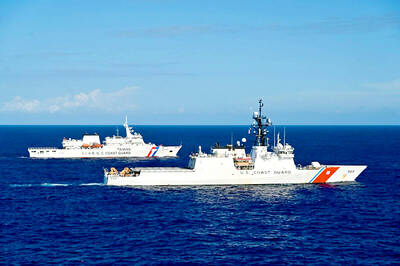
GROWING TIES: The CGA is planning a goodwill mission to the Philippines, in what would be the first time since 1975 a Taiwanese paramilitary vessel has visited the country The Coast Guard Administration (CGA) plans to significantly expand its participation in international security cooperative frameworks and its operational capabilities, a budget proposal for next year showed. The budget indicates a transformation of the CGA from a maritime law enforcement arm into a national defense and intelligence gathering entity capable of tackling larger regional security matters. The proposal showed that personnel from the coast guard’s Intelligence Division and Special Action Support Center are to participate in high-level national security talks with the US. As the CGA has dealt with China’s rising “gray zone” threats around Taiwan, it has become a valuable asset to
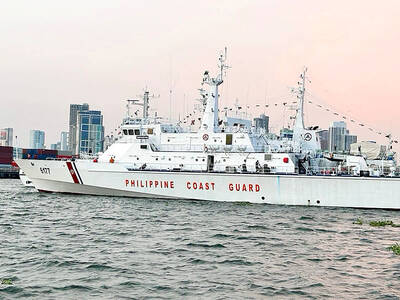
A patrol vessel donated by the Coast Guard Administration (CGA) to the Philippines was commissioned into the Philippine Coast Guard (PCG) on Friday, a Philippine non-governmental organization said. The CGA on Sept. 16 confirmed media reports that Taiwan had donated a retired 500-tonne patrol vessel to the Philippines. The Manila-based We Protect Our Seas (WPS) foundation, which served as an intermediary in the transfer, said that the vessel was formerly the CGA’s 500-tonne petrol vessel Kinmen (CG123). The WPS, in a statement issued on Friday, said the vessel, renamed as the BRP Sarangani, had been commissioned into the PCG the
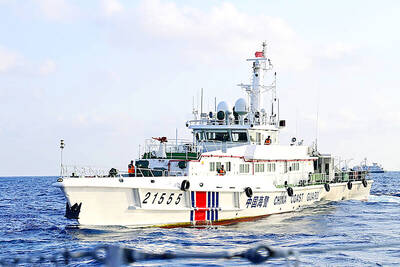
‘GRAY ZONE’ TACTICS: Beijing sent two China Coast Guard vessels to escort a ‘supposedly private research ship,’ a Philippine Coast Guard spokesman said The Coast Guard Administration (CGA) yesterday confirmed that it had recently deployed three patrol vessels to waters in Taiwan’s overlapping exclusive economic zone with the Philippines to monitor three Chinese vessels. CGA Deputy Director-General Hsieh Ching-chin (謝慶欽) said the agency regularly monitors Chinese vessels around Taiwan, and that the deployment south of Oluanpi (鵝鑾鼻), Taiwan proper’s southernmost point, was carried out in accordance with standard procedures. He added that the waters fall within the overlapping exclusive economic zones of Taiwan and the Philippines, which extend 200 nautical miles (370km) from their coastlines. Hsieh made the comments when asked about a


 RSS
RSS