


Seven hospitals have launched an online appointment system to give people easier access to confidential anonymous HIV/AIDS tests, the Centers for Disease Control (CDC) said yesterday.
Concern over discrimination and living with the stigma of HIV/AIDS has resulted in a low testing rate, the agency said.
That prompted it to cooperate with several hospitals in 2003 to provide free anonymous tests, which are given separately from other clinical departments.
People planning to take such tests usually make an appointment by telephone or go directly to the hospital, but starting this year, they can make an appointment online at one of seven hospitals, the agency said.
Forty-one hospitals nationwide provide free anonymous HIV testing. People can also take a simple self-evaluation test anonymously on the agency’s consultation Web site — hiva.cdc.gov.tw — and make an online appointment.
CDC data showed that among the 31,036 reported cases of HIV infections last year, the one-year mortality rate for those who delayed seeking treatment was 18 percent — 11.4 times of those who did not delay in seeking medical care.
The data also showed that the delayed diagnosis rate of anonymous HIV testing is lower than non-anonymous testing.
The agency advised young people to practice safe sex, including using condoms and water-based lubricants and avoiding sex parties, having multiple sex partners or engaging in other high-risk behavior.
It said that statistics showed people aged 15 to 34 accounted for nearly 72 percent of all new HIV infections from January to last month.
The survival rate and quality of life of HIV-positive people can be enhanced with proper medical treatment, the CDC said.
The agency urged people who think they might have been exposed to HIV to get an anonymous confidential test for early diagnosis and treatment.

US President Donald Trump said "it’s up to" Chinese President Xi Jinping (習近平) what China does on Taiwan, but that he would be "very unhappy" with a change in the "status quo," the New York Times said in an interview published yesterday. Xi "considers it to be a part of China, and that’s up to him what he’s going to be doing," Trump told the newspaper on Wednesday. "But I’ve expressed to him that I would be very unhappy if he did that, and I don’t think he’ll do that," he added. "I hope he doesn’t do that." Trump made the comments in

NOT AN OPENING: Trump’s violation of international law does not affect China’s consideration in attacking Taiwan; Beijing lacks capability, not precedent, an official said Taiwanese officials see the US’ capture of the president of Venezuela as a powerful deterrent to Beijing’s aggression and a timely reminder of the US’ ability to defeat militaries equipped with Chinese-made weapons. The strikes that toppled Venezuelan President Nicolas Maduro signaled to authoritarian leaders, including Chinese President Xi Jinping (習近平), US President Donald Trump’s willingness to use military might for international affairs core to US interests, one senior official in Taipei’s security circle said. That reassured Taiwan, the person said. Taipei has also dismissed the idea that Trump’s apparent violation of international law could embolden Beijing, said the official, who was not
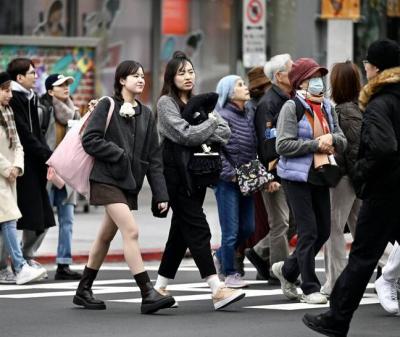
A cold surge advisory was today issued for 18 cities and counties across Taiwan, with temperatures of below 10°C forecast during the day and into tonight, the Central Weather Administration (CWA) said. New Taipei City, Taipei, Taoyuan and Hsinchu, Miaoli and Yilan counties are expected to experience sustained temperatures of 10°C or lower, the CWA said. Temperatures are likely to temporarily drop below 10°C in most other areas, except Taitung, Pingtung, Penghu and Lienchiang (Matsu) counties, CWA data showed. The cold weather is being caused by a strong continental cold air mass, combined with radiative cooling, a process in which heat escapes from
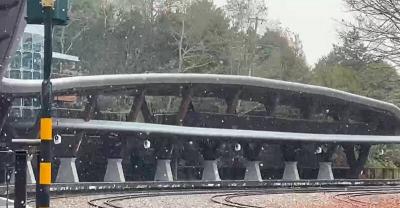
Snow this morning fell on Alishan for the first time in seven years, as a strong continental cold air mass sent temperatures plunging across Taiwan, the Central Weather Administration (CWA) said. The Alishan weather station, located at an elevation of about 2,200m in central Taiwan, recorded snowfall from 8:55am to 9:15am, when the temperature dropped to about 1°C, the CWA said. With increased moisture and low temperatures in the high-altitude Alishan area, the conditions were favorable for snow, CWA forecaster Tsai Yi-chi (蔡伊其) said. The last time snow fell at the Alishan weather station was on Jan. 10, 2018, while graupel fell there


 RSS
RSS