


Workshops to recruit volunteers for national field research into risks posed by the proposed service trade agreement with China were held by a consortium of civic activists yesterday, as the campaign to block passage in the Legislative Yuan continues.
The Economic Democracy Union, Youth Against Oppression in Taiwan (臺左維新), Democracy Tautin and several other groups associated with the 2014 Sunflower movement held workshops on the dangers of economic liberalization, the importance of supervisory articles for trade agreements and other topics at a park at the intersection of Civic Boulevard and Beiping E Road near Democratic Progressive Party (DPP) headquarters, with activists emphasizing the importance of continuing the struggle, despite the ouster in January’s elections of the Chinese Nationalist Party (KMT) administration, which negotiated the agreement.
“We hope to use our organizations to reach out to society and talk with those who would be effected by the agreements to know what they really think,” Democracy Tautin general coordinator Tseng Wen-hsueh (曾玟學) said.
Economic Democracy Union convener Lai Chung-chiang (賴中強) said the consortium would attempt to recruit a core of volunteers to help organize potential victims of the agreement in key legislative districts, with training planned for next month and field research to begin in August.
The trade in services agreement still awaits Legislative Yuan approval, with activists saying that the agreement should be renegotiated following the passage of new supervisory articles before being put to a vote.
Supervisory articles for trade agreements with China proposed by the DPP caucus have drawn criticism from civic groups for what they say are their lack of rigorous provisions guaranteeing civic participation and requiring substantive review of agreements’ potential effects.
About 60 people participated in yesterday’s workshops, with 10 registering as volunteers.

LOUD AND PROUD Taiwan might have taken a drubbing against Australia and Japan, but you might not know it from the enthusiasm and numbers of the fans Taiwan might not be expected to win the World Baseball Classic (WBC) but their fans are making their presence felt in Tokyo, with tens of thousands decked out in the team’s blue, blowing horns and singing songs. Taiwanese fans have packed out the Tokyo Dome for all three of their games so far and even threatened to drown out home team supporters when their team played Japan on Friday. They blew trumpets, chanted for their favorite players and had their own cheerleading squad who dance on a stage during the game. The team struggled to match that exuberance on the field, with
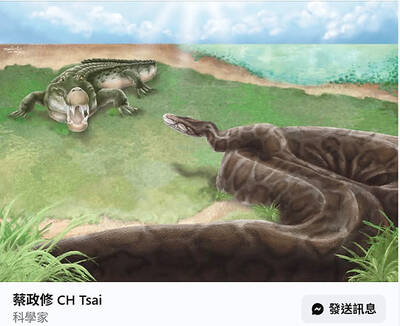
Taiwanese paleontologists have discovered fossil evidence that pythons up to 4m long inhabited Taiwan during the Pleistocene epoch, reporting their findings in the international scientific journal Historical Biology. National Taiwan University (NTU) Institute of Ecology and Evolutionary Biology associate professor Tsai Cheng-hsiu (蔡政修) led the team that discovered the largest snake fossil ever found in Taiwan. The single trunk vertebra was discovered in Tainan at the Chiting Formation, dated to between 400,000 and 800,000 years ago in the Middle Pleistocene, the paper said. The area also produced Taiwan’s first avian fossil, as well as crocodile, mammoth, saber-toothed cat and rhinoceros fossils, it said. Discoveries

Taiwanese paleontologists have discovered fossil evidence that pythons up to 4m long inhabited Taiwan during the Pleistocene epoch, reporting their findings in the international scientific journal Historical Biology. National Taiwan University (NTU) Institute of Ecology and Evolutionary Biology associate professor Tsai Cheng-hsiu (蔡政修) led the team that discovered the largest snake fossil ever found in Taiwan. A single trunk vertebra was discovered in Tainan at the Chiting Formation, dated to between 800,000 to 400,000 years ago in the Middle Pleistocene, the paper said. The area also produced Taiwan’s first avian fossil, as well as crocodile, mammoth, sabre-toothed cat and rhinoceros fossils, it said. Discoveries

Whether Japan would help defend Taiwan in case of a cross-strait conflict would depend on the US and the extent to which Japan would be allowed to act under the US-Japan Security Treaty, former Japanese minister of defense Satoshi Morimoto said. As China has not given up on the idea of invading Taiwan by force, to what extent Japan could support US military action would hinge on Washington’s intention and its negotiation with Tokyo, Morimoto said in an interview with the Liberty Times (sister paper of the Taipei Times) yesterday. There has to be sufficient mutual recognition of how Japan could provide


 RSS
RSS