


The Food and Drug Administration (FDA) confirmed it sent officials to check on the safety of Canadian beef amid reports that a ban on Canadian beef products is to be lifted next month.
Taiwan banned imports of Canadian beef products in February last year following the confirmation of bovine spongiform encephalopathy (BSE) — better known as mad cow disease — in a cow in Alberta.
Food Safety Division head Pan Chih-kuan (潘志寬) on Friday said that Canada, hoping to get the ban lifted, last year asked that risk assessment be conducted.
The FDA sent officials to Canada in November last year to check on its beef, reporting no problems, Pan said, adding that the results of the visit were submitted to the Executive Yuan.
Although the government’s assessment gave Canadian beef a clean bill of health, lifting the ban would still require more inter-agency communication, with the Executive Yuan having the final say, Pan said.
An Executive Yuan official said that the precondition for re-opening Taiwan’s market to Canadian beef will be the safety of the people.
The official, who refused to be named, said many other countries, including China and South Korea, have opened their markets to imports of Canadian beef.
“Government agencies are now handling the matter in line with standard operating procedures,” said the official, who denied that there would be a decision next month as has been reported.
He also confirmed that in April, when then-premier Simon Chang (張善政) met then-premier-designate Lin Chuan (林全) on issues of government transition, Chang discussed handling the Canadian matter.
Because the Chinese Nationalist Party (KMT) no longer had a majority in the legislature, Chang’s bid for communication on the issue among lawmakers went nowhere, the official said.
He said that when Chang met with Lin, Chang said he was willing to reopen the doors to Canadian beef and asked Lin to mention the idea to the Democratic Progressive Party (DPP).
Chang later learned that the DPP would not block the initiative, but the Ministry of Health and Welfare issued a brief on the issue that was so vague that the Ministry of Economic Affairs could not use it as a basis for policy, the official said.

FUKUOKA SITUATION: Japanese media reported that the pathogen is expected to be identified by the summer, while the CDC downplayed the idea that it was hMPV A “mysterious cold-like illness” reported in Japan’s Fukuoka Prefecture does not seem to be a new disease, but Japanese authorities have been asked about the situation, the Centers for Disease Control (CDC) said yesterday. The Fukuoka Prefectural Medical Association on Wednesday told a news conference that a “mystery cold” that has become a hot topic on social media is “highly likely to be caused by some kind of viral infection,” Japan’s KBC News reported. “Many people are experiencing symptoms starting with a sore throat, followed by a runny nose, phlegm and a severe cough,” KBC News reported, citing association officials. Health authorities are

Nvidia Corp CEO Jensen Huang (黃仁勳) arrived in Taiwan yesterday ahead of upcoming AI and technology events, saying he plans to meet with clients and Taiwan Semiconductor Manufacturing Co Chairman C.C. Wei (魏哲家) during his visit. After landing at Taipei Songshan Airport, Huang posed for photos with fans and handed out Yakult drinks to reporters and supporters waiting at the scene, saying he has “a lot to do” during the trip. Asked about reports that Nvidia’s planned headquarters site in Taipei’s Beitou Shilin Technology Park could break ground on May 27, Huang said that if the company holds an event, he would

Carrefour Taiwan is to begin using a new name from the start of July, but it cannot divulge the name until then, the chairman of the supermarket chain's parent company said today. President Chain Store Co chairman Lo Chih-hsien (羅智先) was asked by reporters after a shareholders' meeting to confirm whether the company has settled on a new name for the supermarket brand. In March, the government-registered name of two Carrefour Taiwan branches was quietly changed to "Le Chia Kang" (樂家康) in Chinese, raising speculation that has been selected as the name. Lo said that because of local regulations and contractual obligations, the
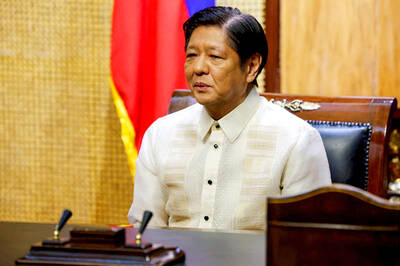
The Philippines would likely be involved in any conflict over Taiwan due to its proximity to the democracy claimed by China, President Ferdinand Marcos Jr said, reiterating a stance that risks angering Beijing. “In the Philippines, we do not have a choice because Taiwan is so close to the Philippines and we have almost 200,000 Filipino nationals living and working in Taiwan,” Marcos said in an interview with Japanese media in Manila on Monday. The Philippine leader’s comments come ahead of a state visit to Japan next week, where he is to meet with Japanese Prime Minister Sanae Takaichi to discuss security


 RSS
RSS