


President Tsai Ing-wen (蔡英文) and Chinese Nationalist Party (KMT) Chairwoman Hung Hsiu-chu (洪秀柱) were in a rare agreement as they shared each other’s Facebook posts condemning self-styled citizen journalist Hung Su-chu (洪素珠) for her discriminatory remarks and expressed their hopes for a more tolerant nation.
Tsai on Friday night shared a Facebook post by Hung Hsiu-chu that condemned Hung Su-chu’s remarks against an elder waishengren (外省人, Mainlander), a term referring to people who fled to Taiwan with the KMT in 1949 after its defeat in the Chinese Civil War.
Hung Su-chu posted a video on her Facebook page, in which she told a waishengren that he did not contribute to Taiwan, but “gnawed on Taiwanese’s bones” and should go back to China.
Hung Hsiu-chu said in her Facebook post that she often saw people using some derogatory terms, such as “Chinese pigs” and “Chinese dogs” to ridicule the KMT and its supporters.
“Where are we taking Taiwan to? What kind of nation we want to make it into? Can our society stop the infighting and stop hurting each other?” she asked.
Tsai shared Hung Hsiu-chu’s post on her Facebook page to answer Hung Hsiu-chu’s question about whether Taiwanese society could stop the infighting and hurting each other.
“I would start doing so myself,” Tsai said. “No one should apologize for their self-identity and hate speech should be condemned, and we should stop spreading ethnic prejudices.”
“Only listening and sharing could really unite the nation, and only when we seriously keep ‘diverse, but equal respect and tolerance’ in our mind could this nation welcome the day for reconciliation,” she added.
Hung Hsiu-chu, in response, thanked Tsai and shared Tsai’s remarks on her Facebook page.
“Let us work together to make hate and discriminatory speeches disappear in our nation,” Hung Hsiu-chu said. “We can work together to make laws to root out hate and discriminatory speeches and behavior from our society.”
While Tsai and Hung Hsiu-chu preached equal rights and tolerance, former president Ma Ying-jeou (馬英九) mentioned the contributions that KMT veterans have made.
“Rongmin (榮民) means ‘citizens of honor,’ and their honor comes from the three major contributions they made to Taiwan: recovering Taiwan through the Second Sino-Japanese War, defending Taiwan during the cross-strait standoff and helping the construction projects for Taiwan’s development,” Ma said in a Facebook post. “Without their sacrifice, we could not have the freedom and democracy, as well as stability that we enjoy today.”
The term rongmin is a title given by the government to soldiers who have served in the military for more than 10 years, or have participated in government-defined “major battles.”
However, in common usage, the term usually refers to soldiers who fled to Taiwan with the KMT regime in the late 1940s and early 1950s.

The manufacture of the remaining 28 M1A2T Abrams tanks Taiwan purchased from the US has recently been completed, and they are expected to be delivered within the next one to two months, a source said yesterday. The Ministry of National Defense is arranging cargo ships to transport the tanks to Taiwan as soon as possible, said the source, who is familiar with the matter. The estimated arrival time ranges from late this month to early next month, the source said. The 28 Abrams tanks make up the third and final batch of a total of 108 tanks, valued at about NT$40.5 billion
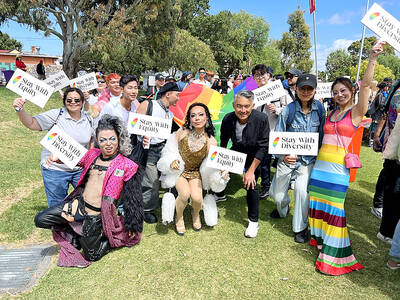
A group from the Taiwanese Designers in Australia association yesterday represented Taiwan at the Midsumma Pride March in Melbourne. The march, held in the St. Kilda suburb, is the city’s largest LGBTQIA+ parade and the flagship event of the annual Midsumma Festival. It attracted more than 45,000 spectators who supported the 400 groups and 10,000 marchers that participated this year, the association said. Taiwanese Designers said they organized a team to march for Taiwan this year, joining politicians, government agencies, professionals and community organizations in showing support for LGBTQIA+ people and diverse communities. As the first country in Asia to legalize same-sex
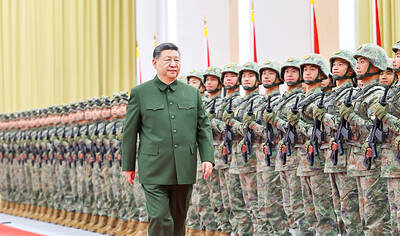
MOTIVES QUESTIONED The PLA considers Xi’s policies toward Taiwan to be driven by personal considerations rather than military assessment, the Epoch Times reports Chinese President Xi Jinping’s (習近平) latest purge of the Chinese People’s Liberation Army (PLA) leadership might have been prompted by the military’s opposition to plans of invading Taiwan, the Epoch Times said. The Chinese military opposes waging war against Taiwan by a large consensus, putting it at odds with Xi’s vision, the Falun Gong-affiliated daily said in a report on Thursday, citing anonymous sources with insight into the PLA’s inner workings. The opposition is not the opinion of a few generals, but a widely shared view among the PLA cadre, the Epoch Times cited them as saying. “Chinese forces know full well that

Travel agencies in Taiwan are working to secure alternative flights for travelers bound for New Zealand for the Lunar New Year holiday, as Air New Zealand workers are set to strike next week. The airline said that it has confirmed that the planned industrial action by its international wide-body cabin crew would go ahead on Thursday and Friday next week. While the Auckland-based carrier pledged to take reasonable measures to mitigate the impact of the workers’ strike, an Air New Zealand flight arriving at Taipei from Auckland on Thursday and another flight departing from Taipei for Auckland on Saturday would have to


 RSS
RSS