


The Chinese Nationalist Party (KMT) caucus yesterday said it was not satisfied with Premier Lin Chuan’s (林全) responses to their three demands, based on which they occupied the podiums in the legislature’s general assembly chamber to block legislative proceedings on Tuesday.
The premier was able to present his policy report to the legislature yesterday, following his failed attempt on Tuesday, when KMT lawmakers boycotted Lin’s report.
In the latest version of the report provided yesterday, responses to the three demands tabled by the KMT caucus on Tuesday — not to allow the import of US pork with ractopamine, not to allow the import of products from the five Japanese prefectures that were affected by radioactive fallout from the Fukushima Dai-ichi nuclear power plant disaster in March 2011 and to ensure Taiwanese fishermen’s rights are protected in disputed waters near the Okinotori atoll claimed by Japan — were added.
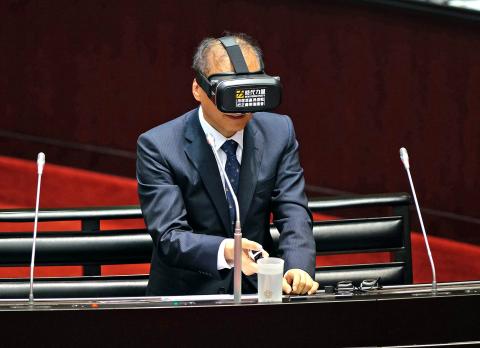
Photo: Wang Yi-sung, Taipei Times
The responses reiterated the Executive Yuan’s response on Wednesday.
On the accusation that imports of US pork containing ractopamine residue would be allowed soon, Lin said that pig farmers’ interests would be protected by enhancing the domestic pork industry and that “until evidence-based risk evaluation is undertaken, we are against any domestic pork and imported pork containing leanness-enhancing additives.”
Regarding the import of Japanese food products from radiation-affected regions, “scientific evidence in line with international regulations would be the grounds for the government’s food safety management” and the government would continue to watch closely the related examinations in Japan and other countries’ regulations and test results concerning Japanese foodstuffs,” Lin said, adding that so far, there are no plans to relax the restrictions.”
On the Okinotori waters dispute, the premier said that there is no dispute over Japan’s sovereignty over Okinotori, but Taiwan’s stance is that Japan should not claim a 200-nautical-mile (370.4km) exclusive economic zone (EEZ) based on Okitonori.
“Taiwanese fishermen have the right to fish in the waters near Okinotori and the government will make every effort to guard their rights,” Lin said, but added that whether Okinotori is an island, which would be grounds for an EEZ, is an issue that has not been decided by the UN Commission on the Limits of the Continental Shelf (CLCS).
The KMT caucus said the premier’s responses were “evasive” and unsatisfactory, accusing the Democratic Progressive Party (DPP) administration of being weak when facing Japan.
“I am disappointed with [the government] in that it does not dare to say that Okinotori is a reef. And why did Lin say [in the report] that Taiwan is ‘willing’ to engage in dialogue with Japan? Is Japan ‘willing’ to do that? If it is, why is it not stated in the report?” KMT Legislator Johnny Chiang (江啟臣) asked.
KMT Legislator Alicia Wang (王育敏) fumed over Lin’s statement that whether Okinotori is a reef has to be determined by the CLCS, saying: “What if the international ruling never comes?”
“And the fact is, the CLCS actually does not deliver rulings on EEZs,” she said. “We now only need a simple answer to the question of whether our fishermen can enter the 200-nautical-mile region of Okinotori.”
Ridiculing Lin’s claim that it the UN is required to determine whether Okinotori is a reef, KMT Legislator Lee Yan-hsiu (李彥秀) asked: “Are we to ask the UN to decide whether we are a country as well?”
The KMT lawmakers also criticized the premier for bringing up “risk evaluations” as they said that it means the import of US pork would in the end be allowed after all.

FUKUOKA SITUATION: Japanese media reported that the pathogen is expected to be identified by the summer, while the CDC downplayed the idea that it was hMPV A “mysterious cold-like illness” reported in Japan’s Fukuoka Prefecture does not seem to be a new disease, but Japanese authorities have been asked about the situation, the Centers for Disease Control (CDC) said yesterday. The Fukuoka Prefectural Medical Association on Wednesday told a news conference that a “mystery cold” that has become a hot topic on social media is “highly likely to be caused by some kind of viral infection,” Japan’s KBC News reported. “Many people are experiencing symptoms starting with a sore throat, followed by a runny nose, phlegm and a severe cough,” KBC News reported, citing association officials. Health authorities are

Nvidia Corp CEO Jensen Huang (黃仁勳) arrived in Taiwan yesterday ahead of upcoming AI and technology events, saying he plans to meet with clients and Taiwan Semiconductor Manufacturing Co Chairman C.C. Wei (魏哲家) during his visit. After landing at Taipei Songshan Airport, Huang posed for photos with fans and handed out Yakult drinks to reporters and supporters waiting at the scene, saying he has “a lot to do” during the trip. Asked about reports that Nvidia’s planned headquarters site in Taipei’s Beitou Shilin Technology Park could break ground on May 27, Huang said that if the company holds an event, he would

Carrefour Taiwan is to begin using a new name from the start of July, but it cannot divulge the name until then, the chairman of the supermarket chain's parent company said today. President Chain Store Co chairman Lo Chih-hsien (羅智先) was asked by reporters after a shareholders' meeting to confirm whether the company has settled on a new name for the supermarket brand. In March, the government-registered name of two Carrefour Taiwan branches was quietly changed to "Le Chia Kang" (樂家康) in Chinese, raising speculation that has been selected as the name. Lo said that because of local regulations and contractual obligations, the
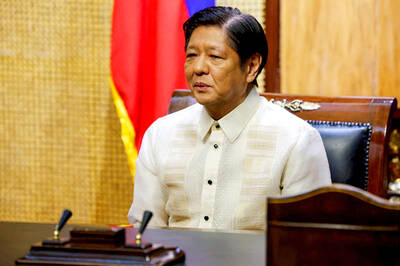
The Philippines would likely be involved in any conflict over Taiwan due to its proximity to the democracy claimed by China, President Ferdinand Marcos Jr said, reiterating a stance that risks angering Beijing. “In the Philippines, we do not have a choice because Taiwan is so close to the Philippines and we have almost 200,000 Filipino nationals living and working in Taiwan,” Marcos said in an interview with Japanese media in Manila on Monday. The Philippine leader’s comments come ahead of a state visit to Japan next week, where he is to meet with Japanese Prime Minister Sanae Takaichi to discuss security


 RSS
RSS