


Democratic Progressive Party (DPP) Legislator Chiu Chih-wei (邱志偉) has proposed a draft amendment to the Animal Protection Act (動物保護法) to provide a legal basis to fine people who buy, sell or eat any product that contains dog or cat meat.
Chiu’s proposed amendment, if passed, would see violators fined between NT$50,000 and NT$250,000 (US$1,532.71 and US$7,663.54).
Citing the Kaohsiung City Autonomous Animal Protection Act (高雄市動物保護自治條例), which was passed last year and prohibits anyone from buying, selling or eating any product that contains dog or cat meat, Chiu said the initiative should be adopted nationwide to provide better animal protection.
The amendment would also prohibit animal owners from leading their animals by car or scooter or face a fine of between NT$15,000 and NT$75,000, Chiu said, adding that the amendment would require individuals who abandon their pets or use them for gambling or competitions to attend a mandatory course on animal protection.
DPP Legislator-at-large Frida Tsai (蔡培慧) also proposed a ban on animals being used in public performances, saying that if any organization or person wants to use an animal to interact with an audience, they must first submit a permit application.
Any organization or person that wants to use animals in public performances must accept an assessment prior to their activities, with an assessor reserving the right to revoke the permit if the assessment fails.
If the amendment passes, violators would be fined between NT$100,000 and NT$3 million, Tsai said.
Many animals that are used in public performances are treated inhumanely, Tsai said, citing how dolphins, a key part of marine performances, are often kept in unsatisfactory environments.
Liao Chun-pin (廖俊斌), chief executive officer of Yehliu Ocean World in New Taipei City, said that while he had no opinion on the proposed amendments, the government should include academics and industry experts in their discussions instead of demonizing establishment owners.
Liao said that Yehliu Ocean World is not a circus, but rather an organization that raises and cares for dolphins and sea lions, adding that he would welcome anyone who wanted to visit Ocean World to see how the organization cares for its animals.
The amendments could put some establishments out of business, Liao said, adding that without any income, the establishments would be unable to afford staff or other expenses related to animal care.
Meanwhile, the National Museum of Marine Biology and Aquarium in Pingtung County said it does not use animals in “performances,” as it sees itself as a museum for conserving marine life.
However, it said that people can still observe the museum’s animals and listen to guides when the animals are fed.

EXCUSES: Beijing is using government and research vessels as a pretext to harass the nation and enter its EEZ, and engage in ‘hegemonic expansion,’ the coast guard said The Coast Guard Administration yesterday said it drove away Chinese oceanographic research vessel Xiang Yang Hong 22 (向陽紅33) from restricted waters after warning it that it was in Taiwan’s exclusive economic zone (EEZ). The Chinese vessel entered restricted waters off the coast of Yilan County’s Suao (蘇澳) at 11:35pm on Thursday, the coast guard said, adding that it dispatched the Lanyu patrol vessel and the boat PP-10077 to shadow the Chinese ship and issue radio warnings ordering it to leave. China has no sovereignty over waters off Taiwan’s east coast, Lanyu’s crew told Xiang Yang Hong 22 over the radio, and demanded

BAIT AND SWITCH: Allowing KMT-run counties to sell to China while the threat of abrupt cancelations hangs overhead is another form of coercion, officials said Beijing is using agricultural purchase offers announced during the Straits Forum to deepen Taiwan’s dependence on the Chinese market, a Taiwanese official said yesterday as they criticized the Taitung County commissioner’s participation in the initiative. During the Straits Forum held in Xiamen on Saturday, Chinese officials announced a sales and purchase agreement for agricultural products from some counties led by the Chinese Nationalist Party (KMT). Taitung County Commissioner Yao Ching-ling (饒慶鈴), who was barred from attending the event in person by the Mainland Affairs Council, participated via video. Under the agreement, China would purchase atemoyas, pomeloes, tea and grouper harvested in Taitung,
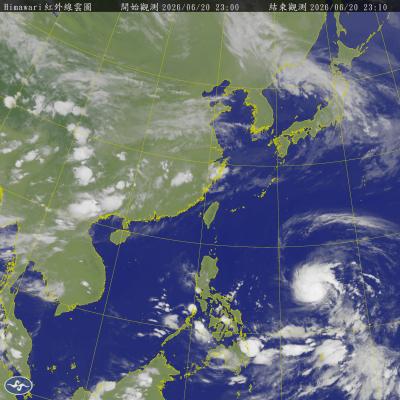
Tropical Storm Mekkhala is forecast to strengthen into a typhoon tomorrow and could come close enough to Taiwan later in the week to prompt a sea warning, the Central Weather Administration (CWA) said yesterday. As of 2 pm, the storm was located 1,870 kilometers southeast of Taiwan's southern tip and moving west- northwest at 23 km per hour. CWA forecaster Cheng Chieh-jen (鄭傑仁) said Mekkhala is expected to continue moving west-northwest through Tuesday under the influence of the Pacific high- pressure system before gradually turning north toward waters east of Taiwan or south of the Ryukyu Islands. The timing and angle of the

Four Taiwanese universities have been ranked among the world's top 200 institutions in the Quacquarelli Symonds (QS) World University Rankings for next year, the highest Taiwan has ever placed in the category, with National Taiwan University (NTU) achieving its best performance at 54th globally and 17th in Asia. The four Taiwanese institutions in the global top 200 are NTU (54th), National Tsing Hua University (142nd), National Yang Ming Chiao Tung University (177th) and National Cheng Kung University (191st), the rankings showed. All four universities achieved their highest-ever global rankings this year, QS data showed. National Cheng Kung University entered the top 200 for


 RSS
RSS