


The Cabinet led by Premier Lin Chuan (林全) had its first weekly meeting yesterday, with Lin saying that there will be no “adjustment period” for the government, which is expected to push for various reforms.
The Cabinet meeting was the first since President Tsai Ing-wen (蔡英文) was sworn in with the new administration on Friday last week, when Lin said he hopes that the Cabinet will be a disciplined team that would show its esprit de corps with professionalism and resolve.
Lin said that he hopes the Cabinet could make major changes in a short period of time in a bid to re-establish the public’s trust in the government, adding that he has three demands and three expectations.
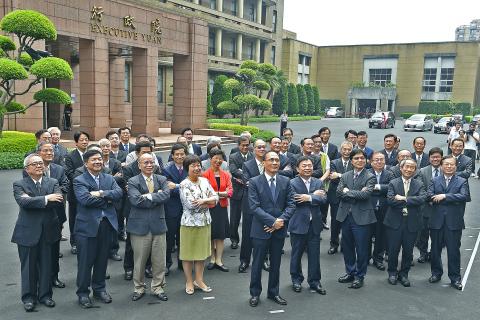
Photo: Chen Chih-chu, Taipei Times
“First, the making of the government’s public policies must be a process that allows sufficient communication with the public; every policy’s starting point should be the public’s needs, expectations and dignity,” Lin said.
The second demand was to set priorities so that policies would be implemented with efficiency, as the government’s resources are limited, he said.
“The administration aims for the nation’s sustainable development based on the idea of ‘people first’ and three core values of ‘innovation, employment and fair distribution,’” Lin said, adding that the third demand would be effective “cross-ministerial integration” when planning and carrying out policies to make sure the principles are met.
The three expectations would re-establish people’s trust in the government, set up an example of an honest officialdom that is discreet in using power and in its behaviors and remarks, and to cherish the opportunity to work for the public and the nation, he said.
Lin reiterated Tsai’s remarks about humility when the Democratic Progressive Party won the elections on Jan. 16, calling on Cabinet members to remain humble.
The Cabinet meeting was attended by five of the six special municipality mayors — Taipei Mayor Ko Wen-je (柯文哲), Taoyuan Mayor Cheng Wen-tsang (鄭文燦), Taichung Mayor Lin Chia-lung (林佳龍), Tainan Mayor William Lai (賴清德) and Kaohsiung Mayor Chen Chu (陳菊).
New Taipei City Mayor Eric Chu (朱立倫) continued his past practice of sending New Taipei City Deputy Mayor Chen Shen-hsien (陳伸賢) to attend in his place.
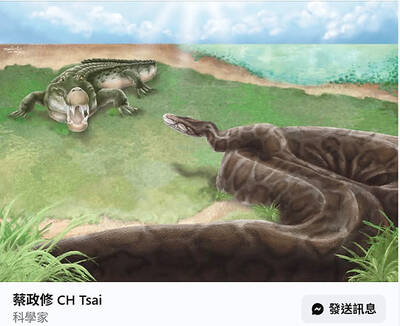
Taiwanese paleontologists have discovered fossil evidence that pythons up to 4m long inhabited Taiwan during the Pleistocene epoch, reporting their findings in the international scientific journal Historical Biology. National Taiwan University (NTU) Institute of Ecology and Evolutionary Biology associate professor Tsai Cheng-hsiu (蔡政修) led the team that discovered the largest snake fossil ever found in Taiwan. The single trunk vertebra was discovered in Tainan at the Chiting Formation, dated to between 400,000 and 800,000 years ago in the Middle Pleistocene, the paper said. The area also produced Taiwan’s first avian fossil, as well as crocodile, mammoth, saber-toothed cat and rhinoceros fossils, it said. Discoveries

Taiwanese paleontologists have discovered fossil evidence that pythons up to 4m long inhabited Taiwan during the Pleistocene epoch, reporting their findings in the international scientific journal Historical Biology. National Taiwan University (NTU) Institute of Ecology and Evolutionary Biology associate professor Tsai Cheng-hsiu (蔡政修) led the team that discovered the largest snake fossil ever found in Taiwan. A single trunk vertebra was discovered in Tainan at the Chiting Formation, dated to between 800,000 to 400,000 years ago in the Middle Pleistocene, the paper said. The area also produced Taiwan’s first avian fossil, as well as crocodile, mammoth, sabre-toothed cat and rhinoceros fossils, it said. Discoveries
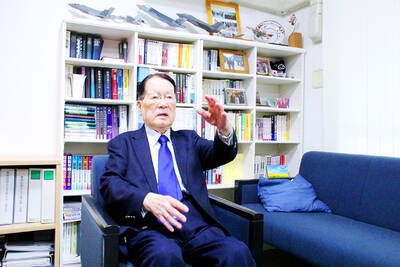
Whether Japan would help defend Taiwan in case of a cross-strait conflict would depend on the US and the extent to which Japan would be allowed to act under the US-Japan Security Treaty, former Japanese minister of defense Satoshi Morimoto said. As China has not given up on the idea of invading Taiwan by force, to what extent Japan could support US military action would hinge on Washington’s intention and its negotiation with Tokyo, Morimoto said in an interview with the Liberty Times (sister paper of the Taipei Times) yesterday. There has to be sufficient mutual recognition of how Japan could provide
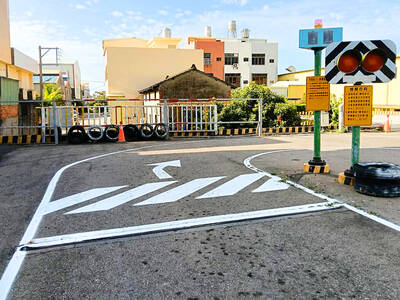
UPDATED TEST: The new rules aim to assess drivers’ awareness of risky behaviors and how they respond under certain circumstances, the Highway Bureau said Driver’s license applicants who fail to yield to pedestrians at intersections or to check blind spots, or omit pointing-and-calling procedures would fail the driving test, the Highway Bureau said yesterday. The change is set to be implemented at the end of the month, and is part of the bureau’s reform of the driving portion of the test, which has been criticized for failing to assess whether drivers can operate vehicles safely. Sedan drivers would be tested regarding yielding to pedestrians and turning their heads to check blind spots, while drivers of large vehicles would be tested on their familiarity with pointing-and-calling


 RSS
RSS