


Changes to the terms of standard tenancy agreements, including that the tenancy deposit cannot be more than two months’ rent, were adopted yesterday, the Consumer Protection Committee said.
To stop landlords from setting unreasonable conditions on tenancy agreements or tenants damaging rented properties, the committee said it has adopted modified tenancy contract items, suggested by the Ministry of the Interior, which came into effect after an official announcement by the ministry.
Committee senior secretary Chen Hsing-hung (陳星宏) said the five main points are: the maximum amount of deposit; specified rates for water, electricity and gas; the responsibility of repairs to a property; mechanisms to avoid termination of tenancy agreement without prior notice; and preventing tax evasion by landlords.
“The landlord cannot set a tenancy deposit higher than two months’ rent,” Chen said, adding that the deposit should be returned to the tenant when the contract has expired or is terminated, or when the house is returned to the landlord.
Water, electricity and gas rates should be clearly stated on the tenancy agreement and in the form of a checklist that clarifies who is responsible for paying the bills, Chen said.
As for the responsibility of repairing damages, the principle is that the landlord should be responsible, but if the damage is clearly caused by the tenant, the landlord is not obligated to pay for the repair.
“If one party wants to terminate the tenancy agreement earlier, it cannot, for example, inform today and move out the next day; they are required to give notice of at least one month,” Chen said.
If one party breaches the contract, the other party can ask for compensation of no more than one month’s rent, he added.
To help prevent tax evasion by landlords, owners cannot ask tenants not to use the property for rental payment declaration and household registration. Neither can landlords force tenants to pay more if property taxes were to rise.
The committee also advised tenants to stamp each page of the tenancy agreement, record conversations or take photographs during the handover of the house and pay the rent by remittance to show evidence that might be useful if disputes occur.
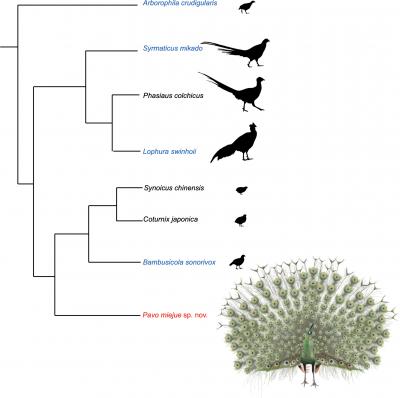
Through analyzing fossil evidence, a research team at National Taiwan University (NTU) discovered the largest endemic bird to have lived in Taiwan, naming it Pavo miejue, or extinct peafowl (滅絕孔雀). The Mikado pheasant, which is printed on the back of the NT$1,000 bank note, was previously believed to be the biggest endemic bird to Taiwan. The research team’s findings suggest that Pavo miejue lived during the Pleistocene epoch tens of thousands of years ago. It is the first endemic extinct bird species discovered and formally named in Taiwan. The study was coauthored by NTU Institute of Ecology and Evolutionary Biology professor Tsai Cheng-hsiu (蔡政修),

In a historic first, Taiwanese officials participated in this year’s Riga Strategic Communications Dialogue in Latvia from Wednesday to Friday last week, which debuted a breakout session focused on Taiwan The event organizer, the NATO Strategic Communications Center of Excellence, displayed Taiwan’s national flag and the officials’ formal titles on their Web site. Taiwanese attendees included National Security Council (NSC) Deputy Secretary-General Lin Fei-fan (林飛帆) and deputy head of the Taipei Representative Office in the UK, Chiang Ya-chi (江雅綺). In addition to the session discussing Taiwan titled “Taiwan: Navigating Strategic Communication in a Tense Environment,” the dialogue also included sessions
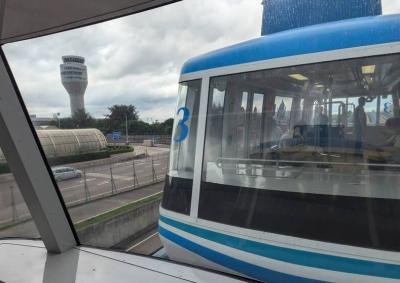
Taiwan Taoyuan International Airport is to suspend its automated Skytrain service connecting Terminal 1 and Terminal 2 starting on July 1 to facilitate connection works for the upcoming Terminal 3, the airport operator said today. Passengers and staff who need to travel between the two terminals after the suspension can instead use the Taoyuan MRT or the airport's 24-hour shuttle bus service, Taoyuan International Airport Corp said. The Taoyuan MRT Airport Line directly links the two terminals, while the shuttle buses are to operate around the clock, the company added. The Skytrain provides free transportation between the airport’s two terminals for travelers and
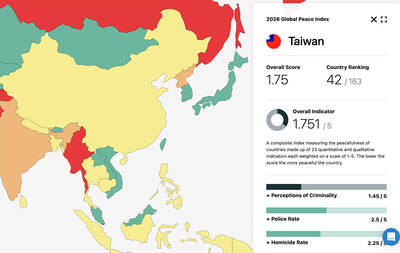
Taiwan ranked 42nd in terms of peacefulness among 163 countries, down five places from last year, according to this year’s Global Peace Index. With an overall score of 1.751, Taiwan dropped from 37th last year, the report published by the global Institute for Economics and Peace showed. The overall score measures a country’s level of peacefulness using 23 quantitative and qualitative indicators across three domains — ongoing domestic and international conflict, societal safety and security, and militarization. While Taiwan ranked 42nd worldwide, it was listed in ninth place among the 19 Asian-Pacific countries in the report, after New Zealand, Singapore, Japan, Malaysia,


 RSS
RSS