


City University of Hong Kong president Kuo Way (郭位) — one of three candidates on a short-list for the next president of Academia Sinica — turned down an interview with President Ma Ying-jeou (馬英九), citing a scheduling conflict and saying that he stood by his April 17 decision to withdraw his candidacy for the job.
In a letter to Ma that was published by the Chinese-language United Daily News on Sunday, Kuo wrote that he was unable to attend the interview due to work commitments, adding that after he had announced his decision to withdraw he had expected the matter to rest there, but his name was nevertheless on a list of candidates submitted to Ma.
When Kuo quit the race, he made remarks highly critical of the selection process for the institution’s president, saying it was mired in mudslinging and scheming, making an otherwise academic matter a highly politicized one, so he had decided to withdraw his candidacy to avoid stoking social divisions.
“Academia Sinica is in need of reform. The institution should be streamlined to make it a purely academic agency, which should be mainly composed of researchers, while its principal duties should be recognizing and rewarding outstanding research, while supporting the development of science and cultural policies,” Kuo wrote in the letter.
The institution does not admit students, which needs to be corrected, and mergers with universities would facilitate the idea of combining research with education, helping to introduce scientific research to society, Kuo wrote.
Kuo was said to be a favored candidate for his perceived affinity with Ma and his pro-China stance, but he wrote in the letter that “in a society where morality has declined, people with integrity who propose honest suggestions become subject to false accusations, which is detrimental to academic freedom.”
Academia Sinica Acting President Wang Fan-sen (王汎森) took over the institution after Ma approved the resignation of former Academia Sinica president Wong Chi-huey (翁啟惠) on Tuesday last week, following Wong’s involvement in an insider trading scandal.
Presidential Office spokesman Charles Chen (陳以信) yesterday reiterated that the appointment of the Academia Sinica president would not be made before Ma has interviewed the candidates, adding that the interviews are still being arranged.
Ma said earlier that he would leave the appointment of the position to president-elect Tsai Ing-wen (蔡英文) after she assumes office if they disagree on the most suitable candidate.
While Academia Sinica has refused to reveal the candidates, a list leaked to the media suggested the candidates are Kuo, University of California Los Angeles department of chemistry and biochemistry director James Liao (廖俊智) and Academia Sinica institute of atomic and molecular sciences director Chou Mei-yin (周美吟).
Liao reportedly won most votes from members of Academia Sinica’s selection committee. The candidate with most votes is typically appointed the institution’s president.

NATIONAL SECURITY: Authorities are working to confirm the identities of the military personnel involved and investigating possible illegal conduct and regulatory violations Authorities are probing possible national security implications after Kinmen police and immigration officers on Sunday found a Chinese woman allegedly posing as a tourist while engaging in prostitution involving more than 10 military personnel. The woman, surnamed Chen (陳), has since been deported, authorities said, adding that investigators are still working to confirm the identities of those implicated, as the records only listed code names and aliases. The case stemmed from a report received by the Kinmen District Prosecutors’ Office on Friday last week from the Jinhu Precinct of the Kinmen County Police Bureau. On Sunday, police, along with the National Immigration

GLOBALGIVING: ‘ Caving to external pressure is not acceptable for an organization that has cultivated justice reform and human rights for 30 years,’ one NGO said A slew of non-government organizations (NGOs) have withdrawn from the GlobalGiving fundraising platform after it announced it would use “Chinese Taipei” instead of “Taiwan” from next month. The Taiwan Good Rice Association wrote on Facebook on Friday that it was informed on April 28 via a teleconference call of the change, which was made because the platform wanted to operate in China. Taiwan Good Rice is to terminate all cooperative relationships with GlobalGiving in response to the platform’s “unilateral and non-negotiable” decision to remove references to Taiwan, the NGO said. “Taiwan is in the official name of Taiwan Good Rice Association and the

HEAVY WEATHER: Typhoon Jangmi is due to crash straight into the Ryukyus as airlines look to shift flights to larger aircraft or cancel flights to Okinawa entirely Taiwan’s international air carriers announced flight adjustments over the weekend as Typhoon Jangmi is forecast to hit the Ryukyu Islands today and tomorrow. The Central Weather Administration (CWA) upgraded Jangmi from a tropical storm to a typhoon at 8am yesterday, with the eye located 580km south of Naha city. It was moving north at 19kph. Today, China Airlines’ CI-120, CI-121, CI-122 and CI-123 flights between Taoyuan and Naha, Okinawa, have been canceled as well as CI-132 and CI-133 between Kaohsiung and Naha. EVA Air’s BR-112, BR-113, BR-186 and BR-185 flights between Taoyuan and Naha are also canceled. Low-cost carrier Tigerair Taiwan canceled IT-230,
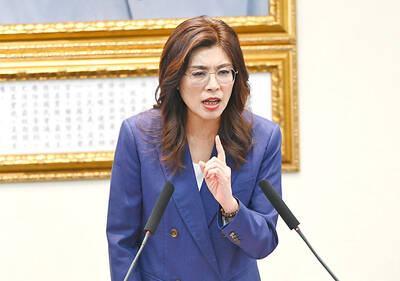
Chinese Nationalist Party (KMT) Chairwoman Cheng Li-wun (鄭麗文) yesterday briefed her party’s Central Standing Committee regarding her scheduled visit to the US between Monday next week and June 16, saying that her purpose would be to persuade the US that the Republic of China (ROC) Constitution was a “one China” constitution that would foster stable and peaceful cross-strait relations. The ROC Constitution is the most important defense for all Taiwanese citizens, as it upholds our democracy and has contributed to our robust economy, which aligns with international and US interests, she said. “We would not be troublemakers and drag the US under,”


 RSS
RSS