


President-elect Tsai Ing-wen’s (蔡英文) administration should improve relations with Japan, India and ASEAN to boost Taiwan’s diplomatic standing and economic growth, academics said.
Tsai’s inauguration on May 20 comes amid political campaigning in Japan for July’s House of Councilors election and in the US for the presidential election in November, slowing the response of the two allies to Taiwan-related issues for the duration of the campaigns, Taiwan Thinktank deputy executive director Lai I-chung (賴怡忠) said.
Notably, US President Barack Obama’s administration is expected to be cautious and defensive for the remainder of this year, he said.
Japanese Prime Minister Shinzo Abe is likely to “retain his advantage” after July’s election and since he will not face another electoral challenge until 2018, he is likely to be “emboldened” in setting an international agenda, a situation that is sure to increase Japan’s significance for Taiwan, Lai said.
Calling Japan a “fulcrum” in Taiwan’s diplomatic efforts, Lai said that Abe’s relative freedom of action is likely to encourage Tokyo to play a prominent role in the region in ways that might favor Taiwanese interests.
In multilateral trade negotiations such as the Trans-Pacific Partnership, Japan might possibly eclipse the US in diplomatic value, he said.
Yen Chen-shen (嚴震生), a research fellow at National Chengchi University’s Institute of International Relations, said that retaining diplomatic allies that recognize Taiwan’s statehood is likely to be a serious test for Tsai’s government, considering the Gambia’s severing of diplomatic ties with Taipei.
Although the Gambia’s move and its later establishment of ties with Beijing does not appear to be the result of a new Chinese diplomatic offensive, its effect on Taiwan’s international standing is still high, Yen said.
The Gambia broke ties with Taiwan in on Nov. 15, 2013, and resumed them with Beijing on March 17.
Resources are crucial to maintaining Taiwan’s diplomatic partners and the government should continue delivering aid to international partners, and involving the US in its efforts, especially in South and Central America, where the US “is reluctant to see a powerful Chinese presence,” Yen said.
“Taiwan should tell diplomatic allies that their ties with Taiwan would improve their relationship with the US,” Lai said.
Taiwan is interposed between the US and China, and therefore should be wary of making lopsided concessions to one side that would result in a loss of leverage, and avoid the risk of becoming a sacrificial piece in the US-Chinese “co-opetition,” Yen said, calling on Tsai’s government to avoid overly intimate collaborations with the US.
As for potential partners and allies, Lai said that ASEAN members and India, which have experienced rapid economic growth, should be targeted for diplomatic ties, because relationships with them might “increase Taiwan’s presence in the region, hedge Taiwan’s economic risks and spur domestic growth.”
Taiwan should be focusing on “diplomacy of values” and “cooperation in democracy and human-rights issues” with European nations through non-governmental organizations (NGOs), adding that a strategy that focuses on NGOs might make Taiwan’s accession into the international community easier, Lai said.
“Taiwan becoming a center of NGO activity would help the nation define its role in global affairs, which is more important than formal attendance in certain international summits,” he said.
Diplomatic allies should be utilized as staging areas to obtain recognition from other nations and to change the mechanisms of international organizations that would favor Taiwan’s participation in future talks and meetings, Lai said.

FUKUOKA SITUATION: Japanese media reported that the pathogen is expected to be identified by the summer, while the CDC downplayed the idea that it was hMPV A “mysterious cold-like illness” reported in Japan’s Fukuoka Prefecture does not seem to be a new disease, but Japanese authorities have been asked about the situation, the Centers for Disease Control (CDC) said yesterday. The Fukuoka Prefectural Medical Association on Wednesday told a news conference that a “mystery cold” that has become a hot topic on social media is “highly likely to be caused by some kind of viral infection,” Japan’s KBC News reported. “Many people are experiencing symptoms starting with a sore throat, followed by a runny nose, phlegm and a severe cough,” KBC News reported, citing association officials. Health authorities are

Nvidia Corp CEO Jensen Huang (黃仁勳) arrived in Taiwan yesterday ahead of upcoming AI and technology events, saying he plans to meet with clients and Taiwan Semiconductor Manufacturing Co Chairman C.C. Wei (魏哲家) during his visit. After landing at Taipei Songshan Airport, Huang posed for photos with fans and handed out Yakult drinks to reporters and supporters waiting at the scene, saying he has “a lot to do” during the trip. Asked about reports that Nvidia’s planned headquarters site in Taipei’s Beitou Shilin Technology Park could break ground on May 27, Huang said that if the company holds an event, he would

Carrefour Taiwan is to begin using a new name from the start of July, but it cannot divulge the name until then, the chairman of the supermarket chain's parent company said today. President Chain Store Co chairman Lo Chih-hsien (羅智先) was asked by reporters after a shareholders' meeting to confirm whether the company has settled on a new name for the supermarket brand. In March, the government-registered name of two Carrefour Taiwan branches was quietly changed to "Le Chia Kang" (樂家康) in Chinese, raising speculation that has been selected as the name. Lo said that because of local regulations and contractual obligations, the
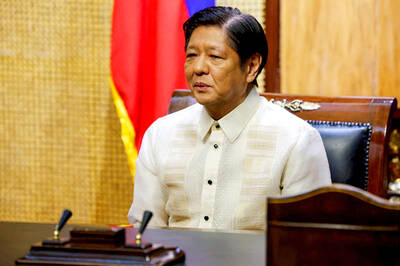
The Philippines would likely be involved in any conflict over Taiwan due to its proximity to the democracy claimed by China, President Ferdinand Marcos Jr said, reiterating a stance that risks angering Beijing. “In the Philippines, we do not have a choice because Taiwan is so close to the Philippines and we have almost 200,000 Filipino nationals living and working in Taiwan,” Marcos said in an interview with Japanese media in Manila on Monday. The Philippine leader’s comments come ahead of a state visit to Japan next week, where he is to meet with Japanese Prime Minister Sanae Takaichi to discuss security


 RSS
RSS