


A National Human Rights Museum exhibition featuring 10 undelivered letters composed by people just before their executions during the White Terror era opened at National Taitung University on Monday.
In the White Terror era, many death-row inmates awaiting execution for charges of political offenses wrote letters to their families and gave them to prison guards in the vain hope that they would be delivered, exhibition organizers said.
Instead, the authorities collected the unsent letters and deposited them in a classified government archive. By the time of declassification, some of the letters had been sealed for more than 60 years, organizers said.
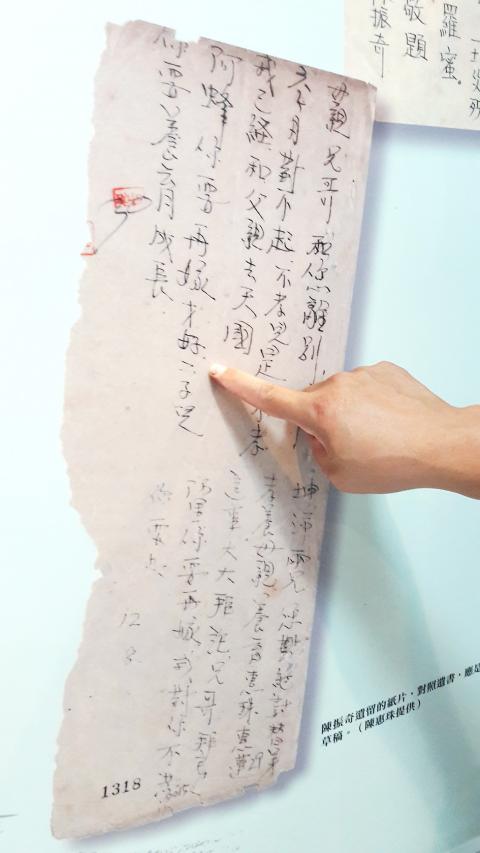
Photo: Huang Ming-tang, Taipei Times
In 2011, the museum completed cataloging the archive, counting letters from 112 prisoners who were executed.
After ensuring surviving family members would receive the letters, the museum chose 10 documents from the archive to use in an exhibition to commemorate White Terror history.
The letters contained final personal messages to loved ones.
Many husbands told their wives they should remarry.
Kuo Ching (郭慶) said in his final message to his wife: “If possible, I would like you to remarry.”
Chen Chen-chi’s (陳振奇) letter read: “I have followed father to heaven. A-feng (阿蜂), it would be best for you to remarry.”
Another husband, Wang Yao-hsun (王耀勳), wrote: “Please wait until our daughter is six years old before remarrying.”
Tsai Tieh-cheng (蔡鐵城) addressed his letter to his sister, saying: “I am so sorry. I failed you in my mission as your brother.”
Chou Wei (周威), a civics instructor at National Taitung Girls’ Senior High School and his class of 30 students were among the visitors to the exhibition on its first day, and the letters moved many of them to tears.
“The exhibition’s historical material is useful to help students deepen their understanding of the White Terror era,” Chou said.
“It helps them to see the harm to human rights that the state apparatus can inflict when it operates without regard for procedural justice,” Chou added.
The exhibition, which was jointly organized with the university, runs through Thursday next week.

FUKUOKA SITUATION: Japanese media reported that the pathogen is expected to be identified by the summer, while the CDC downplayed the idea that it was hMPV A “mysterious cold-like illness” reported in Japan’s Fukuoka Prefecture does not seem to be a new disease, but Japanese authorities have been asked about the situation, the Centers for Disease Control (CDC) said yesterday. The Fukuoka Prefectural Medical Association on Wednesday told a news conference that a “mystery cold” that has become a hot topic on social media is “highly likely to be caused by some kind of viral infection,” Japan’s KBC News reported. “Many people are experiencing symptoms starting with a sore throat, followed by a runny nose, phlegm and a severe cough,” KBC News reported, citing association officials. Health authorities are

Nvidia Corp CEO Jensen Huang (黃仁勳) arrived in Taiwan yesterday ahead of upcoming AI and technology events, saying he plans to meet with clients and Taiwan Semiconductor Manufacturing Co Chairman C.C. Wei (魏哲家) during his visit. After landing at Taipei Songshan Airport, Huang posed for photos with fans and handed out Yakult drinks to reporters and supporters waiting at the scene, saying he has “a lot to do” during the trip. Asked about reports that Nvidia’s planned headquarters site in Taipei’s Beitou Shilin Technology Park could break ground on May 27, Huang said that if the company holds an event, he would

The Ministry of Finance this afternoon announced the winning numbers for the March-April uniform invoice lottery. The winning number for the NT$10 million (US$318,060) special prize is 19531471, and the winning number for the NT$2 million grand prize is 85941329. Three numbers were drawn for the NT$200,000 first prize: 07225810, 20231230 and 83518781. Those with receipts matching the last seven digits of any of the first-prize numbers will win the NT$40,000 second prize, while those matching the last six digits will win the NT$10,000 third prize. Those whose receipts match the last five digits of the first-prize numbers can claim the NT$4,000 fourth prize,
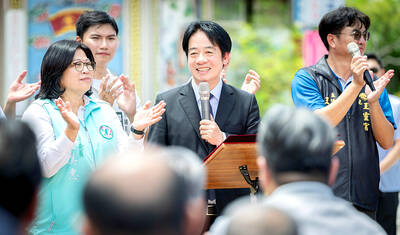
SIX SUBSIDIES: The monthly allowance for older farmers is to increase to NT$10,000, and NT$5,000 is to be given to homemakers under the national pension system, Lai said The government is to implement major welfare policies for disadvantaged groups, including raising the monthly allowance for older farmers to NT$10,000 and providing homemakers with NT$5,000 per month, President William Lai (賴清德) said yesterday. Lai made the remarks during a visit to Wangling Temple in Chiayi County, saying that the planned increases were being introduced amid economic growth and an increase in tax revenue. Touting a policy, in which the government plans to provide a monthly allowance of NT$5,000 for every child under the age of 18 in a bid to address Taiwan’s low birthrate, Lai said that if received for the


 RSS
RSS