


Chinese Nationalist Party (KMT) Chairwoman Hung Hsiu-chu (洪秀柱) yesterday said opposition parties had reacted poorly to the deportation of Taiwanese from Kenya to China as part of an alleged fraud investigation.
Hung said the Democratic Progressive Party (DPP) and the New Power Party (NPP) had acted irrationally and used populist rhetoric in discussing the incident, adding that she expects the KMT to be the mediator between the DPP government and Beijing should a political stalemate arise.
At a KMT Central Standing Committee meeting, Hung said the Kenya incident shows that if the “foundation of friendliness” of the cross-strait relationship is lacking, mutual trust between the two sides would be affected.
“The KMT firmly endorses the [so-called] ‘1992 consensus’ and the cross-strait peace it helps maintain, and it expects itself to maintain cross-strait relations and play a role if interactions between the DPP and the Chinese Communist Party [CCP] reach an impasse,” she said.
The “1992 consensus,” a term former Mainland Affairs Council chairman Su Chi (蘇起) admitted making up in 2000, refers to a tacit understanding between the KMT and the Chinese government that both sides of the Taiwan Strait acknowledge there is “one China,” with each side having its own interpretation of what “China” means.
Hung said that fighting crime committed by people outside their home nation is a responsibility shared by all states, and Taiwanese should support the government’s handling of such cases, which have followed international rules.
“In 2011, a group of Taiwanese were involved in telephone fraud in the Philippines and were deported [to China] by the Philippine government. [Taipei] negotiated [with Beijing] for four months, based on the Cross-Strait Joint Crime-Fighting and Judicial Mutual Assistance Agreement (海峽兩岸共同打擊犯罪及司法互助協議) before the suspects were brought back to Taiwan. It was only because there was a foundation of friendliness and a communication channel based on mutual trust between the two sides that the result was achieved,” she said.
Hung said “some politicians of the DPP and the NPP” engaged in political manipulation that is “blind to reason, as well as being populist in nature” and has seriously damaged the nation’s image.
“We hope that the DPP and the NPP could learn a lesson and stop being irrational and incurring ridicule for misinterpreting the law,” Hung said.
Hung made the remarks after a talk by Sun Yang-ming (孫揚明), senior adviser to the Prospect Foundation, who was invited by the KMT to speak on the Kenya incident.
Sun accused the legislature of being ignorant of international law, referring to a statement released last week by the Legislative Yuan — with the endorsement of all party caucuses — that condemned the Chinese government’s action in the deportation of Taiwanese from Kenya to China.
“Minister of Justice Luo Ying-shay (羅瑩雪) was right when she said that the Republic of China (ROC) does not have priority of jurisdiction in the Kenya incident involving phone fraud based in Kenya,” Sun said. “The Taiwanese suspects, who have criminal records in China and the subjects of the alleged crimes reside in China.”
“The only mistake Beijing made was that it did not notify us [of its action] in advance,” he said.
Sun said the statement issued by the DPP-led legislature insinuated a “two-state doctrine” by calling Beijing “the Chinese authority” instead of “mainland China.”
“Since when has such a term appeared in the ROC Constitution?” Sun said. “Legislative Speaker Su Jia-chyuan (蘇嘉全) should explain what kind of [cross-strait status] he is suggesting by using such terms.”
Sun said the DPP has been capitalizing on the incident to bolster its political interests, because it knows that an inauguration speech by president-elect Tsai Ing-wen (蔡英文) that does not include the “1992 consensus” and the “one China” policy would prompt a strong reaction from Beijing that would damage Taiwanese benefits.
“Demonizing the CCP is the easiest way to justify [the DPP’s] rejection of the terms proposed by Beijing,” he said.
“Without the ROC Constitution, localization [“Taiwanization”] amounts to Taiwanese independence. The structure of the cross-strait relationship is based on the ROC Constitution. It is lamentable that Tsai, having occupied the position of minister of the Mainland Affairs Council for so long, still does not recognize ‘one country, two regions’” underlying the ROC Constitution, Sun said.

Actor Darren Wang (王大陸) was sentenced to six months in prison, commutable to a fine, by the New Taipei District Court today for contravening the Personal Data Protection Act (個人資料保護法) in a case linked to an alleged draft-dodging scheme. Wang allegedly paid NT$3.6 million (US$114,380) to an illegal group to help him evade mandatory military service through falsified medical documents, prosecutors said. He transferred the funds to Chen Chih-ming (陳志明), the alleged mastermind of a draft-evasion ring, although he lost contact with him as he was already in detention on fraud charges, they said. Chen is accused of helping a

SECURITY: Starlink owner Elon Musk has taken pro-Beijing positions, and allowing pro-China companies to control Taiwan’s critical infrastructure is risky, a legislator said Starlink was reluctant to offer services in Taiwan because of the nation’s extremely high penetration rates in 4G and 5G services, the Ministry of Digital Affairs said yesterday. The ministry made the comments at a meeting of the legislature’s Transportation Committee, which reviewed amendments to Article 36 of the Telecommunications Management Act (電信管理法). Article 36 bans foreigners from holding more than 49 percent of shares in public telecommunications networks, while shares foreigners directly and indirectly hold are also capped at 60 percent of the total, unless specified otherwise by law. The amendments, sponsored by Chinese Nationalist Party (KMT) Legislator Ko
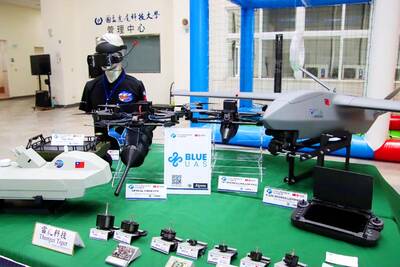
NON-RED SUPPLY: Boosting the nation’s drone industry is becoming increasingly urgent as China’s UAV dominance could become an issue in a crisis, an analyst said Taiwan’s drone exports to Europe grew 41.7-fold from 2024 to last year, with demand from Ukraine’s fight against Russian aggression the most likely driver of growth, a study showed. The Institute for Democracy, Society and Emerging Technology (DSET) in a statement on Wednesday said it found that many of Taiwan’s uncrewed aerial vehicle (UAV) sales were from Poland and the Czech Republic. These countries likely transferred the drones to Ukraine to aid it in its fight against the Russian invasion that started in 2022, it said. Despite the gains, Taiwan is not the dominant drone exporter to these markets, ranking second and fourth

The eastern extension of the Taipei MRT Red Line could begin operations as early as late June, the Taipei Department of Rapid Transit Systems said yesterday. Taipei Rapid Transit Corp said it is considering offering one month of free rides on the new section to mark its opening. Construction progress on the 1.4km extension, which is to run from the current terminal Xiangshan Station to a new eastern terminal, Guangci/Fengtian Temple Station, was 90.6 percent complete by the end of last month, the department said in a report to the Taipei City Council's Transportation Committee. While construction began in October 2016 with an


 RSS
RSS