


The New Power Party (NPP) caucus yesterday proposed amendments to the Criminal Code to extend the government’s jurisdiction over criminal offenses committed abroad amid alleged international telephone fraud involving Taiwanese overseas, while the party urged China to share evidence to facilitate a joint criminal investigation.
The party plans to revise Article 7 of the Criminal Code, which stipulates that the code applies where Taiwanese commit an offense abroad that is punishable by more than three years in prison.
The party proposed to drop the three-year minimum prison term as a requisite for the code’s application.
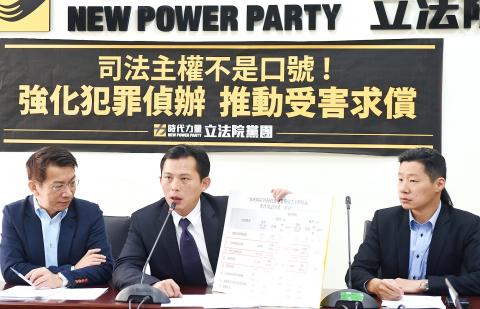
Photo: Chien Jung-fong, Taipei Times
“The revision will no longer limit the application of the Criminal Code to serious offenses, but the code would apply where an offense committed abroad is punishable by local laws. That would provide legal grounds for Taiwan to request extradition or international judicial cooperation in cases involving Taiwanese, regardless of the severity of offense,” NPP Legislator Hsu Yung-ming (徐永明) said. “Criminal investigations can be improved only if judicial jurisdiction can be maintained. Only by doing this can we crack down on telephone fraud rings.”
Forty-five Taiwanese were last week deported from Kenya to China for suspected involvement in telephone fraud, which has sparked debate about Taiwan’s jurisdiction in international criminal cases, while a delegation from the government is to depart for China today to negotiate with Chinese authorities.
NPP Legislator Huang Kuo-chang (黃國昌) said China has not acted consistently according to the Cross-Strait Joint Crime-Fighting and Judicial Mutual Assistance Agreement (海峽兩岸共同打擊犯罪及司法互助協議), which stipulates that suspects and evidence of a criminal case involving both nations should be handed over to the nation that prosecutes the case.
China only processed 1,357 of the 4,061 requests from Taiwan to demand information about criminal cases from 2009 to this year, while Taiwan processed 1,090 of the 1,346 Chinese requests, Huang said.
In terms of facilitating criminal investigation and evidence collection, China granted 61 percent of Taiwan’s requests, while Taiwan granted 92 percent of China’s requests, he said.
“China is suppressing Taiwan’s judicial sovereignty by not fulfilling the agreement. The delegation must make sure it asks China performs its obligation and delivers evidence along with suspects,” Huang said.
The party also plans to review all laws to establish a mechanism to help people affected by fraud seek compensation, which should include the confiscation of illegal assets and the participation of victims in prosecution and legal proceedings.

FUKUOKA SITUATION: Japanese media reported that the pathogen is expected to be identified by the summer, while the CDC downplayed the idea that it was hMPV A “mysterious cold-like illness” reported in Japan’s Fukuoka Prefecture does not seem to be a new disease, but Japanese authorities have been asked about the situation, the Centers for Disease Control (CDC) said yesterday. The Fukuoka Prefectural Medical Association on Wednesday told a news conference that a “mystery cold” that has become a hot topic on social media is “highly likely to be caused by some kind of viral infection,” Japan’s KBC News reported. “Many people are experiencing symptoms starting with a sore throat, followed by a runny nose, phlegm and a severe cough,” KBC News reported, citing association officials. Health authorities are

Nvidia Corp CEO Jensen Huang (黃仁勳) arrived in Taiwan yesterday ahead of upcoming AI and technology events, saying he plans to meet with clients and Taiwan Semiconductor Manufacturing Co Chairman C.C. Wei (魏哲家) during his visit. After landing at Taipei Songshan Airport, Huang posed for photos with fans and handed out Yakult drinks to reporters and supporters waiting at the scene, saying he has “a lot to do” during the trip. Asked about reports that Nvidia’s planned headquarters site in Taipei’s Beitou Shilin Technology Park could break ground on May 27, Huang said that if the company holds an event, he would

Carrefour Taiwan is to begin using a new name from the start of July, but it cannot divulge the name until then, the chairman of the supermarket chain's parent company said today. President Chain Store Co chairman Lo Chih-hsien (羅智先) was asked by reporters after a shareholders' meeting to confirm whether the company has settled on a new name for the supermarket brand. In March, the government-registered name of two Carrefour Taiwan branches was quietly changed to "Le Chia Kang" (樂家康) in Chinese, raising speculation that has been selected as the name. Lo said that because of local regulations and contractual obligations, the

The Philippines would likely be involved in any conflict over Taiwan due to its proximity to the democracy claimed by China, President Ferdinand Marcos Jr said, reiterating a stance that risks angering Beijing. “In the Philippines, we do not have a choice because Taiwan is so close to the Philippines and we have almost 200,000 Filipino nationals living and working in Taiwan,” Marcos said in an interview with Japanese media in Manila on Monday. The Philippine leader’s comments come ahead of a state visit to Japan next week, where he is to meet with Japanese Prime Minister Sanae Takaichi to discuss security


 RSS
RSS