


Minister of Justice-designate Chiu Tai-san (邱太三) yesterday said that there is no need to revise fraud laws, because penalties are at a judge’s discretion.
The deportation of 45 Taiwanese involved in a telecommunications fraud case in Kenya and China has sparked a debate in which some lawmakers have proposed increasing penalties for fraud offenses as part of efforts to stem the crime.
Some in China, where many are affected by fraud, have said that Taiwanese courts treat fraudsters more leniently than in China.
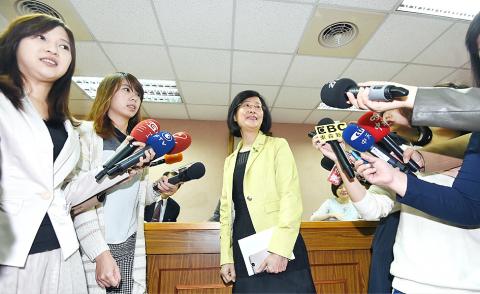
Photo: Liu Hsin-de, Taipei Times
The Criminal Code stipulates that those convicted of fraud using telephones or other communication equipment face imprisonment of not more than five years, Chiu said.
However, in 2004 the nature of the penalties for fraud offenses was revised to “one offense, one penalty,” Chiu said, adding that this means that the courts can increase sentences based on the number of plaintiffs.
If moves are made to revise the code, “all [the relevant] sentences would be aggravated and Taiwan would, as a result, become a nation that has adopted heavy penalties,” he said.
As it stands, a defendant convicted of multiple fraud charges can be sentenced to up to 20 years in prison, depending on the severity of the crime and the judges’ discretion, the minister-designate said.
Chiu said the way Chinese handled the Kenyan deportations was “rude and savage” and that under regulations governing relations between the two sides of the Taiwan Strait, Taiwan has jurisdiction over its people, even if they commit crimes in China.
Taiwan has lodged strong protests against Kenya and China after the deportations on Friday last week and Tuesday this week.
China argues that the Taiwanese were part of a fraud ring with Chinese who were stationed in Kenya and were cheating people in China.
Fraudsters trying to scam people in China have increasingly resorted to setting up equipment outside of the region to avoid the reach of Beijing authorities as they crack down on telephone fraud.

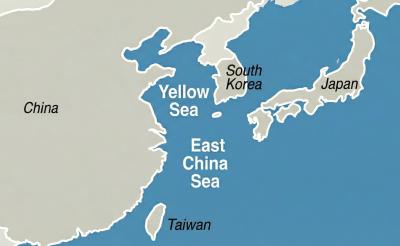
China has reserved offshore airspace in the Yellow Sea and East China Sea from March 27 to May 6, issuing alerts usually used to warn of military exercises, although no such exercises have been announced, the Wall Street Journal (WSJ) reported yesterday. Reserving such a large area for 40 days without explanation is an “unusual step,” as military exercises normally only last a few days, the paper said. These alerts, known as Notice to Air Missions (Notams), “are intended to inform pilots and aviation authorities of temporary airspace hazards or restrictions,” the article said. The airspace reserved in the alert is
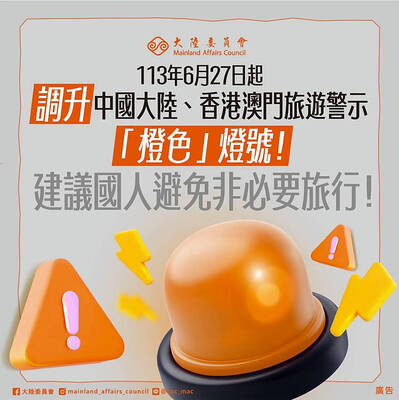
More than 6,000 Taiwanese students have participated in exchange programs in China over the past two years, despite the Mainland Affairs Council’s (MAC) “orange light” travel advisory, government records showed. The MAC’s publicly available registry showed that Taiwanese college and university students who went on exchange programs across the Strait numbered 3,592 and 2,966 people respectively. The National Immigration Agency data revealed that 2,296 and 2,551 Chinese students visited Taiwan for study in the same two years. A review of the Web sites of publicly-run universities and colleges showed that Taiwanese higher education institutions continued to recruit students for Chinese educational programs without

A bipartisan group of US senators has introduced a bill to enhance cooperation with Taiwan on drone development and to reduce reliance on supply chains linked to China. The proposed Blue Skies for Taiwan Act of 2026 was introduced by Republican US senators Ted Cruz and John Curtis, and Democratic US senators Jeff Merkley and Andy Kim. The legislation seeks to ease constraints on Taiwan-US cooperation in uncrewed aerial systems (UAS), including dependence on China-sourced components, limited access to capital and regulatory barriers under US export controls, a news release issued by Cruz on Wednesday said. The bill would establish a "Blue UAS
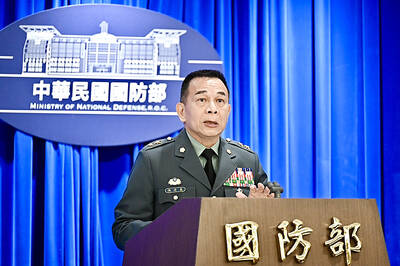
The Republic of China Army Command yesterday relieved Kinmen Defense Battalion commander after authorities indicted the officer on charges connected to using methamphetamine. The Kinmen District Prosecutors’ Office on Wednesday detained Colonel He (何) after the Coast Guard linked him to drug shipments and proceeded to charge him yesterday for using and possessing crystal meth. The man was released on a NT$50,000 bail and banned from leaving Kinmen, the office said. Army Chief of Staff Lieutenant General Chen Chien-yi (陳建義) told a news conference yesterday that He has been removed and another officer is taking over the unit as the acting commander. The military


 RSS
RSS