


President-elect Tsai Ing-wen (蔡英文) should expose the identities and actions of White Terror perpetrators after she assumes office on May 20, human rights campaigners and survivors of the White Terror era said yesterday.
Transitional justice is possible only when the responsibility of White Terror perpetrators is investigated, Formosan Political Prisoners Association honorary director-general Tsai Kuan-yu (蔡寬裕) said.
Chang Chiu-wu (張秋梧), a family member of a White Terror victim, said the Chinese Nationalist Party (KMT) must acknowledge its wrongdoing in its past actions and obtain the forgiveness of victims’ relatives.
“Tsai Ing-wen’s administration will need to be prepared to invest substantial resources in her proposed Truth and Reconciliation Commission for it to succeed,” said Huang Chang-lin (黃長玲), an associate professor of political science at National Taiwan University and former Taiwan Association for Truth and Reconciliation chairperson.
“Researching historical archives of the White Terror era is a daunting task and would require the Tsai administration to dedicate substantial resources to its proposed truth and reconciliation commission,” she added.
Huang said that the truth and reconciliation commission would need to clarify its role and function within existing government institutions, because there are many models for transitional justice organizations that have been used by governments around the world.
“Taiwanese have yet to acquire a deep understanding of history, which would only be made possible by a thorough examination of historical archives,” Huang said.
That controversy still surrounds former president Chiang Kai-shek’s (蔣介石) role in the 228 Incident, even though he commanded supreme political power during the massacre, suggests that the public “do not have an adequate knowledge of the White Terror system of government,” Huang said, adding that many ellipses continue to plague historical reconstructions of the events.
The 228 Incident refers to the crackdown launched by the Chinese Nationalist Party (KMT) regime against civilian demonstrations following an incident in Taipei on Feb. 27, 1947. The event also marked the beginning of the White Terror era that saw thousands of Taiwanese arrested, imprisoned and executed.
Chang said that many issues related to the 228 Incident remain unresolved.
“For example, the number of people slain during the massacre continues to be disputed, there is no unambiguous acknowledgment of Chiang Kai-shek’s culpability, and the KMT has not been made to apologize for the White Terror era,” Chang said, rejecting President Ma Ing-jeou’s (馬英九) apology on behalf of the government as “phony.”
“The victims’ families have a right to expect an apology from the KMT as a political party,” she added.

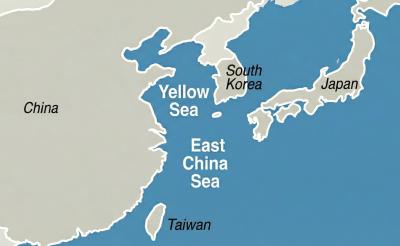
China has reserved offshore airspace in the Yellow Sea and East China Sea from March 27 to May 6, issuing alerts usually used to warn of military exercises, although no such exercises have been announced, the Wall Street Journal (WSJ) reported yesterday. Reserving such a large area for 40 days without explanation is an “unusual step,” as military exercises normally only last a few days, the paper said. These alerts, known as Notice to Air Missions (Notams), “are intended to inform pilots and aviation authorities of temporary airspace hazards or restrictions,” the article said. The airspace reserved in the alert is

South Korea is planning to revise its controversial electronic arrival card, a step Taiwanese officials said prompted them to hold off on planned retaliatory measures, a South Korean media report said yesterday. A Yonhap News Agency report said that the South Korean Ministry of Foreign Affairs is planning to remove the “previous departure place” and “next destination” fields from its e-arrival card system. The plan, reached after interagency consultations, is under review and aims to simplify entry procedures and align the electronic form with the paper version, a South Korean ministry official said. The fields — which appeared only on the electronic form
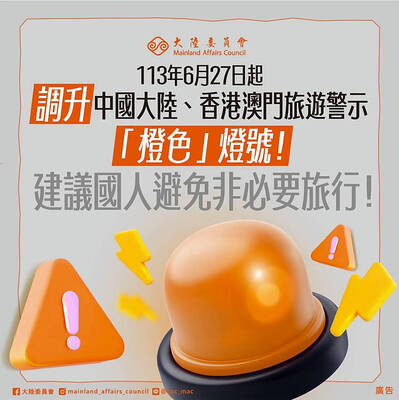
More than 6,000 Taiwanese students have participated in exchange programs in China over the past two years, despite the Mainland Affairs Council’s (MAC) “orange light” travel advisory, government records showed. The MAC’s publicly available registry showed that Taiwanese college and university students who went on exchange programs across the Strait numbered 3,592 and 2,966 people respectively. The National Immigration Agency data revealed that 2,296 and 2,551 Chinese students visited Taiwan for study in the same two years. A review of the Web sites of publicly-run universities and colleges showed that Taiwanese higher education institutions continued to recruit students for Chinese educational programs without

A bipartisan group of US senators has introduced a bill to enhance cooperation with Taiwan on drone development and to reduce reliance on supply chains linked to China. The proposed Blue Skies for Taiwan Act of 2026 was introduced by Republican US senators Ted Cruz and John Curtis, and Democratic US senators Jeff Merkley and Andy Kim. The legislation seeks to ease constraints on Taiwan-US cooperation in uncrewed aerial systems (UAS), including dependence on China-sourced components, limited access to capital and regulatory barriers under US export controls, a news release issued by Cruz on Wednesday said. The bill would establish a "Blue UAS


 RSS
RSS