


President-elect Tsai Ing-wen (蔡英文) should make a pledge to show her incoming administration’s determination to address the issue of the Chinese Nationalist Party’s (KMT) ill-gotten party assets, academics said yesterday.
Critics have labeled the KMT’s assets “ill-gotten” because the party took them from the Japanese colonial government, private businesses and individuals when it took control of Taiwan in the late 1940s.
Despite several bills proposed at the legislature on “ill-gotten party assets,” academics said they are worried about the actual result of the Democratic Progressive Party’s (DPP) campaign to pursue the matter, as the issue is politically sensitive and highly polarized.
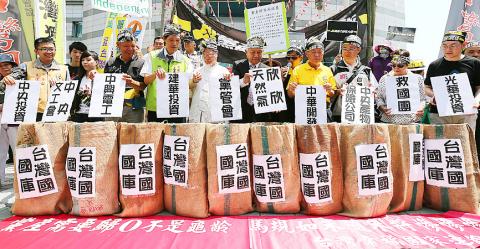
Photo: Fang Pin-chao, Taipei Times
Lo Cheng-tsung (羅承宗) of the Zero Party Asset Alliance said the incoming Tsai administration does not have to wait until the legislation is passed to pursue the KMT’s illegitimate party assets.
He said that although the DPP was a minority in the legislature when former president Chen Shui-bian (陳水扁) was in power, and there was no legislation on the issue, the Ministry of Civil Service was already checking on the KMT’s assets.
Therefore, the first thing Tsai should do when she is sworn in is to have the government continue such work based on what has already been accomplished, while updating information on the Executive Yuan’s Web site.
Huang Shih-hsin (黃世鑫), an honorary professor at National Taipei University’s Department of Public Finance, said that Tsai should clearly declare her determination in pursuing the KMT’s assets and make legislation on KMT assets a priority in the legislature. Moreover, if a commission on ill-gotten assets is created, it should immediately ask the KMT to submit relevant documents, or the party headquarters should be searched, adding that there should also be clauses to provide awards to whistle-blowers from within the party, he said.
Hsu Hui-feng (許惠峰), a law professor at Chinese Cultural University, said that as the DPP holds an absolute majority at the legislature, it should integrate different versions of proposals to take care of the issue as quickly as possible and exempt those who were involved in handling ill-gotten party assets from criminal responsibilities so that they cooperate.
Lo said organizations affiliated with the KMT, such as the China Youth Corps and the National Women’s League of the Republic of China, should be pursued as “organizations whose personnel, finance or operations are currently or have been under the control of a political party” as stipulated in the New Power Party’s proposal.

Yangmingshan National Park authorities yesterday urged visitors to respect public spaces and obey the law after a couple was caught on a camera livestream having sex at the park’s Qingtiangang (擎天崗) earlier in the day. The Shilin Police Precinct in Taipei said it has identified a suspect and his vehicle registration number, and would summon him for questioning. The case would be handled in accordance with public indecency charges, it added. The couple entered the park at about 11pm on Thursday and began fooling around by 1am yesterday, the police said, adding that the two were unaware of the park’s all-day live

A former soldier and an active-duty army officer were yesterday indicted for allegedly selling classified military training materials to a Chinese intelligence operative for a total of NT$79,440. The Taipei District Prosecutors’ Office indicted Chen Tai-yin (陳泰尹) and Lee Chun-ta (李俊達) for contravening the National Security Act (國家安全法) and the Anti-Corruption Act (貪污治罪條例). Chen left the military in September 2013 after serving alongside then-staff sergeant Lee, now an army lieutenant, at the 21st Artillery Command of the army’s Sixth Corps from 2011 to 2013, according to the indictment. Chen met a Chinese intelligence operative identified as “Wang” (王) through a friend in November

Minister of Digital Affairs Lin Yi-ching (林宜敬) yesterday cited regulatory issues and national security concerns as an expert said that Taiwan is among the few Asian regions without Starlink. Lin made the remarks on Facebook after funP Innovation Group chief executive officer Nathan Chiu (邱繼弘) on Friday said Taiwan and four other countries in Asia — China, North Korea, Afghanistan and Syria — have no access to Starlink. Starlink has become available in 166 countries worldwide, including Ukraine, Malaysia, the Philippines and Vietnam, in the six years since it became commercial, he said. While China and North Korea block Starlink, Syria is not

Yangmingshan National Park’s Qingtiangang (擎天崗) nature area has gone viral after a park livestream camera observed a couple in the throes of intimate congress, which was broadcast live on YouTube, drawing large late-night crowds and sparking a backlash over noise, bright lights and disruption to wildlife habitat. The area’s livestream footage appeared to show a couple engaging in sexual activity on a picnic table in the park on Friday last week, with the uncensored footage streamed publicly online. The footage quickly spread across social media, prompting a tide of visitors to travel to the site to “check in” and recreate the


 RSS
RSS