


The legislature’s Transportation Committee yesterday passed a resolution asking the Ministry of Transportation and Communications to return to the government properties owned by the Telecommunications Association and Postal Association — two subsidiaries under the ministry — or to dismiss these two organizations, adding that the matter should be resolved within three months.
Lawmakers threatened to send the case to the Control Yuan for investigation if ministry officials fail to comply with the resolution.
The committee was scheduled to review the performances of all the subsidiaries under the ministry and National Communications Commission, but lawmakers in the question-and-answer session focused on whether the two agencies should be dismissed.
The lawmakers said that the two associations — which are under Chunghwa Telecom Co (中華電信) and Chunghwa Post Co (中華郵政) — are only in charge of managing the properties they own and function more like real estate companies, adding that the properties managed by these associations belong to the state and could end up being in the hands of private owners.
Democratic Progressive Party (DPP) Legislator Cheng Yun-peng (鄭運鵬) said that the committee had already passed a similar resolution in the previous legislative session, but the ministry chose not to do anything about it. Though five of nine seats on the board of directors of the Telecommunications Association are representatives of government agencies, Cheng said that the current chairman of the association also serves as the executive vice president of Chunghwa Telecom.
He asked how the ministry makes sure that these properties would not end up being in the hands of private owners.
“Previously, the ownership of the properties was not an issue, because both Chunghwa Telecom and Chunghwa Post were government agencies. However, the former is now a private company and the latter has been turned into a state-run corporation. They can dispose state property for their own purposes with all these properties in their hands,” Cheng said.
Cheng said that the ministry should dismiss these two associations. If the ministry thinks that it is impossible to dismiss these organizations and their existence is indispensable, he said that the associations should return the properties to the state first, whose operations should be funded by the ministry instead.
DPP Legislator Cheng Pao-ching (鄭寶清) said the Telecommunications Association sits on state properties with market value exceeding NT$20 billion (US$616.48 million).
He questioned whether the supposedly public properties would become private assets, as the association has already put some of its properties up for public tender.
The Telecommunication Association argued that it not only manages properties, but it also represents Taiwan’s efforts to join the International COSPAS-SARSAT Program, a satellite and rescue alert detection and information distribution system established in 1979. The nation would probably never be able to join the international organization again if the association is dismissed, because China could reject the nation’s re-entry, the association said.
However, DPP Legislator Hsiao Bi-khim (蕭美琴) said that the association’s claim simply does not hold.
She said that the association has already participated in COSPAS-SARSAT as a private entity and can be replaced by another private organization. She also said that it is better that the Coast Guard Administration and the Fishery Agency join the COSPAS-SARSAT instead, considering the function of the international organization.
DPP Legislator Yeh Yi-jin (葉宜津) said that a similar resolution to dismiss the two associations after they return the properties to the state was passed at the previous legislative session, when the Chinese Nationalist Party (KMT) was the majority in the Legislative Yuan. This means dismissing these two associations is the consensus reached between the DPP and KMT.
Deputy Minister of Transportation and Communications Tseng Dar-jen (曾大仁) said the ministry would risk facing lawsuits from some of the members of the associations if they are dismissed or asked to return the properties.
Tseng also said that the associations serve actual purposes and the ministry would have no way to oversee their operations if the ministry has lawsuits with any one of them.
“We will respect the legislature’s resolution and continue to seek ways [to dismantle the associations],” he said.
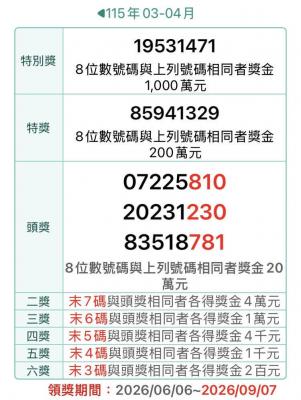
The Ministry of Finance this afternoon announced the winning numbers for the March-April uniform invoice lottery. The winning number for the NT$10 million (US$318,060) special prize is 19531471, and the winning number for the NT$2 million grand prize is 85941329. Three numbers were drawn for the NT$200,000 first prize: 07225810, 20231230 and 83518781. Those with receipts matching the last seven digits of any of the first-prize numbers will win the NT$40,000 second prize, while those matching the last six digits will win the NT$10,000 third prize. Those whose receipts match the last five digits of the first-prize numbers can claim the NT$4,000 fourth prize,

SIX SUBSIDIES: The monthly allowance for older farmers is to increase to NT$10,000, and NT$5,000 is to be given to homemakers under the national pension system, Lai said The government is to implement major welfare policies for disadvantaged groups, including raising the monthly allowance for older farmers to NT$10,000 and providing homemakers with NT$5,000 per month, President William Lai (賴清德) said yesterday. Lai made the remarks during a visit to Wangling Temple in Chiayi County, saying that the planned increases were being introduced amid economic growth and an increase in tax revenue. Touting a policy, in which the government plans to provide a monthly allowance of NT$5,000 for every child under the age of 18 in a bid to address Taiwan’s low birthrate, Lai said that if received for the
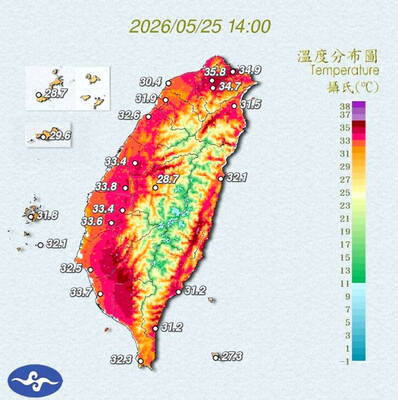
STAY COOL: The HPA recommended that people stay hydrated, use air-conditioning or fans while indoors, wear loose-fitting clothes and walk in the shade while outdoors Employers must implement measures such as installing cooling equipment, and providing drinking water and rest breaks for outdoor workers starting from Monday next week, the Taipei Department of Labor said on Sunday. Employers who fail to comply could face fines of NT$30,000 to NT$300,000 under the Occupational Safety and Health Act (職業安全衛生法), the department said. Businesses in Taipei employing fewer than 100 workers, as well as registered self-employed workers with labor insurance coverage, could receive on-site assessments and guidance from occupational safety consultants to help them apply for central government subsidies to implement or improve heat-protection measures, it said. Under the Ministry of

NATIONAL SECURITY: Authorities are working to confirm the identities of the military personnel involved and investigating possible illegal conduct and regulatory violations Authorities are probing possible national security implications after Kinmen police and immigration officers on Sunday found a Chinese woman allegedly posing as a tourist while engaging in prostitution involving more than 10 military personnel. The woman, surnamed Chen (陳), has since been deported, authorities said, adding that investigators are still working to confirm the identities of those implicated, as the records only listed code names and aliases. The case stemmed from a report received by the Kinmen District Prosecutors’ Office on Friday last week from the Jinhu Precinct of the Kinmen County Police Bureau. On Sunday, police, along with the National Immigration


 RSS
RSS