


Minister of Justice Luo Ying-shay (羅瑩雪) yesterday said there is a schedule for executions and there would be no rush to carry them out on the nation’s 42 death-row inmates.
“We do not have a timetable for carrying out capital punishment,” Luo said at a meeting with top judiciary officials to discuss the cases.
“The review process is ongoing for these cases,” Luo said at a press briefing after the event. “They will undergo review on a case-by-case basis. We have proceeded in a prudent manner and must ensure there has been no miscarriage of justice before going on to the next step.”

Photo: CNA
The three vice ministers of justice along with the head of the Supreme Prosecutors’ Office attended the meeting.
For cases where there is contention over possible wrongful conviction, Luo said they would be handed over to a “special review committee” formed in the past few months under the jurisdiction of the Supreme Prosecutors’ Office.
When asked whether the ministry would carry out executions before May 20, when her term as minister is to end as the new government takes over, Luo said there are no set dates and it would depend on the assessment of each case.
Amnesty International yesterday released a report on the global situation of capital punishment.
The report said in the past year, Taiwan executed six death-row inmates “based on political considerations,” saying the first of the six executions came in the aftermath of the killing of a schoolgirl in Taipei’s Beitou District (北投) in May last year.
Luo denied there was any political motivation in the execution.
“It was not so. People were making connections and putting meaning to something that had no direct relationship,” she said. “The ministry had to make many decisions over the course of a year. We get criticized for doing something and also get criticized for not doing things. Under such conditions, it is difficult for government officials to take action on any issue.”
“Despite voices in the international community advocating for the abolishment of capital punishment, the ministry has to listen to the opinion of the majority in this nation,” Luo said. “This is why we have not rushed to amend the law on capital punishment, since the situation is different in each nation.”
The minister also touted her five-day visit to China last week, where she held talks with top officials of Chinese judiciary agencies.
She said the Chinese agencies agreed to work closer with Taiwan to crack down on crime and promised to take up more active measures to assist in requests for repatriation of Taiwanese fugitives.

The military has spotted two Chinese warships operating in waters near Penghu County in the Taiwan Strait and sent its own naval and air forces to monitor the vessels, the Ministry of National Defense (MND) said. Beijing sends warships and warplanes into the waters and skies around Taiwan on an almost daily basis, drawing condemnation from Taipei. While the ministry offers daily updates on the locations of Chinese military aircraft, it only rarely gives details of where Chinese warships are operating, generally only when it detects aircraft carriers, as happened last week. A Chinese destroyer and a frigate entered waters to the southwest
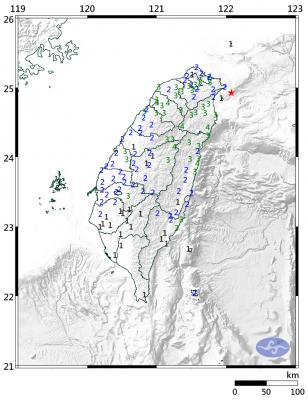
A magnitude 6.1 earthquake struck off the coast of Yilan County at 8:39pm tonight, the Central Weather Administration (CWA) said, with no immediate reports of damage or injuries. The epicenter was 38.7km east-northeast of Yilan County Hall at a focal depth of 98.3km, the CWA’s Seismological Center said. The quake’s maximum intensity, which gauges the actual physical effect of a seismic event, was a level 4 on Taiwan’s 7-tier intensity scale, the center said. That intensity level was recorded in Yilan County’s Nanao Township (南澳), Hsinchu County’s Guansi Township (關西), Nantou County’s Hehuanshan (合歡山) and Hualien County’s Yanliao (鹽寮). An intensity of 3 was

Japanese Prime Minister Sanae Takaichi’s comment last year on Tokyo’s potential reaction to a Taiwan-China conflict has forced Beijing to rewrite its invasion plans, a retired Japanese general said. Takaichi told the Diet on Nov. 7 last year that a Chinese naval blockade or military attack on Taiwan could constitute a “survival-threatening situation” for Japan, potentially allowing Tokyo to exercise its right to collective self-defense. Former Japan Ground Self-Defense Force general Kiyofumi Ogawa said in a recent speech that the remark has been interpreted as meaning Japan could intervene in the early stages of a Taiwan Strait conflict, undermining China’s previous assumptions
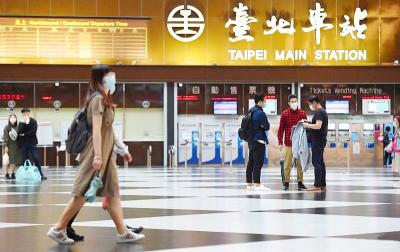
Taiwan Railways Corp (TRC) today announced that Shin Kong Mitsukoshi has been selected as the preferred bidder to operate the Taipei Railway Station shopping mall, replacing the current operator, Breeze Development Co Ltd. Among eight qualified firms that delivered presentations and were evaluated by a review committee, Shin Kong Mitsukoshi was ranked first, while Breeze was named the runner-up, the rail company said in a statement. Contract negotiations are to proceed in accordance with regulations, it said, adding that if negotiations with the top bidder fail, it could invite the second-ranked applicant to enter talks. Breeze in a statement today expressed doubts over


 RSS
RSS