


The US should sell Taiwan the weapons it requires to deter Chinese aggression, former National Security Council deputy secretary-general Parris Chang (張旭成) said on Wednesday in Washington.
“Taiwan has lots of defense needs in the face of the growing threat from China,” he told a roundtable discussion hosted by the Foundation for Defense of Democracies.
Chang was part of a delegation of senior former officials from the Democratic Progressive Party (DPP) visiting the US for talks with members of the US Congress, think tanks and foreign policy experts.
“We have heard lots of talk about US concerns over Taiwan’s defense needs, but we need action,” Chang said.
He said it is important for the US to know that China is not its friend.
Chang called for robust US-Taiwan defense cooperation so that Taiwan “can truly be free from intimidation.”
He pleaded for the administration of US President Barack Obama to sell Taiwan advanced fighter jets, diesel-electric submarines and improved missile technology.
Chang also urged Washington to improve and increase high-level military dialogue between the two nations.
Chang said he acknowledges that the US has stopped making diesel-electric submarines, but added: “Where there is a will, there is a way.”
He said the US could buy submarines from Japan, upgrade them, equip them with new systems and then sell them to Taiwan.
It would take a decade for Taiwan to build its own submarines, while going the Japan route might only take four years, Chang said.
“We really need this deterrent weapon and we hope our message will get to the [US President Barack Obama’s] administration, because this is the one thing that would show the US really cares, is trying to help and is not just talking,” he said.
Chang said the delegation, which includes former vice president Annette Lu (呂秀蓮) and former minister of national defense Michael Tsai (蔡明憲), has already talked with members of the US Congress, urging them to attend the inauguration of president-elect Tsai Ing-wen (蔡英文).
“We would like to see the Obama administration send a high-ranking delegation to attend the inauguration — it would mean a great deal to Taiwan,” he said.
Chang said that Taiwan was facing “considerable pressure” from China in the wake of Tsai’s election.
“The Chinese want her to say in her inaugural speech that she will accept the so-called ‘1992 consensus’ and will accept the ‘one China’ principle — this I am sure she will not do,” he said.

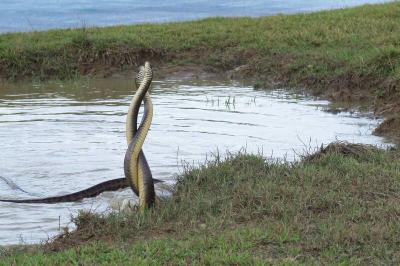
Kenting National Park service technician Yang Jien-fon (楊政峰) won a silver award in World Grand Prix Photography Awards Spring Season for his photograph of two male rat snakes intertwined in combat. Yang’s colleagues at Kenting National Park said he is a master of nature photography who has been held back by his job in civil service. The awards accept entries in all four seasons across six categories: architectural and urban photography, black-and-white and fine art photography, commercial and fashion photography, documentary and people photography, nature and experimental photography, and mobile photography. Awards are ranked according to scores and divided into platinum, gold and
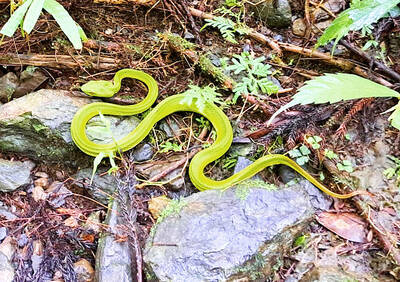
More than half of the bamboo vipers captured in Tainan in the past few years were found in the city’s Sinhua District (新化), while other districts had smaller catches or none at all. Every year, Tainan captures about 6,000 snakes which have made their way into people’s homes. Of the six major venomous snakes in Taiwan, the cobra, the many-banded krait, the brown-spotted pit viper and the bamboo viper are the most frequently captured. The high concentration of bamboo vipers captured in Sinhua District is puzzling. Tainan Agriculture Bureau Forestry and Nature Conservation Division head Chu Chien-ming (朱健明) earlier this week said that the
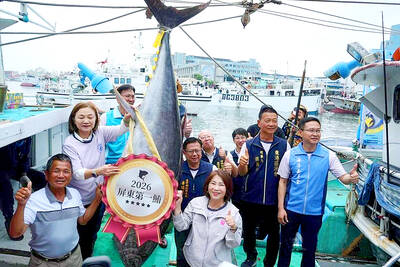
The first bluefin tuna of the season, brought to shore in Pingtung County and weighing 190kg, was yesterday auctioned for NT$10,600 (US$333.5) per kilogram, setting a record high for the local market. The auction was held at the fish market in Donggang Fishing Harbor, where the Siaoliouciou Island-registered fishing vessel Fu Yu Ching No. 2 delivered the “Pingtung First Tuna” it had caught for bidding. Bidding was intense, and the tuna was ultimately jointly purchased by a local restaurant and a local company for NT$10,600 per kilogram — NT$300 ,more than last year — for a total of NT$2.014 million. The 67-year-old skipper
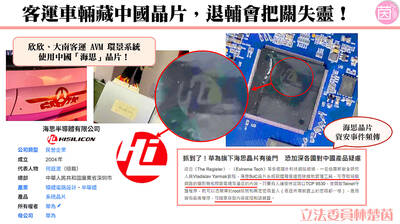
BREACH OF CONTRACT: The bus operators would seek compensation and have demanded that the manufacturer replace the chips with ones that meet regulations Two bus operators found to be using buses with China-made chips are to demand that the original manufacturers replace the systems and provide compensation for breach of contract, the Veterans Affairs Council said yesterday. Democratic Progressive Party Legislator Michelle Lin (林楚茵) yesterday said that Da Nan Bus Co and Shin-Shin Bus Co Ltd have fielded a total of 82 buses that are using Chinese chips. The bus models were made by Tron-E, while the systems provider was CYE Electronics, Lin said. Lin alleged that the buses were using chips manufactured by Huawei subsidiary HiSilicon Co, which presents a national security risk if the


 RSS
RSS