


A proposed bill to address the Chinese Nationalist Party’s (KMT) allegedly illegal party assets is in fact a special draft act intended to address injustices committed in an era of autocratic rule, academics said in response to the KMT’s claim that the legislation was “specifically targeting” the party.
The draft legislation on oversight and management of political party assets, along with the KMT’s version, passed the legislature’s first reading and was referred to a legislative committee last week.
New Power Party (NPP) Legislator Freddy Lim (林昶佐) held a public hearing, in which academics and experts debated the bill.
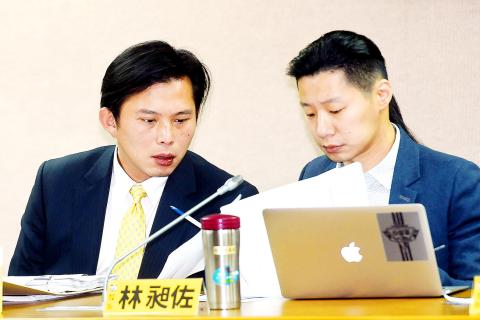
Photo: Fang Pin-chao, Taipei Times
Chinese Culture University Department of Law director Hsu Hui-feng (許惠峰) said Article 4, Clause 5 of the KMT version — which stipulates that stock of all party-owned or businesses in which a party has invested, as well as funds received from sales of formerly owned businesses, should be considered “legal funding” — was a farce.
If the KMT version were to be accepted, it would be a “non-transitional justice” law, as it would leave nothing for the nation to demand as compensation, Hsu said, adding that the KMT’s attempt to blatantly deceive the public should be condemned.
National Dong Hwa University professor Shih Cheng-feng (施正鋒) said that the draft “targets” the KMT, because there are no other Taiwanese political parties like it.
The KMT allegedly obtained its party assets through the theft of former Japanese-owned corporations, the expropriation of Taiwanese property and, in the case of its outlying organizations, outright takeovers, Shih added.
There is a strong public expectation for transitional justice, making this the best time to handle the KMT party assets issue, Shih said.
“If the Democratic Progressive Party (DPP) does not handle the issue now, [president-elect] Tsai Ing-wen (蔡英文) might not get a second term as president,” Shih said.
As creation of an ad hoc committee to deal with ill-gotten party assets in the Legislative Yuan might create distrust between the two major political parties, the Presidential Office would probably provide a better platform for the committee, Shih said.
The president could appoint nonpartisan professionals to investigate the issue, which would help to mend fences between the DPP and KMT, Shih added.
Lim said that the draft legislation applied to all registered political parties, adding that no party could compare with the KMT, which seized national and private property and inappropriately managed or invested in various business.
NPP Legislator Huang Kuo-chang (黃國昌) said the current version of the draft act only defines “KMT-linked organizations,” but what also need to be added are the process of how to identify those organizations and possible punishments for them.
Huang also said the committee should be authorized to offer immunity or rewards to former civil servants who are willing to cooperate with investigations, adding that people such as Liu Tai-ying (劉泰英), an aide to former president Lee Teng-hui (李登輝) who was convicted of embezzlement of public property, would be of immeasurable value to investigators.
Investigations should be expanded to cover private sector staff of former party-owned businesses, Huang said, adding that in many cases, these individuals would know more about companies’ finances.
Liu, a former KMT member who was appointed by the party to chair the China Development Industrial Bank, was rumored to be the party’s main go-to person for finance.
The bank, founded in 1959 in a joint venture with the World Bank and the government’s Ministry of Economic Affairs, was the first bank founded with direct investment and corporate financing in Taiwan.

FUKUOKA SITUATION: Japanese media reported that the pathogen is expected to be identified by the summer, while the CDC downplayed the idea that it was hMPV A “mysterious cold-like illness” reported in Japan’s Fukuoka Prefecture does not seem to be a new disease, but Japanese authorities have been asked about the situation, the Centers for Disease Control (CDC) said yesterday. The Fukuoka Prefectural Medical Association on Wednesday told a news conference that a “mystery cold” that has become a hot topic on social media is “highly likely to be caused by some kind of viral infection,” Japan’s KBC News reported. “Many people are experiencing symptoms starting with a sore throat, followed by a runny nose, phlegm and a severe cough,” KBC News reported, citing association officials. Health authorities are

Nvidia Corp CEO Jensen Huang (黃仁勳) arrived in Taiwan yesterday ahead of upcoming AI and technology events, saying he plans to meet with clients and Taiwan Semiconductor Manufacturing Co Chairman C.C. Wei (魏哲家) during his visit. After landing at Taipei Songshan Airport, Huang posed for photos with fans and handed out Yakult drinks to reporters and supporters waiting at the scene, saying he has “a lot to do” during the trip. Asked about reports that Nvidia’s planned headquarters site in Taipei’s Beitou Shilin Technology Park could break ground on May 27, Huang said that if the company holds an event, he would

The Ministry of Finance this afternoon announced the winning numbers for the March-April uniform invoice lottery. The winning number for the NT$10 million (US$318,060) special prize is 19531471, and the winning number for the NT$2 million grand prize is 85941329. Three numbers were drawn for the NT$200,000 first prize: 07225810, 20231230 and 83518781. Those with receipts matching the last seven digits of any of the first-prize numbers will win the NT$40,000 second prize, while those matching the last six digits will win the NT$10,000 third prize. Those whose receipts match the last five digits of the first-prize numbers can claim the NT$4,000 fourth prize,
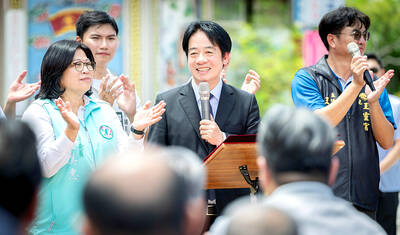
SIX SUBSIDIES: The monthly allowance for older farmers is to increase to NT$10,000, and NT$5,000 is to be given to homemakers under the national pension system, Lai said The government is to implement major welfare policies for disadvantaged groups, including raising the monthly allowance for older farmers to NT$10,000 and providing homemakers with NT$5,000 per month, President William Lai (賴清德) said yesterday. Lai made the remarks during a visit to Wangling Temple in Chiayi County, saying that the planned increases were being introduced amid economic growth and an increase in tax revenue. Touting a policy, in which the government plans to provide a monthly allowance of NT$5,000 for every child under the age of 18 in a bid to address Taiwan’s low birthrate, Lai said that if received for the


 RSS
RSS