


The Chinese Nationalist Party (KMT) yesterday expressed regret over an arson attack targeting its headquarters in Taipei in the early hours of the morning, saying the KMT has made a great effort to help soothe the pains of families of the 228 Incident victims.
The 228 Incident refers to an uprising that began on Feb. 27, 1947, and was violently suppressed by the then-KMT government and eventually led to the White Terror era.
“We regret the occurrence of such violence on a day that is marred by historical trauma,” KMT Culture and Communications Committee director-general Lin Yi-hua (林奕華) said in a news release.
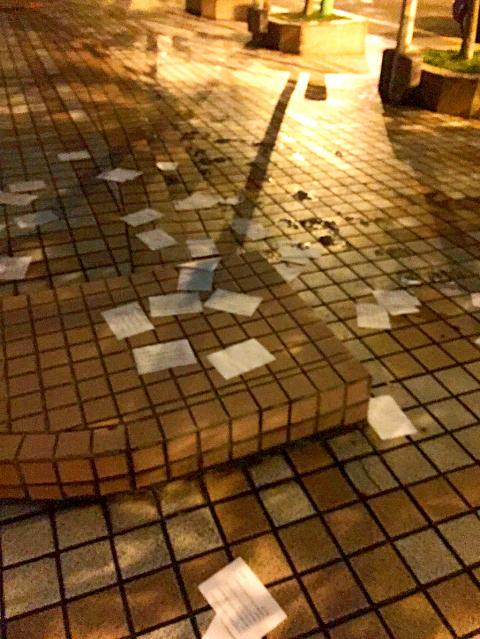
Photo: CNA, courtesy of a member of the public
Lin said that for many years, the KMT and President Ma Ying-jeou (馬英九) have endeavored to assuage the sorrow and heal the pains of those affected by the 228 Incident, and have pushed for ethnic rapprochement.
Taiwan has freedom of expression, Lin said, adding that such aggressive behavior would not only be spurned by people, but also galvanize greater hatred and ethnic division.
“Nevertheless, the KMT will never forget the lessons of the 228 Incident and will continue in its endeavor to promote social harmony,” Lin said.
Lin made the remarks after a motorcyclist allegedly threw four Molotov cocktails and dozens of fliers toward the square outside KMT headquarters at about 3:50am.
According to surveillance footage provided by the party, only one of the Molotov cocktails exploded, causing a small fire, which was extinguished by the building’s security guards.
The fliers scattered on the ground said: “The murderous KMT and the Republic of China [ROC] should not exist in Taiwan. The KMT and the US government should take full responsibility for Taiwan’s massacres and political persecution.”
“The KMT must return all its properties, lands and ill-gotten gains to Taiwanese. The party and the ROC must face the consequences of their actions and be kicked out of this sacred Taiwan,” the fliers said.
Police were investigating the crime as of press time last night.
KMT Acting Chairperson Huang Min-hui (黃敏惠) also issued a statement denouncing the attempted arson attack, saying the last thing people want to see is someone taking advantage of the nation’s historical wounds to aggravate social division.
“We should remember this painful history, learn from the lesson of blood and tears, and march forward in solidarity and harmony,” Huang said.
Former deputy legislative speaker Hung Hsiu-chu (洪秀柱), who is vying for KMT chairpersonship in the Mar. 26 by-election, said the KMT would not succumb to violent threats of any kind.
“I urge police to apprehend the culprit as soon as possible. I do not believe any conduct aimed at spreading hatred under the pretext of ‘transitional justice’ would be accepted by Taiwanese,” Hung said.
Hung said only through understanding, tolerance and respect could Taiwanese head toward a brighter future.

LOUD AND PROUD Taiwan might have taken a drubbing against Australia and Japan, but you might not know it from the enthusiasm and numbers of the fans Taiwan might not be expected to win the World Baseball Classic (WBC) but their fans are making their presence felt in Tokyo, with tens of thousands decked out in the team’s blue, blowing horns and singing songs. Taiwanese fans have packed out the Tokyo Dome for all three of their games so far and even threatened to drown out home team supporters when their team played Japan on Friday. They blew trumpets, chanted for their favorite players and had their own cheerleading squad who dance on a stage during the game. The team struggled to match that exuberance on the field, with
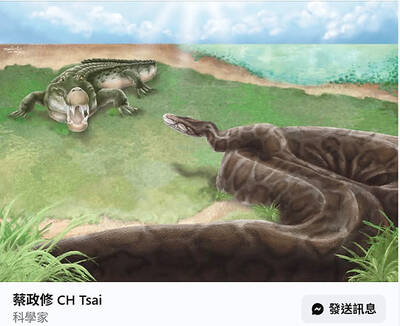
Taiwanese paleontologists have discovered fossil evidence that pythons up to 4m long inhabited Taiwan during the Pleistocene epoch, reporting their findings in the international scientific journal Historical Biology. National Taiwan University (NTU) Institute of Ecology and Evolutionary Biology associate professor Tsai Cheng-hsiu (蔡政修) led the team that discovered the largest snake fossil ever found in Taiwan. The single trunk vertebra was discovered in Tainan at the Chiting Formation, dated to between 400,000 and 800,000 years ago in the Middle Pleistocene, the paper said. The area also produced Taiwan’s first avian fossil, as well as crocodile, mammoth, saber-toothed cat and rhinoceros fossils, it said. Discoveries

Taiwanese paleontologists have discovered fossil evidence that pythons up to 4m long inhabited Taiwan during the Pleistocene epoch, reporting their findings in the international scientific journal Historical Biology. National Taiwan University (NTU) Institute of Ecology and Evolutionary Biology associate professor Tsai Cheng-hsiu (蔡政修) led the team that discovered the largest snake fossil ever found in Taiwan. A single trunk vertebra was discovered in Tainan at the Chiting Formation, dated to between 800,000 to 400,000 years ago in the Middle Pleistocene, the paper said. The area also produced Taiwan’s first avian fossil, as well as crocodile, mammoth, sabre-toothed cat and rhinoceros fossils, it said. Discoveries

Whether Japan would help defend Taiwan in case of a cross-strait conflict would depend on the US and the extent to which Japan would be allowed to act under the US-Japan Security Treaty, former Japanese minister of defense Satoshi Morimoto said. As China has not given up on the idea of invading Taiwan by force, to what extent Japan could support US military action would hinge on Washington’s intention and its negotiation with Tokyo, Morimoto said in an interview with the Liberty Times (sister paper of the Taipei Times) yesterday. There has to be sufficient mutual recognition of how Japan could provide


 RSS
RSS