


Southern Taiwan saw very poor air quality yesterday due to pollution from China, with the key indicator of fine particulate matter smaller than 2.5 micrometers (PM 2.5) hitting the hazardous level of 10 in Kaohsiung, the Environmental Protection Administration (EPA) said.
As of 10am, concentrations of PM2.5 reached level 8 in Tainan and Pingtung County and 10 in Kaohsiung mainly because a cold air mass has brought a concentration of dust from China since Saturday, the EPA said.
Level 10 PM2.5 concentrations exceed 71 micrograms per cubic meter and are considered extremely high, but measurements above level 7 are deemed severe enough to cause tangible discomfort and health problems, the agency said.
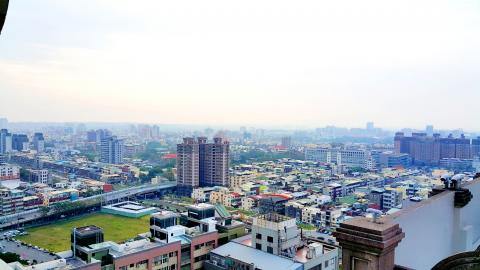
Photo: Chen Wen-chan, Taipei Times
Given the poor air quality, the elderly and those with chronic lung or heart diseases should avoid prolonged or strenuous outdoor physical activity, the EPA said.
Meanwhile, a physician at Chi Mei Medical Center said seven of the nation’s top 10 causes of death by cancer are associated with air pollution.
Hsieh Yi-ju (謝依儒) said the source of PM2.5 can be from natural activities such as volcanic eruptions, forest fires or rock weathering; or from human activities such as emissions from motor vehicles, factories and power plants, or burning, cooking and smoking.
More than 30 percent of the nation’s PM2.5 is brought in from across national borders, including industrial pollution and sand storms from China, Hsieh said, adding that these particles are so small that they can bypass the nose and throat and penetrate deeper into the lungs and bloodstream, bringing toxic substances into the body.
He said PM2.5 matter mainly affects the respiratory tract, triggering symptoms including coughing, breathing difficulties, a decline in lung function, asthma, chronic inflammation or a weakened immune system.
However, PM2.5 matter also affects the cardiovascular system, contributing to chronic inflammation, autonomic nervous system disorders and arrhythmias, Hsieh said, adding that studies showed that it effects the brain too, leading to higher risks of suffering a stoke or developing dementia.
Yu Chia-hang (余佳航), a doctor of traditional Chinese medicine at the Ministry of Health and Welfare’s Sinying Hospital, said vegetables and herbs classified by traditional Chinese medical theory as “white foods” might alleviate discomfort caused by PM2.5 pollution.
Exposure to heavy concentrations PM2.5 frequently caused symptoms such as watery eyes, eye pains, coughing, sneezing, runny nose, nasal congestion, throat pain and poor sleep, he said.
To reduce symptoms of exposure to PM2.5 pollution, Yu said people should incorporate medicinal vegetables and herbs classified as “white foods” in their diets because these foods are believed to bolster lung health.
“White foods” include Asian pears, white mu-err mushrooms and the fungus Wolfiporia extensa; lotus seeds, prickly water lily seeds and coix seeds; and the Chinese white radish, cinnamon vines and lilium bulbs, Yu said.
Yu said that only respirators or masks with a N95 rating or higher offer any protection against PM2.5 pollution, and that users should fit the masks snugly to the face without leaving gaps.
Users must replace the mask every four hours to avoid inhaling harmful quantities of fine particles accumulated on the mask, he added.
Concern about the smoke from burning mugwort in traditional Chinese medical therapy is misplaced because recent research suggests that mugwort smoke in a reasonably ventilated traditional clinic is not a significant health risk, while the medical benefits of mugwort smoke as an antioxidant is supported by several studies, Yu said.
Additional reporting by CNA

NATIONAL SECURITY: Authorities are working to confirm the identities of the military personnel involved and investigating possible illegal conduct and regulatory violations Authorities are probing possible national security implications after Kinmen police and immigration officers on Sunday found a Chinese woman allegedly posing as a tourist while engaging in prostitution involving more than 10 military personnel. The woman, surnamed Chen (陳), has since been deported, authorities said, adding that investigators are still working to confirm the identities of those implicated, as the records only listed code names and aliases. The case stemmed from a report received by the Kinmen District Prosecutors’ Office on Friday last week from the Jinhu Precinct of the Kinmen County Police Bureau. On Sunday, police, along with the National Immigration

GLOBALGIVING: ‘ Caving to external pressure is not acceptable for an organization that has cultivated justice reform and human rights for 30 years,’ one NGO said A slew of non-government organizations (NGOs) have withdrawn from the GlobalGiving fundraising platform after it announced it would use “Chinese Taipei” instead of “Taiwan” from next month. The Taiwan Good Rice Association wrote on Facebook on Friday that it was informed on April 28 via a teleconference call of the change, which was made because the platform wanted to operate in China. Taiwan Good Rice is to terminate all cooperative relationships with GlobalGiving in response to the platform’s “unilateral and non-negotiable” decision to remove references to Taiwan, the NGO said. “Taiwan is in the official name of Taiwan Good Rice Association and the

HEAVY WEATHER: Typhoon Jangmi is due to crash straight into the Ryukyus as airlines look to shift flights to larger aircraft or cancel flights to Okinawa entirely Taiwan’s international air carriers announced flight adjustments over the weekend as Typhoon Jangmi is forecast to hit the Ryukyu Islands today and tomorrow. The Central Weather Administration (CWA) upgraded Jangmi from a tropical storm to a typhoon at 8am yesterday, with the eye located 580km south of Naha city. It was moving north at 19kph. Today, China Airlines’ CI-120, CI-121, CI-122 and CI-123 flights between Taoyuan and Naha, Okinawa, have been canceled as well as CI-132 and CI-133 between Kaohsiung and Naha. EVA Air’s BR-112, BR-113, BR-186 and BR-185 flights between Taoyuan and Naha are also canceled. Low-cost carrier Tigerair Taiwan canceled IT-230,

Chinese Nationalist Party (KMT) Chairwoman Cheng Li-wun (鄭麗文) yesterday briefed her party’s Central Standing Committee regarding her scheduled visit to the US between Monday next week and June 16, saying that her purpose would be to persuade the US that the Republic of China (ROC) Constitution was a “one China” constitution that would foster stable and peaceful cross-strait relations. The ROC Constitution is the most important defense for all Taiwanese citizens, as it upholds our democracy and has contributed to our robust economy, which aligns with international and US interests, she said. “We would not be troublemakers and drag the US under,”


 RSS
RSS