


Sun Yat-sen’s (孫逸仙) designation as the nation’s “founding father” should be dropped, Democratic Progressive Party Legislator Gao Jyh-peng (高志鵬) said yesterday, pledging to push for legislation to remove the legal requirement that Sun’s portrait be displayed in public buildings.
Gao said that Sun’s title as the nation’s “founding father” is a remnant of one-party rule under the Chinese Nationalist Party’s (KMT) authoritarian regime and ran against democratic principles.
Legal mentions of the designation are seen only in connection with the national flag, he said, citing the National Emblem and National Flag of the Republic of China Act (中華民國國徽國旗法) and the Oath Act (宣誓條例).
The National Emblem Act states that the national flag should be placed “above the portrait of the father of the nation” in government buildings, while the Oath Act mandates that officials taking the oath of office should face both the national flag and the “portrait of the father of the nation.”
While the flag is a symbol of the nation whose status is mandated in the Constitution, Sun’s status as “founding father” was crafted by Chiang Kai-shek (蔣介石) as a tool to justify the legitimacy of his regime, Gao said, questioning why leaders should be obligated to bow before something that has no relation to Taiwan’s modern democratic society.
While requirements mandating that portraits of Chiang and his son, former president Chiang Ching-kuo (蔣經國), be displayed in schools were abolished in 2002, the KMT had previously blocked legislation to drop requirements to display Sun’s portrait, Gao said.
Lee Hsiao-feng (李筱峰), a professor at National Taipei University of Education’s Graduate School of Taiwanese Culture, echoed Gao’s proposal, saying that Sun was only designated as the “founding father” in 1940 as part of an executive order intended to whitewash Chiang Kai-shek’s distortion of history and bolster his claim of being Sun’s successor.
While Sun made an undeniable contribution to the 1911 Xinhai Revolution that overthrew the Qing Dynasty, the revolution’s success also depended on many other people, Lee said, adding that Sun should be removed from the “cult of personality” built around him by Chiang Kai-shek.
Earlier this month, Kaohsiung Municipal Senior High School announced it would no longer make its students bow to portraits of Sun and the national flag in its end-of-semester ceremony.
Bowing three times to the flag and Sun’s portrait during school ceremonies has been a tradition for students in elementary, junior-high and high schools.
The school’s principal said the move was not politically motivated, while a student council called it a step toward depoliticizing the campus and achieving transitional justice.
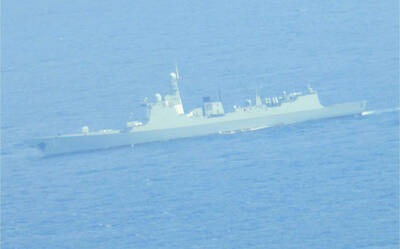
The military has spotted two Chinese warships operating in waters near Penghu County in the Taiwan Strait and sent its own naval and air forces to monitor the vessels, the Ministry of National Defense (MND) said. Beijing sends warships and warplanes into the waters and skies around Taiwan on an almost daily basis, drawing condemnation from Taipei. While the ministry offers daily updates on the locations of Chinese military aircraft, it only rarely gives details of where Chinese warships are operating, generally only when it detects aircraft carriers, as happened last week. A Chinese destroyer and a frigate entered waters to the southwest
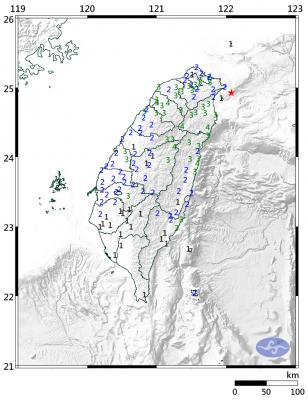
A magnitude 6.1 earthquake struck off the coast of Yilan County at 8:39pm tonight, the Central Weather Administration (CWA) said, with no immediate reports of damage or injuries. The epicenter was 38.7km east-northeast of Yilan County Hall at a focal depth of 98.3km, the CWA’s Seismological Center said. The quake’s maximum intensity, which gauges the actual physical effect of a seismic event, was a level 4 on Taiwan’s 7-tier intensity scale, the center said. That intensity level was recorded in Yilan County’s Nanao Township (南澳), Hsinchu County’s Guansi Township (關西), Nantou County’s Hehuanshan (合歡山) and Hualien County’s Yanliao (鹽寮). An intensity of 3 was
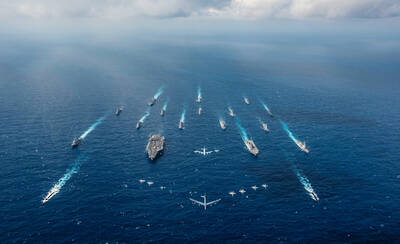
Japanese Prime Minister Sanae Takaichi’s comment last year on Tokyo’s potential reaction to a Taiwan-China conflict has forced Beijing to rewrite its invasion plans, a retired Japanese general said. Takaichi told the Diet on Nov. 7 last year that a Chinese naval blockade or military attack on Taiwan could constitute a “survival-threatening situation” for Japan, potentially allowing Tokyo to exercise its right to collective self-defense. Former Japan Ground Self-Defense Force general Kiyofumi Ogawa said in a recent speech that the remark has been interpreted as meaning Japan could intervene in the early stages of a Taiwan Strait conflict, undermining China’s previous assumptions
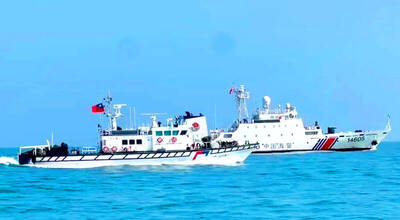
Instead of focusing solely on the threat of a full-scale military invasion, the US and its allies must prepare for a potential Chinese “quarantine” of Taiwan enforced through customs inspections, Stanford University Hoover fellow Eyck Freymann said in a Foreign Affairs article published on Wednesday. China could use various “gray zone” tactics in “reconfiguring the regional and ultimately the global economic order without a war,” said Freymann, who is also a nonresident research fellow at the US Naval War College. China might seize control of Taiwan’s links to the outside world by requiring all flights and ships entering or leaving Taiwan


 RSS
RSS