


The first session of the ninth legislature convened yesterday, with 113 newly elected and re-elected lawmakers reporting for duty at the Legislative Yuan.
Many legislators waited at the Legislative Yuan’s front door before it opened at 8am to be the first to report for work, including Democratic Progressive Party (DPP) legislators Huang Wei-cher (黃偉哲) and Chen Ou-po (陳歐珀).
First to arrive was DPP Legislator Cheng Yun-peng (鄭運鵬), who entered the Legislative Yuan via a side door without walking the red carpet lined with police officers and reporters.
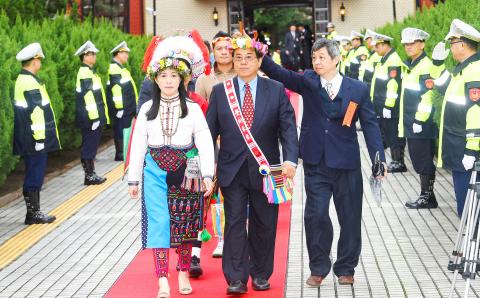
Photo: Chang Chia-ming, Taipei Times
Cheng said he had not intended to be the first legislator to report for duty.
Some New Power Party (NPP) legislators attracted attention because of their involvement in the 2014 Sunflower movement, which saw protesters occupy the Legislative Yuan’s main chamber in protest against the government’s handling of a cross-strait service trade agreement.
“In 2014, there were many friends who charged into this building because something happened inside that broke the hearts of Taiwanese. After two years, we are back again, entrusted with a commission to change this place and ensure that nothing similar happens ever again,” said NPP executive chairman Huang Kuo-chang (黃國昌), referring to the controversial passage of service trade pacts through the Legislative Yuan’s Home Affairs Committee.
Huang walked the carpet with his wife and daughter and was welcomed by the police.
NPP legislators Hsu Yung-ming (徐永明), Kawlo Iyun Pacidal and Hung Tzu-yung (洪慈庸) appeared with their families, with Hung saying: “Legislative reform and transparency are our top priorities.”
NPP Legislator Freddy Lim (林昶佐) was accompanied by his assistant, Sunflower movement activist Wu Cheng (吳崢).
DPP legislators Cheng Li-chun (鄭麗君), Chiu Yi-ying (邱議瑩) and Hsiao Bi-khim (蕭美琴), collectively nicknamed “the SHE of the DPP” by Internet users after the pop girl band, made an appearance together.
Hsiao said she was extremely grateful for being able to return to the Legislative Yuan, “especially in the capacity of Hualien representative,” as she competed in a difficult electoral district in the Jan. 16 legislative elections.
DPP Legislator Tsai Yi-yu (蔡易餘) walked the carpet with his mother and grandmother, saying he wore a newly made suit to welcome a new job, while DPP Legislator Karen Yu (余宛如) arrived with her baby.
Chinese Nationalist Party (KMT) Legislator Wang Jin-pyng (王金平) said his mood remained the same, despite having stepped down from the post of legislative speaker, which he had filled for 17 years, adding that he would make a different contribution in his new role.
KMT Legislator Chen Chao-ming (陳超明) arrived with his centenarian mother, saying he was thankful for his mother’s support during his decades-long political career.
Accompanied by his parents, KMT Legislator Apollo Chen (陳學聖) said that although the KMT secured only 35 seats in the legislature, the party would still exercise its remaining influence to protect the public.
KMT Legislator Ko Chih-en (柯志恩) showed up with her former students from Tamkang University, saying that young people’s support is what the KMT needs most, while KMT Legislator Chiang Wan-an (蔣萬安) arrived with his wife and son.
KMT Legislator Hsu Chen-wei (徐榛蔚) walked the carpet with her ex-husband, Hualien County Commissioner Fu Kun-chi (傅崑萁), with Fu saying he was glad to visit the Legislative Yuan as a retired lawmaker and a family member of a new legislator, adding that Hsu Chen-wei would outperform him.
Additional reporting by Abraham Gerber and Chang Hsiao-ti


UPGRADE: The Kang Ding-class frigate is replacing its Chaparall missiles with Tien Chien II and Hua Yang VLS, which would provide it with long-range, 360° air defense Taiwan plans to produce 1,200 to 1,376 Hai Chien II missiles (海劍二, Sea Sword II) — also known as TC-2N — to serve as the standard air defense system of the navy’s surface combatant fleet, a source said yesterday. Last week, the Hai Chien II, the naval version of the Tien Kung II missile (天劍二, Sky Sword II), completed a live-fire test in waters off the National Chungshan Institute of Science and Technology’s Jiupeng facility (九鵬) in Pingtung County’s Manjhou Township (滿州). The MIM72 Chaparral and other dated air defense missiles that currently arm Taiwanese ships have inadequate range to combat Chinese

REASONS FOR TRAVEL: An assistant professor said that proposed amendments to penalize drivers if they used drugs overseas would not deter people from traveling People who operate a motor vehicle under the influence of marijuana would have their driver’s license revoked, even if they used the substance while overseas, the Ministry of Transportation and Communications said yesterday, citing proposed amendments to the Road Traffic Management and Penalty Act (道路交通管理處罰條例). The amendments would also authorize the government to revoke the licenses of people determined to have used Category 1 or Category 2 narcotics, even if they were not operating a vehicle while under the influence of drugs, as well as ban them from taking the license test for three years, the ministry said. People aged 18 or

Johanne Liou (劉喬安), a Taiwanese woman who shot to unwanted fame during the Sunflower movement protests in 2014, returned to Taiwan last night after being deported from the US. She is to stand trial in Taiwan for charges involving embezzlement, fraud and drug crimes. The Criminal Investigation Bureau (CIB) said it took her into custody at Taiwan Taoyuan International Airport and would first question her before transferring her to the New Taipei District Prosecutors’ Office. She was arrested upon disembarking a flight from San Francisco that landed shortly before 7pm. Liou absconded to the US in 2019 after jumping bail
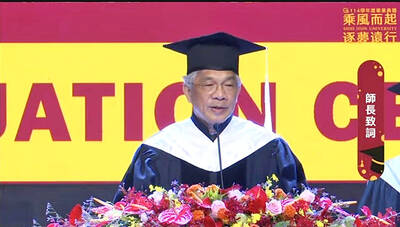
Shih Hsin University President Chen Ching-he (陳清河) yesterday issued a public apology for comments made in his commencement speech last week, stating that he has asked the school to suspend his duties and halt his wages for two months as a show of contrition. At the commencement ceremony on May 30, Chen said, “If you don’t manage your time well, or your own emotions, or your health, then I am telling every one of you — put a quick end to ‘you,’ because the world has no need for ‘you.’” The comments have sparked significant controversy online, and Chen through an open


 RSS
RSS