


Taiwan has achieved its highest-ever score in the annual Index of Economic Freedom released on Friday, remaining the 14th-freest economy in the world, the same position it occupied in the previous year’s ranking.
The nation is ranked fifth out of 42 economies in the Asia-Pacific region and has improved over the past year in seven of the 10 categories measured by the index.
“Despite progress, however, a relatively high level of perceived corruption and a rigid labor market still restrain Taiwan’s overall economic freedom,” the report said.
Published and compiled by the Heritage Foundation and the Wall Street Journal, the report has attracted global attention for more than 20 years.
The global average score for economic freedom is 60.4 out of 100, with Taiwan scoring above that figure with 75.1.
Among the 178 nations ranked, scores improved for 101 nations and declined for 73, while 90 nations were found to provide a moderate or better level of economic freedom.
The number of people living in economically “unfree” nations remains high — 4.5 billion, or 65 percent of the world’s population. More than half of them live in just two countries, China and India.
“The fundamental relationship between economic freedom and prosperity is readily apparent worldwide,” the report said. “No matter the region, per capita income levels are consistently higher in countries that are economically freer.”
Hong Kong and Singapore were ranked first and second respectively for the 21st consecutive year, followed by New Zealand, Australia and Switzerland.
The index evaluates nations in four broad policy areas: Rule of law, limited government, regulatory efficiency and open markets.
There are 10 specific categories: Property rights, freedom from corruption, fiscal freedom, government spending, business freedom, labor freedom, monetary freedom, trade freedom, investment freedom and financial freedom.
In Taiwan, connections remain between politics and big business, and corruption is still a problem, the report said.
“Economic freedom is the fundamental right of every human to control his or her own labor and property,” the report said.
“In an economically free society, individuals are free to work, produce, consume and invest in any way they please,” it added.
Prudent macroeconomic policy within a stable legal and monetary environment has been key to rising levels of economic freedom in Taiwan over the past five years, the report said.
“Commitment to structural reforms and openness to global commerce have enabled Taiwan to advance far into the ‘mostly free’ category,” it said. “Taiwan’s export-driven, dynamic economy benefits from a well-functioning legal framework and a tradition of private-sector entrepreneurship.”
“The efficient business environment is facilitated by a competitively low corporate tax rate and the elimination of minimum capital requirements for incorporating a company,” the report said.

FUKUOKA SITUATION: Japanese media reported that the pathogen is expected to be identified by the summer, while the CDC downplayed the idea that it was hMPV A “mysterious cold-like illness” reported in Japan’s Fukuoka Prefecture does not seem to be a new disease, but Japanese authorities have been asked about the situation, the Centers for Disease Control (CDC) said yesterday. The Fukuoka Prefectural Medical Association on Wednesday told a news conference that a “mystery cold” that has become a hot topic on social media is “highly likely to be caused by some kind of viral infection,” Japan’s KBC News reported. “Many people are experiencing symptoms starting with a sore throat, followed by a runny nose, phlegm and a severe cough,” KBC News reported, citing association officials. Health authorities are

Nvidia Corp CEO Jensen Huang (黃仁勳) arrived in Taiwan yesterday ahead of upcoming AI and technology events, saying he plans to meet with clients and Taiwan Semiconductor Manufacturing Co Chairman C.C. Wei (魏哲家) during his visit. After landing at Taipei Songshan Airport, Huang posed for photos with fans and handed out Yakult drinks to reporters and supporters waiting at the scene, saying he has “a lot to do” during the trip. Asked about reports that Nvidia’s planned headquarters site in Taipei’s Beitou Shilin Technology Park could break ground on May 27, Huang said that if the company holds an event, he would

The Ministry of Finance this afternoon announced the winning numbers for the March-April uniform invoice lottery. The winning number for the NT$10 million (US$318,060) special prize is 19531471, and the winning number for the NT$2 million grand prize is 85941329. Three numbers were drawn for the NT$200,000 first prize: 07225810, 20231230 and 83518781. Those with receipts matching the last seven digits of any of the first-prize numbers will win the NT$40,000 second prize, while those matching the last six digits will win the NT$10,000 third prize. Those whose receipts match the last five digits of the first-prize numbers can claim the NT$4,000 fourth prize,
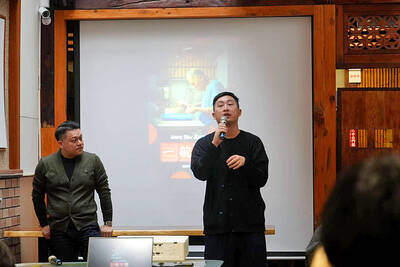
Taiwan Travelogue (臺灣漫遊錄), which earlier this week became the first Taiwanese novel to win the International Booker Prize, is to be adapted into a television series through a Taiwan-Japan coproduction, producer Chang Chen-yu (張辰漁) said yesterday. Chang, a producer at World Softest Production Film Co, wrote on Facebook that the company had been searching for projects with international appeal that retain a strong Taiwanese identity after colleagues and Japanese partners strongly recommended the novel. After reading the book, Chang said he immediately decided to pursue the screen rights. “A great story has the power to transcend time and borders, and connect countless people,”


 RSS
RSS