


President-elect Tsai Ing-wen (蔡英文) on Saturday led the Democratic Progressive Party (DPP) to a landslide victory and became the nation’s first female president.
A professor of law with a doctoral degree from the London School of Economics and Political Science, Tsai, born in 1956, entered the limelight in 1998 as a member of a delegation that negotiated terms for the nations accession to the WTO, making a reputation for herself as a technocrat with level-headedness at the negotiation table.
In 2000, the DPP’s Chen Shui-bian (陳水扁) was elected president and Tsai was named Mainland Affairs Council minister. She carried multiple diplomatic duties, including ongoing WTO negotiations.

Photo: Bloomberg
Her most notable achievement was itemizing the “trade checklist” for Taiwan’s entry to the WTO. Fabled in policy circles, the checklist has since been adopted as a standard diplomatic document by nations wanting to enter the WHO.
It came as a surprise in 2008 when the DPP chairmanship fell to Tsai — seemingly an academic in an ivory tower, far removed from the average voter — at a time when the party’s electoral prospects were poor.
However, seemingly through sheer force of will, Tsai gradually developed a substantial grassroots following and resuscitated the DPP’s political fortunes.

Photo: AP
In 2008, the DPP’s reputation was at its worst, rocked by corruption allegations against then-president Chen, who was later convicted. That year, DPP presidential candidate Frank Hsieh (謝長廷) lost to the Chinese Nationalist Party’s (KMT) Ma Ing-jeou (馬英九) by a margin of 2 million votes and the party’s representation in the legislature dropped to 27 seats.
It was the DDP darkest hour. Many observers then agreed that the DPP’s demise was imminent and no one wanted to be at the helm of a sinking ship.
Then-National Tsing Hua University, assistant professor of sociology Yao Jen-to (姚人多) led a group of academics who successfully lobbied Tsai to take over the DPP.
Party insiders gave Tsai a political life expectancy of less than two years.
Tsai, an academic who was born into wealth, matured into a formidable politician despite a dry, scholarly style that was widely considered to be too phlegmatic for the public.
She was drab in public speech, lacking theatrical flair and scarcely made political promises. Yet her tenacity in the face of adversity became widely acknowledged as her hallmark trait.
In 2009, Tsai led the DPP to a much-needed victory in a legislative by-election in Yulin County, restoring the flagging morale of the party.
In the same year’s county commissioner and special municipality mayoral elections, the DPP recaptured Yilan County with 45 percent of the vote. Confidence in Tsai’s leadership grew as the DPP began to win a string of local victories.
In 2010, the DPP won several legislative by-elections in Taoyuan, Taichung and Taitung, followed by the successful grassroots elections in 2012 in Changhua’s Huatan (花壇) and Lugang (鹿港) townships.
Tsai also contended in the 2010 New Taipei City mayoral election and although she was defeated, she won over 1 million votes and cemented her position as the DPP presidential candidate for 2012.
The DPP lost its 2012 presidential bid, but Tsai refused to quit. She ordered thorough reforms to address the party’s flaws, focusing on the party’s economic policies, its ability to represent Taiwan’s democratic values and protect national sovereignty in cross-strait relations.
Over the next four years, Tsai poured her energy into improving the DPP’s cross-strait program, policy design and roster of legislators-at-large, and assembled a team of academic and policy experts for her future administration.
Saturday’s election results represent a long-awaited vindication of her grit and hard work.

LOUD AND PROUD Taiwan might have taken a drubbing against Australia and Japan, but you might not know it from the enthusiasm and numbers of the fans Taiwan might not be expected to win the World Baseball Classic (WBC) but their fans are making their presence felt in Tokyo, with tens of thousands decked out in the team’s blue, blowing horns and singing songs. Taiwanese fans have packed out the Tokyo Dome for all three of their games so far and even threatened to drown out home team supporters when their team played Japan on Friday. They blew trumpets, chanted for their favorite players and had their own cheerleading squad who dance on a stage during the game. The team struggled to match that exuberance on the field, with
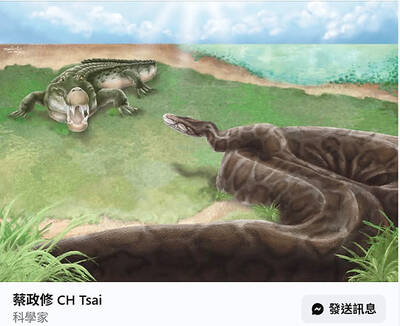
Taiwanese paleontologists have discovered fossil evidence that pythons up to 4m long inhabited Taiwan during the Pleistocene epoch, reporting their findings in the international scientific journal Historical Biology. National Taiwan University (NTU) Institute of Ecology and Evolutionary Biology associate professor Tsai Cheng-hsiu (蔡政修) led the team that discovered the largest snake fossil ever found in Taiwan. The single trunk vertebra was discovered in Tainan at the Chiting Formation, dated to between 400,000 and 800,000 years ago in the Middle Pleistocene, the paper said. The area also produced Taiwan’s first avian fossil, as well as crocodile, mammoth, saber-toothed cat and rhinoceros fossils, it said. Discoveries

Taiwanese paleontologists have discovered fossil evidence that pythons up to 4m long inhabited Taiwan during the Pleistocene epoch, reporting their findings in the international scientific journal Historical Biology. National Taiwan University (NTU) Institute of Ecology and Evolutionary Biology associate professor Tsai Cheng-hsiu (蔡政修) led the team that discovered the largest snake fossil ever found in Taiwan. A single trunk vertebra was discovered in Tainan at the Chiting Formation, dated to between 800,000 to 400,000 years ago in the Middle Pleistocene, the paper said. The area also produced Taiwan’s first avian fossil, as well as crocodile, mammoth, sabre-toothed cat and rhinoceros fossils, it said. Discoveries
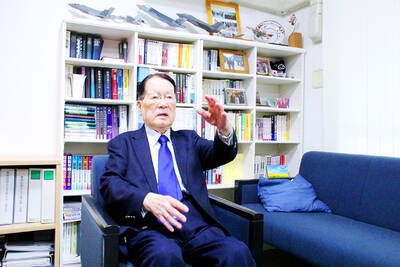
Whether Japan would help defend Taiwan in case of a cross-strait conflict would depend on the US and the extent to which Japan would be allowed to act under the US-Japan Security Treaty, former Japanese minister of defense Satoshi Morimoto said. As China has not given up on the idea of invading Taiwan by force, to what extent Japan could support US military action would hinge on Washington’s intention and its negotiation with Tokyo, Morimoto said in an interview with the Liberty Times (sister paper of the Taipei Times) yesterday. There has to be sufficient mutual recognition of how Japan could provide


 RSS
RSS