


While security measures to protect Democratic Progressive Party (DPP) presidential candidate Tsai Ing-wen (蔡英文) were said to have been tightened amid speculations of potential security threats, loopholes in security still existed that might have put Tsai at risk.
On Monday, as Tsai, walked out of the Fengtian Temple (奉天宮) in Chiayi County’s Singang Township (新港) after a religious ceremony and was about to climb onto the back of a pick-up truck with bullet proof glass cabin to tour the township with a motorcade, a man in a red jacket, carrying a camera, came out of nowhere and climbed onto the vehicle, shocking journalists standing on a media truck awaiting Tsai’s arrival.
“What is he doing?” “Who is that guy?” “What are the security officers doing?” The journalists who witnessed what just happened asked among themselves.
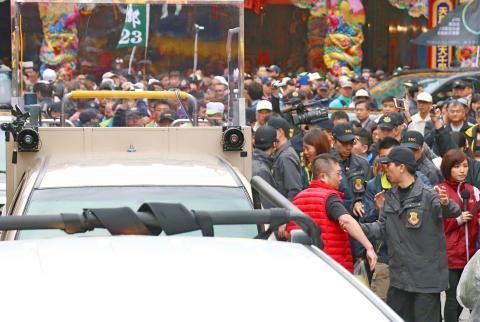
Photo: Loa Iok-sin, TaipeI Times
The man was immediately pulled down from the truck by police and National Security Bureau (NSB) officers and, without question, the officers set him free when he got down from the car.
Escorted by security officers, Tsai climbed onto the pickup truck as if nothing happened and security personnel seemingly did not check if the man left any suspicious objects in the vehicle — fortunately he did not.
At rallies with tens of thousands of participants, reporters are often asked to wear media passes and stay in a specific area in front of the stage.
At the same time, the crowd would be asked to stay at a certain distance away from the stage.
However, when Tsai makes her “grand entry” through the crowd, enthusiastic supporters forget the restrictions: They often break through the human chain formed by security personnel and sometimes go closer to the stage than reporters.
If people in charge of maintaining security think that journalists with passes — which were issued by the DPP after checking each reporter’s identity — might pose security threats to the presidential candidate and should be restricted to a certain area, why were the participants, who were mostly unknown to party staff and security personnel, allowed to get so close to the candidate?
It is also astonishing that, sometimes, before the beginning or the end of Tsai’s motorcade parade, supporters give presents to Tsai, while security officers standing next to her doing nothing and allow Tsai to take the packages directly from the supporters.
What if there was something dangerous in those bags?
At a campaign rally in Miaoli County, Tsai took questions from the media before walking into the rally, but as Tsai was walking away into the rally venue, a journalist who wanted to ask one more question grabbed Tsai’s arm, trying to persuade her to stay.
Security lapses have not only occured during the last week of campaigning, when Tsai toured the nation, they have been present since the very beginning when she registered her candidacy in November.
At the time, the plan was that an armored motorcade dispatched from the NSB should pick up Tsai at the entrance of the commission building. Yet, Tsai waited for a long time, and the vehicles did not show.
Instead of telling the motorcade to hurry up, security officers guided Tsai and Chen to the entrance of the compound, where more than 100 supporters, as well as protesters, were waiting.
It is fortunate that nothing that threatened the candidates’ safety, but security agencies must learn to do more to protect candidates.

Considering that most countries issue more than five denominations of banknotes, the central bank has decided to redesign all five denominations, the bank said as it prepares for the first major overhaul of the banknotes in more than 24 years. Central bank Governor Yang Chin-lung (楊金龍) is expected to report to the Legislative Yuan today on the bank’s operations and the redesign’s progress. The bank in a report sent to the legislature ahead of today’s meeting said it had commissioned a survey on the public’s preferences. Survey results showed that NT$100 and NT$1,000 banknotes are the most commonly used, while NT$200 and NT$2,000

The Centers for Disease Control (CDC) yesterday reported the first case of a new COVID-19 subvariant — BA.3.2 — in a 10-year-old Singaporean girl who had a fever upon arrival in Taiwan and tested positive for the disease. The girl left Taiwan on March 20 and the case did not have a direct impact on the local community, it said. The WHO added the BA.3.2 strain to its list of Variants Under Monitoring in December last year, but this was the first imported case of the COVID-19 variant in Taiwan, CDC Deputy Director-General Lin Ming-cheng (林明誠) said. The girl arrived in Taiwan on

ANNUAL EVENT: Two massive Pokemon balloons are to be set up in Daan Park, with an event zone operating from 10am to 6pm This year’s Taipei Floral Picnic is to be held at Daan Park today and tomorrow, featuring an exclusive Pokemon Go event, a themed food market, a coffee rave picnic area and stage performances, the Taipei Department of Information and Tourism said yesterday. Two massive Pokemon balloons are to be set up in the park as attractions, with an exclusive event zone operating from 10am to 6pm, it said. Participants who complete designated tasks on-site would have a chance to receive limited-edition souvenirs, it added. People could also try the newly launched game Pokemon Pokopia in the trial area, the department said. Three PokeStops are

South Korea is planning to revise its controversial electronic arrival card, a step Taiwanese officials said prompted them to hold off on planned retaliatory measures, a South Korean media report said yesterday. A Yonhap News Agency report said that the South Korean Ministry of Foreign Affairs is planning to remove the “previous departure place” and “next destination” fields from its e-arrival card system. The plan, reached after interagency consultations, is under review and aims to simplify entry procedures and align the electronic form with the paper version, a South Korean ministry official said. The fields — which appeared only on the electronic form


 RSS
RSS