


The Ministry of Education’s youth development administration granted Yunlin County camp volunteers a subsidy for their work last year revitalizing the now-deserted Jianguo Veterans’ Village (建國眷村) in Huwei Township (虎尾).
Jianguo Village Revitalization Association director-general Lu Yun-hsiang (魯紜湘) said the village is a large complex of four communities and had once been home to more than 5,000 veterans and their families. The village was mostly deserted in 2007, with only a few families still living in the area, she said.
Some of the buildings were dormitories originally built for Japanese naval air group pilots during the Japanese colonial era, Lu said, adding that since the Chinese Nationalist Party (KMT) came to Taiwan from China, the village had been converted into units for veterans and their families.
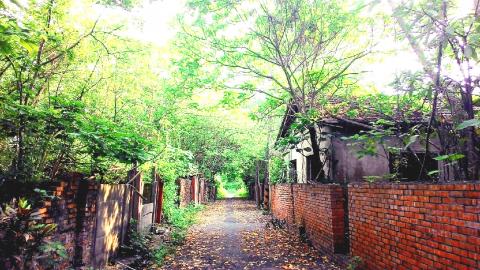
Photo courtesy of the Ministry of Education
The village also has underground bunkers with telecommunication facilities, which were installed after the KMT came to Taiwan, Lu said.
“The village has seen cruel times, but it is modern history. It should not be forgotten,” she said.
Youth group member Liu Chih-chien (劉志謙) said that while efficient use of the land is a good thing in the eyes of governments, it means great changes to the living conditions and relationships of the few residents in the area.
“With our efforts, we hope to bring the village back into the spotlight,” Liu said.
Yunlin County Government Cultural Affairs Director Lin Yuan-chuan (林源泉) said the county government has listed the village as a “cultural settlement.”
The county government is applying to the Ministry of Culture and the Ministry of the Interior for funding to conserve the village and revitalize the area, Lin said.
“The village and its history, especially its ties to Japanese naval air groups — many of which became Kamikaze pilots — are collective memories of the Huwei townsfolk,” Huwei resident Lin Hung-wen (林鴻文) said, adding that if the county government could conserve the area, he would be glad to see it.
During the latter stages of the war, the Japanese Empire resorted to suicide attacks on the Allied forces in the Pacific — mainly US forces — after having lost its aerial superiority in the theater following a crippling loss at the Midway Atoll.
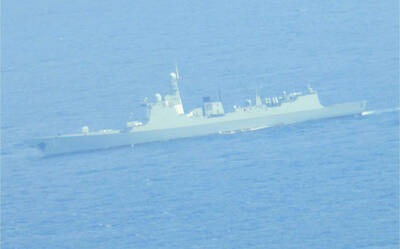
The military has spotted two Chinese warships operating in waters near Penghu County in the Taiwan Strait and sent its own naval and air forces to monitor the vessels, the Ministry of National Defense (MND) said. Beijing sends warships and warplanes into the waters and skies around Taiwan on an almost daily basis, drawing condemnation from Taipei. While the ministry offers daily updates on the locations of Chinese military aircraft, it only rarely gives details of where Chinese warships are operating, generally only when it detects aircraft carriers, as happened last week. A Chinese destroyer and a frigate entered waters to the southwest
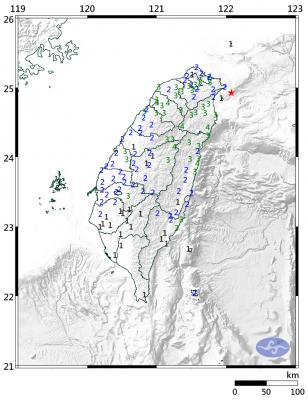
A magnitude 6.1 earthquake struck off the coast of Yilan County at 8:39pm tonight, the Central Weather Administration (CWA) said, with no immediate reports of damage or injuries. The epicenter was 38.7km east-northeast of Yilan County Hall at a focal depth of 98.3km, the CWA’s Seismological Center said. The quake’s maximum intensity, which gauges the actual physical effect of a seismic event, was a level 4 on Taiwan’s 7-tier intensity scale, the center said. That intensity level was recorded in Yilan County’s Nanao Township (南澳), Hsinchu County’s Guansi Township (關西), Nantou County’s Hehuanshan (合歡山) and Hualien County’s Yanliao (鹽寮). An intensity of 3 was
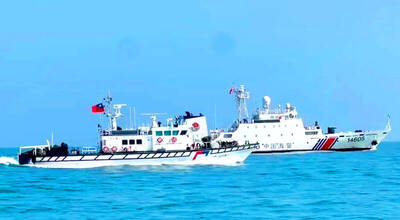
Instead of focusing solely on the threat of a full-scale military invasion, the US and its allies must prepare for a potential Chinese “quarantine” of Taiwan enforced through customs inspections, Stanford University Hoover fellow Eyck Freymann said in a Foreign Affairs article published on Wednesday. China could use various “gray zone” tactics in “reconfiguring the regional and ultimately the global economic order without a war,” said Freymann, who is also a nonresident research fellow at the US Naval War College. China might seize control of Taiwan’s links to the outside world by requiring all flights and ships entering or leaving Taiwan
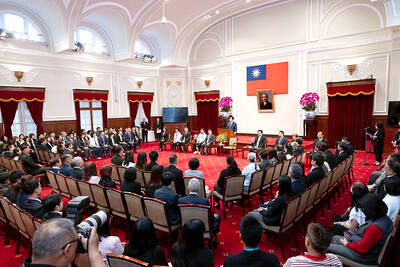
The next minimum wage hike is expected to exceed NT$30,000, President William Lai (賴清德) said yesterday during an award ceremony honoring “model workers,” including migrant workers, at the Presidential Office ahead of Workers’ Day today. Lai said he wished to thank the awardees on behalf of the nation and extend his most sincere respect for their hard work, on which Taiwan’s prosperity has been built. Lai specifically thanked 10 migrant workers selected for the award, saying that although they left their home countries to further their own goals, their efforts have benefited Taiwan as well. The nation’s industrial sector and small businesses lay


 RSS
RSS