


A legal expert filed a lawsuit against former Ting Hsin International Group (頂新集團) executive Wei Ying-chiao (魏應交) at the Supreme Prosecutors’ Office yesterday, alleging that Wei took NT$80 million (US$2.38 million) in kickbacks from irregular transactions in 2009 and that NT$5.25 million of that money was used to make an illegal donation to the Chinese Nationalist Party (KMT).
People First Party candidate and publisher of the influential Journal on the Rule of Law (法治時報) Huang Yueh-hung (黃越宏) also alleged political inference in the 2009 case, saying that public prosecutors acted as “protection” for Ting Hsin Group by dropping charges against Wei.
Huang alleged that Wei pressured SinoPac Securities (永豐金證券) into paying NT$80 million in kickbacks when the group’s subsidiary Master Kong Holdings (康師傅) issued Taiwan depositary receipts (TDR) for its listing on the Taiwan Stock Exchange in late 2009.
Master Kong Holdings — China’s leading instant noodle manufacturer — issued 380 million TDRs at its listing and reportedly raised about NT$14.2 billion in the deal, that was underwritten by SinoPac Securities.
Master Kong was listed on the stock market as a foreign-owned company, registered in the Cayman Islands, with Tingyi (Cayman Islands) Holding Corp (康師傅控股有限公司) its registered name.
Taipei District Prosecutors’ Office officials had evidence of Wei pressuring SinoPac Securities into paying NT$80 million, and also had evidence that Wei used NT$5.25 million of that money to make an off-the-books donation to the KMT intended for use in its election campaign, Huang said.
“For his illegal financial activities, Wei should have been charged with embezzlement and fraud, and he also violated the Political Donations Act (政治獻金法),” he said.
However, public prosecutors dropped charges against Wei and SinoPac Securities chairman Huang Min-chu (黃敏助), Huang said, and instead prosecuted what he called “two minor figures” in the case — Tai Chia-wei (戴家偉) and Chuang Ying-ming (莊英明), deputy managers for SinoPac’s securities market capital section and securities sales section respectively.
“[The decision to drop the case] resulted in a tycoon getting away with taking kickbacks, but the employees handling the money were convicted,” he said, adding therefore he is requesting that the head prosecutor personally handles his lawsuit, so that it is not dropped as a result of judicial interference.

LOUD AND PROUD Taiwan might have taken a drubbing against Australia and Japan, but you might not know it from the enthusiasm and numbers of the fans Taiwan might not be expected to win the World Baseball Classic (WBC) but their fans are making their presence felt in Tokyo, with tens of thousands decked out in the team’s blue, blowing horns and singing songs. Taiwanese fans have packed out the Tokyo Dome for all three of their games so far and even threatened to drown out home team supporters when their team played Japan on Friday. They blew trumpets, chanted for their favorite players and had their own cheerleading squad who dance on a stage during the game. The team struggled to match that exuberance on the field, with
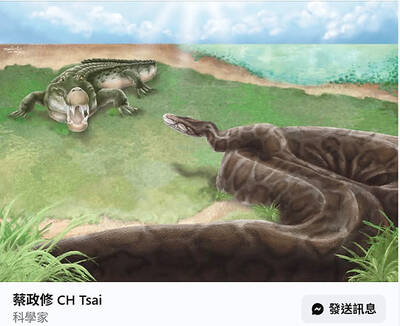
Taiwanese paleontologists have discovered fossil evidence that pythons up to 4m long inhabited Taiwan during the Pleistocene epoch, reporting their findings in the international scientific journal Historical Biology. National Taiwan University (NTU) Institute of Ecology and Evolutionary Biology associate professor Tsai Cheng-hsiu (蔡政修) led the team that discovered the largest snake fossil ever found in Taiwan. The single trunk vertebra was discovered in Tainan at the Chiting Formation, dated to between 400,000 and 800,000 years ago in the Middle Pleistocene, the paper said. The area also produced Taiwan’s first avian fossil, as well as crocodile, mammoth, saber-toothed cat and rhinoceros fossils, it said. Discoveries

Taiwanese paleontologists have discovered fossil evidence that pythons up to 4m long inhabited Taiwan during the Pleistocene epoch, reporting their findings in the international scientific journal Historical Biology. National Taiwan University (NTU) Institute of Ecology and Evolutionary Biology associate professor Tsai Cheng-hsiu (蔡政修) led the team that discovered the largest snake fossil ever found in Taiwan. A single trunk vertebra was discovered in Tainan at the Chiting Formation, dated to between 800,000 to 400,000 years ago in the Middle Pleistocene, the paper said. The area also produced Taiwan’s first avian fossil, as well as crocodile, mammoth, sabre-toothed cat and rhinoceros fossils, it said. Discoveries
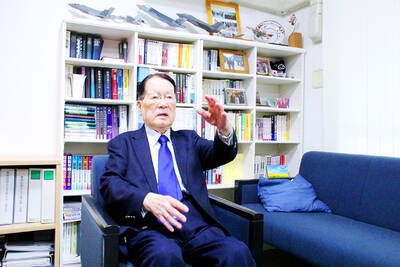
Whether Japan would help defend Taiwan in case of a cross-strait conflict would depend on the US and the extent to which Japan would be allowed to act under the US-Japan Security Treaty, former Japanese minister of defense Satoshi Morimoto said. As China has not given up on the idea of invading Taiwan by force, to what extent Japan could support US military action would hinge on Washington’s intention and its negotiation with Tokyo, Morimoto said in an interview with the Liberty Times (sister paper of the Taipei Times) yesterday. There has to be sufficient mutual recognition of how Japan could provide


 RSS
RSS