


About 17,000 tonnes of disposable chopsticks made in Vietnam could contain biphenyl or hydrogen peroxide, as the harmful chemicals were found by random inspections nationwide, the Food and Drug Administration (FDA) said yesterday.
The agency said that among 225 samples of disposable chopsticks collected at 172 hypermarkets, supermarkets and disposable tableware wholesale stores, one sample was found to contain biphenyl and three other samples were found to contain hydrogen peroxide.
FDA Southern Center Interim Director Liu Fang-ming (劉芳銘) said long-term exposure to both substances can cause negative health effects and long-term exposure to biphenyl can also cause liver damage.
He said regulations prohibit the use of biphenyl (a preservative) in chopstick production and that no hydrogen peroxide (a bleaching agent) residue should be present in the finished product, while sulfur dioxide (another bleaching agent) residue is limited to less than 500 parts per million in disposable chopsticks.
“The nation imports about 25,000 to 30,000 tonnes of disposable chopsticks every year,” administration official Yang Chien-Hui (楊千慧) said, citing statistics of the past five years.
About 86 percent of disposable chopsticks are imported from China, 12 percent from Vietnam, 1.8 percent from Indonesia and the rest from various other countries, she added.
The four defective samples were all from Vietnam, from a total of about 17,000 tonnes that were imported, Liu said, adding that the administration has called for a recall of the chopsticks so they can be destroyed.
“If using disposable chopsticks is necessary, people should carefully look at and smell them before use, avoiding chopsticks that are too white or have a sour smell, which could indicate they contain excessive levels of bleaching agents,” Yang said.
The four importers of the chopsticks can face a fine of between NT$30,000 and NT$3 million (US$908 and US$90,772) if they do not recall all products before Jan. 15, he said.

LOUD AND PROUD Taiwan might have taken a drubbing against Australia and Japan, but you might not know it from the enthusiasm and numbers of the fans Taiwan might not be expected to win the World Baseball Classic (WBC) but their fans are making their presence felt in Tokyo, with tens of thousands decked out in the team’s blue, blowing horns and singing songs. Taiwanese fans have packed out the Tokyo Dome for all three of their games so far and even threatened to drown out home team supporters when their team played Japan on Friday. They blew trumpets, chanted for their favorite players and had their own cheerleading squad who dance on a stage during the game. The team struggled to match that exuberance on the field, with
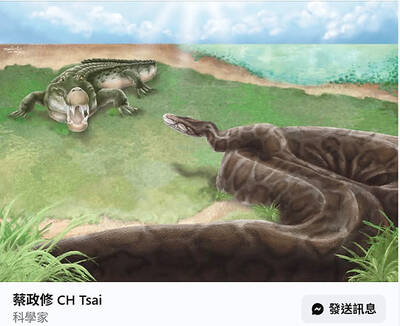
Taiwanese paleontologists have discovered fossil evidence that pythons up to 4m long inhabited Taiwan during the Pleistocene epoch, reporting their findings in the international scientific journal Historical Biology. National Taiwan University (NTU) Institute of Ecology and Evolutionary Biology associate professor Tsai Cheng-hsiu (蔡政修) led the team that discovered the largest snake fossil ever found in Taiwan. The single trunk vertebra was discovered in Tainan at the Chiting Formation, dated to between 400,000 and 800,000 years ago in the Middle Pleistocene, the paper said. The area also produced Taiwan’s first avian fossil, as well as crocodile, mammoth, saber-toothed cat and rhinoceros fossils, it said. Discoveries

Taiwanese paleontologists have discovered fossil evidence that pythons up to 4m long inhabited Taiwan during the Pleistocene epoch, reporting their findings in the international scientific journal Historical Biology. National Taiwan University (NTU) Institute of Ecology and Evolutionary Biology associate professor Tsai Cheng-hsiu (蔡政修) led the team that discovered the largest snake fossil ever found in Taiwan. A single trunk vertebra was discovered in Tainan at the Chiting Formation, dated to between 800,000 to 400,000 years ago in the Middle Pleistocene, the paper said. The area also produced Taiwan’s first avian fossil, as well as crocodile, mammoth, sabre-toothed cat and rhinoceros fossils, it said. Discoveries
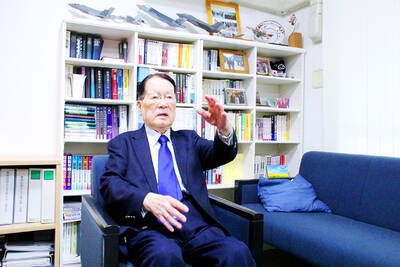
Whether Japan would help defend Taiwan in case of a cross-strait conflict would depend on the US and the extent to which Japan would be allowed to act under the US-Japan Security Treaty, former Japanese minister of defense Satoshi Morimoto said. As China has not given up on the idea of invading Taiwan by force, to what extent Japan could support US military action would hinge on Washington’s intention and its negotiation with Tokyo, Morimoto said in an interview with the Liberty Times (sister paper of the Taipei Times) yesterday. There has to be sufficient mutual recognition of how Japan could provide


 RSS
RSS