


Taipei is to host the Velo-city Global Conference 2016 from Feb. 27 to March 1 as part of its effort to transform itself into a “cycling city.”
In doing so, Taipei would be the first Asian city to host the event, the premier international cycling conference organized by the European Cyclists’ Federation (ECF), which aims to improve the planning and provision of infrastructure for the daily use of bicycles in urban areas.
Cycling experts, city planners, policymakers, non-governmental organizations and researchers from around the world have been invited to the conference to analyze the state of cycling in Taipei, and the event is likely to encourage greater attention and commentary from the public.
Transforming the city’s cycling infrastructure would require listening to the public’s opinions, suggestions and concerns and addressing them accordingly, Taiwanese observers said, adding that some issues about the system need to be given due consideration.
Among the issues was pedestrians’ complaints about cyclists.
In September this year, results of a survey by the Taipei Department of Transportation, which measured residents’ views on the safety of cycling in the city, showed that from the perspective of pedestrians and motorists, the most annoying behavior by cyclists is riding under arcades or on sidewalks (36.9 percent), followed by zig-zagging in traffic (23.2 percent) and riding outside of designated bicycle lanes (21.3 percent).
Riding under arcades is prohibited by law and if there are no bicycle paths, cyclists must either find an alternate route on the road or dismount and walk their bicycles when passing through crowded areas.
Late last year, the city announced plans to further expand the network of bicycle paths, which in the downtown area total 42.48km, while the combined length of sidewalks and bicycle paths total 332.88km. By next year, the length of bicycle paths is planned to reach 500km and it is estimated that, by 2018, bicycle paths would be placed on all roads wider than 40m.
There is also the issue of not having a sufficient number of bicycle racks for cyclists to park their bicycles.
In the Gongguan (公館) business area, for example, the bike racks are consistently filled to capacity. To address this issue, the Taipei Parking Management and Development Office this year said that it would increase bicycle racks at locations with high demand to boost its “green traffic” policy and encourage cycling.
Since 2013, the office has allowed residential buildings and private enterprises to apply to set up bicycle racks in public spaces, a measure which won praise from the public. Providing sufficient and convenient bicycle racks not only reduces bicycle theft, but gives an orderly appearance, in turn improving the general look of the city, observers said.
Meanwhile, the YouBike bicycle rental system, which has gained popularity among residents — with the number of rentals exceeding 40 million as of March — has its own problems.
One common problem YouBike users might encounter is broken bicycles. This raises the separate issue of the insufficient number of bicycles during peak hours and at crowded locations.
Another issue that needs attention is the lack of enforcement of cycling rules, such as talking on or playing with mobile phones while riding, riding while intoxicated, riding at night without headlights and not yielding to pedestrians, the observers said. Breaking these rules incurs a fine of between NT$300 and NT$600.
Considering that the fine for committing such violations is relatively low, especially compared with other countries where more hefty fines are enforced, many riders might not feel compelled to follow the rules, the observers said.
The focus on Taipei’s cycling infrastructure and the opportunity for greater dialogue between relevant government bodies, cycling experts and residents that the conference is expected to bring together would pave the way for the city to realize its vision of becoming a bicycle-friendly environment, they added.
“We have the ambition to become a cycling city. The city of Taipei is proud to host Velo-city Global and showcase the success of the YouBike bicycle rental system, new investments in infrastructure and, of course, the vibrant bicycle industry which supports our efforts,” Department of Transportation Commissioner Chung Hui-yu (鍾慧諭) said.


China has reserved offshore airspace in the Yellow Sea and East China Sea from March 27 to May 6, issuing alerts usually used to warn of military exercises, although no such exercises have been announced, the Wall Street Journal (WSJ) reported yesterday. Reserving such a large area for 40 days without explanation is an “unusual step,” as military exercises normally only last a few days, the paper said. These alerts, known as Notice to Air Missions (Notams), “are intended to inform pilots and aviation authorities of temporary airspace hazards or restrictions,” the article said. The airspace reserved in the alert is

NAMING SPAT: The foreign ministry called on Denmark to propose an acceptable solution to the erroneous nationality used for Taiwanese on residence permits Taiwan has revoked some privileges for Danish diplomatic staff over a Danish permit that lists “Taiwan” as “China,” Eric Huang (黃鈞耀), head of the Ministry of Foreign Affairs’ Department of European Affairs, told a news conference in Taipei yesterday. Reporters asked Huang whether the Danish government had responded to the ministry’s request that it correct the nationality on Danish residence permits of Taiwanese, which has been listed as “China” since 2024. Taiwan’s representative office in Denmark continues to communicate with the Danish government, and the ministry has revoked some privileges previously granted to Danish representatives in Taiwan and would continue to review

More than 6,000 Taiwanese students have participated in exchange programs in China over the past two years, despite the Mainland Affairs Council’s (MAC) “orange light” travel advisory, government records showed. The MAC’s publicly available registry showed that Taiwanese college and university students who went on exchange programs across the Strait numbered 3,592 and 2,966 people respectively. The National Immigration Agency data revealed that 2,296 and 2,551 Chinese students visited Taiwan for study in the same two years. A review of the Web sites of publicly-run universities and colleges showed that Taiwanese higher education institutions continued to recruit students for Chinese educational programs without
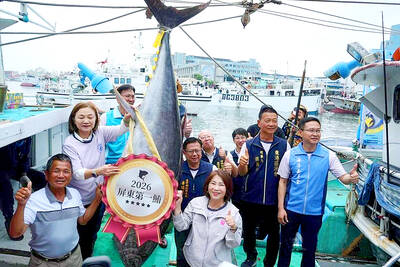
The first bluefin tuna of the season, brought to shore in Pingtung County and weighing 190kg, was yesterday auctioned for NT$10,600 (US$333.5) per kilogram, setting a record high for the local market. The auction was held at the fish market in Donggang Fishing Harbor, where the Siaoliouciou Island-registered fishing vessel Fu Yu Ching No. 2 delivered the “Pingtung First Tuna” it had caught for bidding. Bidding was intense, and the tuna was ultimately jointly purchased by a local restaurant and a local company for NT$10,600 per kilogram — NT$300 ,more than last year — for a total of NT$2.014 million. The 67-year-old skipper


 RSS
RSS