


A majority of the public feel that the government has failed to protect their basic human right to health and ensure fairness in the judiciary this year, a survey released yesterday by the Shih Hsin University Institute of Knowledge Economy Development indicated.
The survey, now in its seventh year, asked respondents to grade the government’s efforts to promote freedom and human rights on a scale of 1 to 5, with 1 denoting abysmal,” 3 representing “fair” and 5 indicating “excellent.”
The survey’s methodology is based on a system created by Freedom House, a US watchdog organization dedicated to the expansion of freedom and democracy around the world, the institute said.
The government’s score on “human right to health,” listed under the government’s “overall performance” to protect human rights, dropped from last year’s 2.5 to 2.1 this year, while the approval rating in the “right to fair trials” category fell from 2.3 to 1.9.
The ratings are likely to have been negatively impacted by the Changhua District Court’s decision to acquit six former Ting Hsin International Group managers of all charges related to a tainted oil scandal, institute assistant researcher Yeh Feng-ku (葉峰谷) said.
With the Jan. 16 presidential and legislative elections around the corner, the government’s score on the “right to elections” category took a major fall from 3.1 last year to 2.7 this year.
When asked "whether they agree" that death penalty "should be abolished," 22.8 percent of respondents said they partially disagree, while 61.6 percent said they completely disagree with it.
The survey asked respondents how often they came into contact with news about human rights and democracy, and researchers cross-referenced the answers given for each item, discovering that the more a person was exposed to information, the less likely they were to rate the government’s performance highly.
Presidential Office Human Rights Advisory Committee member Chai Sung-lin (柴松林) said that while he would not say that the court had issued an unjust verdict in the Ting Hsin case, the ruling was a “far cry” from public expectations, and this gave rise to the government’s poor ratings in the survey.
The nation’s legislative and judicial systems should be reviewed, and the results would have been quite different if the “innocent until proven guilty” principle adopted by the nation’s judiciary was replaced by the principle of acting in good faith, Chai said.
The ratings are not necessarily a setback for the nation’s democracy, as they could indicate that information is more accessible and that the public now has a better understanding or cares more about the issue of human rights, attorney Yang Fang-wan (楊芳婉) said.
Regarding the Ting Hsin case, abstruse language allowed judges to interpret national laws “to their liking,” she said.

FUKUOKA SITUATION: Japanese media reported that the pathogen is expected to be identified by the summer, while the CDC downplayed the idea that it was hMPV A “mysterious cold-like illness” reported in Japan’s Fukuoka Prefecture does not seem to be a new disease, but Japanese authorities have been asked about the situation, the Centers for Disease Control (CDC) said yesterday. The Fukuoka Prefectural Medical Association on Wednesday told a news conference that a “mystery cold” that has become a hot topic on social media is “highly likely to be caused by some kind of viral infection,” Japan’s KBC News reported. “Many people are experiencing symptoms starting with a sore throat, followed by a runny nose, phlegm and a severe cough,” KBC News reported, citing association officials. Health authorities are

Nvidia Corp CEO Jensen Huang (黃仁勳) arrived in Taiwan yesterday ahead of upcoming AI and technology events, saying he plans to meet with clients and Taiwan Semiconductor Manufacturing Co Chairman C.C. Wei (魏哲家) during his visit. After landing at Taipei Songshan Airport, Huang posed for photos with fans and handed out Yakult drinks to reporters and supporters waiting at the scene, saying he has “a lot to do” during the trip. Asked about reports that Nvidia’s planned headquarters site in Taipei’s Beitou Shilin Technology Park could break ground on May 27, Huang said that if the company holds an event, he would

Carrefour Taiwan is to begin using a new name from the start of July, but it cannot divulge the name until then, the chairman of the supermarket chain's parent company said today. President Chain Store Co chairman Lo Chih-hsien (羅智先) was asked by reporters after a shareholders' meeting to confirm whether the company has settled on a new name for the supermarket brand. In March, the government-registered name of two Carrefour Taiwan branches was quietly changed to "Le Chia Kang" (樂家康) in Chinese, raising speculation that has been selected as the name. Lo said that because of local regulations and contractual obligations, the
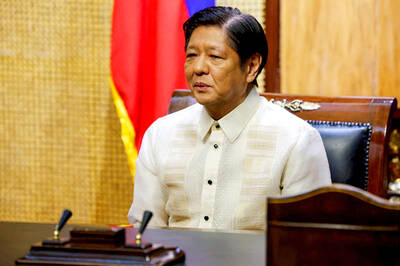
The Philippines would likely be involved in any conflict over Taiwan due to its proximity to the democracy claimed by China, President Ferdinand Marcos Jr said, reiterating a stance that risks angering Beijing. “In the Philippines, we do not have a choice because Taiwan is so close to the Philippines and we have almost 200,000 Filipino nationals living and working in Taiwan,” Marcos said in an interview with Japanese media in Manila on Monday. The Philippine leader’s comments come ahead of a state visit to Japan next week, where he is to meet with Japanese Prime Minister Sanae Takaichi to discuss security


 RSS
RSS