


New Taipei City had the highest growth rate of lung cancer cases in the nation between 2006 and 2011, as well as the highest female lung cancer incidence rate and growth rate, with Taipei coming second in terms of the lung cancer growth rate among women, which doctors said is associated with urban air pollution.
Changhua Medical Alliance standing director and rehabilitation physician Lee Wu-po (李武波) said that according to Health Promotion Administration statistics, lung cancer has been the leading cause of cancer deaths in Taiwan for five consecutive years, and among the 9,167 people who died of lung cancer last year, 5,893 were men and 3,274 were women.
Taiwan’s population has increased by 28 percent over the past 30 years, but the growth rate of lung cancer cases is 131 percent, almost five times more than the population growth rate, Lee said.
According to the latest data released by the administration, New Taipei City led the nation in the growth of lung cancer cases from 2006 to 2011, with a 16 percent growth rate — almost twice the nation’s average growth rate at 9 percent — while the number of the city’s residents developing lung cancer increased from 34 to 39 per 100,000 people every year, Lee said.
URBAN AREAS
Urban areas had the highest growth rates and incidence rates of lung cancer among women from 2006 to 2011, with New Taipei City topping other municipalities with a 28 percent growth rate and an incidence rate of 28 per 100,000 women, followed by Taipei’s 26 per 100,000 women, he said.
In terms of male lung cancer incidence rates and growth rates during the same period, Chiayi City had the highest growth rate of 16 percent, while Yilan County had the highest incidence rate of 57 per 100,000 men, Lee said.
INCIDENCE RATES
However, Taitung County, Chiayi City and New Taipei City had the highest lung cancer incidence rates in 2011, Lee said, adding that the trend in lung cancer incidence and mortality could not be judged on statistics for a single year.
Yilan County had the highest incidence rate over a 10-year time frame since 2000, with 39 per 100,000 people developing lung cancer, followed by New Taipei City, Keelung and Chiayi County, all with a lung cancer incidence rate of 37 per 100,000 people.
Lee said that air pollution is not exclusive to central and southern municipalities.
“What affects northern Taiwan is another type of air pollution,” he said.
Higher female lung cancer incidence rates in large cities cannot be explained simply by vehicle emissions, Lee said, adding that pollution caused by cooking fumes can linger in limited and poorly ventilated kitchen spaces — which are typically found in urban apartments — which could be further exacerbated with the consumption of adulterated oil products, he said.
“The Ministry of Health and Welfare has been playing dumb. It has the data to understand the cause of increased lung cancer incidence rates, but has not done any research, preventing the public from understanding the cause of heightened cancer risks,” Lee added.

SECURITY: Starlink owner Elon Musk has taken pro-Beijing positions, and allowing pro-China companies to control Taiwan’s critical infrastructure is risky, a legislator said Starlink was reluctant to offer services in Taiwan because of the nation’s extremely high penetration rates in 4G and 5G services, the Ministry of Digital Affairs said yesterday. The ministry made the comments at a meeting of the legislature’s Transportation Committee, which reviewed amendments to Article 36 of the Telecommunications Management Act (電信管理法). Article 36 bans foreigners from holding more than 49 percent of shares in public telecommunications networks, while shares foreigners directly and indirectly hold are also capped at 60 percent of the total, unless specified otherwise by law. The amendments, sponsored by Chinese Nationalist Party (KMT) Legislator Ko

The eastern extension of the Taipei MRT Red Line could begin operations as early as late June, the Taipei Department of Rapid Transit Systems said yesterday. Taipei Rapid Transit Corp said it is considering offering one month of free rides on the new section to mark its opening. Construction progress on the 1.4km extension, which is to run from the current terminal Xiangshan Station to a new eastern terminal, Guangci/Fengtian Temple Station, was 90.6 percent complete by the end of last month, the department said in a report to the Taipei City Council's Transportation Committee. While construction began in October 2016 with an

NON-RED SUPPLY: Boosting the nation’s drone industry is becoming increasingly urgent as China’s UAV dominance could become an issue in a crisis, an analyst said Taiwan’s drone exports to Europe grew 41.7-fold from 2024 to last year, with demand from Ukraine’s fight against Russian aggression the most likely driver of growth, a study showed. The Institute for Democracy, Society and Emerging Technology (DSET) in a statement on Wednesday said it found that many of Taiwan’s uncrewed aerial vehicle (UAV) sales were from Poland and the Czech Republic. These countries likely transferred the drones to Ukraine to aid it in its fight against the Russian invasion that started in 2022, it said. Despite the gains, Taiwan is not the dominant drone exporter to these markets, ranking second and fourth
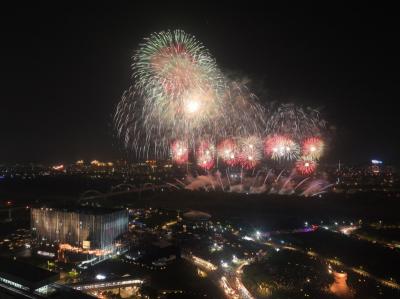
The New Taipei City Art Museum this weekend plans to celebrate its first anniversary with a two-day extravaganza featuring live concerts and a large-scale synchronized fireworks and drone display, the New Taipei City Cultural Affairs Department said. The two-day celebrations are to take place in the museum’s outdoor park, with markets and live performances by singers including Ann Bai (白安), Bii (畢書盡) and the Cosmos People (宇宙人), the department said. The highlight on both evenings would be the "Echoes of Light" show, an aerial spectacle combining fireworks and drone performances designed around the concept of "dual stages in the sky," it


 RSS
RSS