

Former Taichung mayor Jason Hu (胡志強) was yesterday named Chinese Nationalist Party (KMT) presidential candidate Eric Chu’s (朱立倫) campaign manager and vowed to “turn the tide” in favor of the KMT in the six weeks leading up to the Jan. 16 election.
Hu said it took him “five seconds” to accept Chu’s invitation to serve as chief of staff at the KMT presidential election campaign headquarters.
“This is a crucial moment for the survival of the KMT,” Hu said.
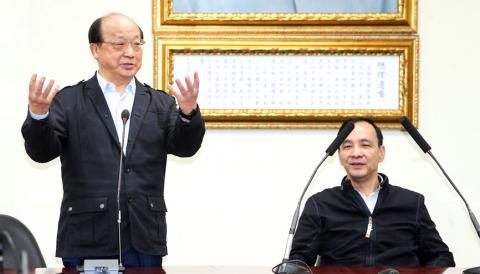
Photo: CNA
At a press conference at the KMT headquarters in Taipei, Hu promised to do his best “for what is right” and “turn the tide toward victory” for the KMT in the countdown to the Jan. 16 elections.
Hu served as foreign minister under former president Lee Teng-hui (李登輝) and has been working as a vice chairman of Want Want China Times Group (旺旺中時媒體集團) since he lost his bid for re-election as Taichung mayor in December last year.
Hu said that as Chu’s campaign manager, what he wants most is to achieve victory.
He said he will study how to boost the momentum of Chu’s campaign in the final weeks before the election.
At the press conference, Chu also announced other major appointments, including that of Deputy Legislative Speaker Hung Hsiu-chu (洪秀柱) as head of his advisory group.
Hung was originally nominated by the KMT National Congress as its presidential candidate in July, but three months later, an extraordinary National Congress of the party passed a motion to void her nomination, and installed Chu as the party’s nominee instead on Oct. 17.
There had been rumors that the two had been at odds since, but Chu took the initiative to visit Hung at her official residence on Thursday evening — which is seen by political observers as a move to reconciliation — before yesterday’s announcement.
Also, Legislative Speaker Wang Jin-pyng (王金平) was named as chief of the KMT campaign’s support group.
Chu’s national campaign headquarters are to be formally inaugurated today. He has been trailing in opinion polls far behind Democratic Progressive Party presidential candidate Tsai Ing-wen (蔡英文).
Chu said he decided to name Hu as his campaign manager because Hu is very familiar with electoral matters and has participated in almost every presidential election campaign in the country.
Chu said many people who had been unlikely to support him have now decided to do so out of concern for the nation.
He urged people who are disappointed with the KMT not to despair, but rather to come out and vote.
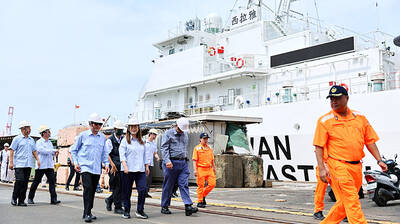
Ocean Affairs Council (OAC) Minister Kuan Bi-ling (管碧玲) on Wednesday said decommissioned coast guard vessels were given to the Philippines to enhance regional rescue capacity and would not affect Taiwanese fishers’ rights and benefits. Kuan made the remarks after confirmation on Tuesday that a 500-tonne Coast Guard Administration (CGA) patrol and rescue vessel would be given to the Philippine Coast Guard. The donation ceremony was reportedly done in Manila, but whether the vessel — previously numbered “CG123” and named Kinmen (金門) — has been handed over has yet to be confirmed. China’s Taiwan Affairs Office (TAO) on Wednesday criticized the donation for “taking

The Ministry of Finance today announced the winning numbers for the July-August uniform invoice lottery. The winning number for the NT$10 million (US$314,663) special prize is 89996565, while the winning number for the NT$2 million grand prize is 91098182. Three numbers were drawn for the NT$200,000 first prize: 54348835, 44991397 and 06595111. Those with receipts matching the last seven digits of any of the first-prize numbers can claim the NT$40,000 second prize, while those matching the last six digits qualify for the NT$10,000 third prize. Those whose receipts match the last five digits of the first-prize numbers are eligible for the NT$4,000 fourth prize,
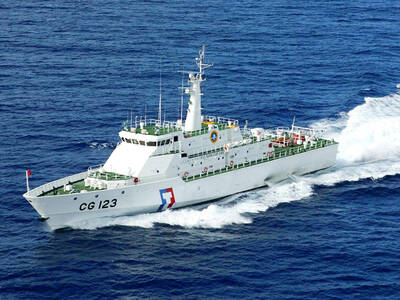
A decommissioned 500-tonne Kinmen-class patrol vessel recently donated by Taiwan’s Coast Guard Administration (CGA) has been delivered to the Philippine Coast Guard (PCG), a source said yesterday. The source said the vessel transferred to the PCG at a ceremony organized by the Philippine Non-government WPS Foundation on Monday was donated by the CGA. The CGA confirmed the donation on Wednesday last week following a United Daily News (UDN) report of a Philippine law enforcement vessel registered as "BLINGNO.1" setting sail for sea trials from Kaohsiung Port that day, citing tracking data from
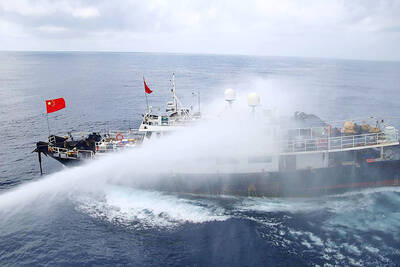
Taiwan has upgraded its maritime patrol capacity around the Pratas Islands (Dongsha Islands, 東沙群島) in the disputed South China Sea, including regularly sending larger ships there, the government said on Wednesday, responding to an increase in Chinese activities. Lying roughly between southern Taiwan and Hong Kong, the Taiwan-controlled Pratas Islands are seen by security experts as vulnerable to a Chinese attack due to their distance — more than 400km — from Taiwan. In a statement late on Wednesday, the Coast Guard Administration (CGA) said its overall patrol and enforcement capacity in Pratas waters has been “comprehensively upgraded.” With the completion of a wharf


 RSS
RSS