


Chinese Nationalist Party (KMT) vice presidential candidate Jennifer Wang (王如玄) yesterday moved out of a government dormitory in Taipei City’s Daan District (大安), in an attempt to put an end to controversy concerning her real-estate dealings.
Wang addressed reporters waiting outside the dorm on Hangzhou S Road Sec 2, where she and her husband have been living since 2005.
“I have delivered on my promise to move out of the faculty dormitory within 10 days. I have lived here for a long time and have forged close emotional bonds with the building’s security officers,” Wang said.
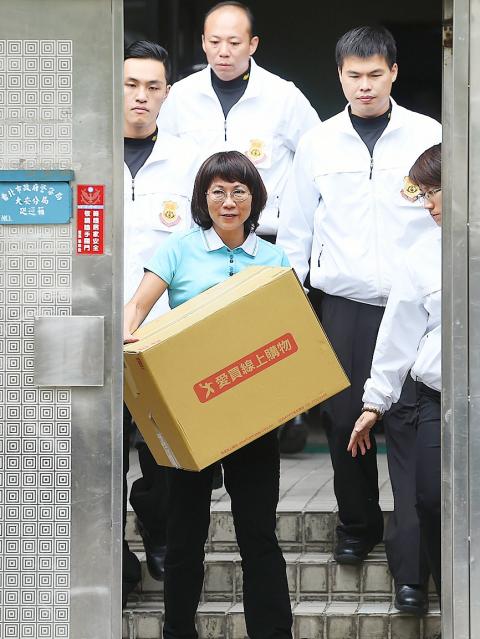
Photo: Chu Pei-hsiung, Taipei Times
Asked whether she felt she was being coerced to leave the dormitory, Wang said she was someone who lived in the present and was willing to subject herself to the highest moral standards.
Wang’s relocation came just four days after she pledged to move out of the dorm amid controversy surrounding herself and her husband, Judicial Yuan Department of Government Ethics Director Huang Tung-hsun (黃東焄).
The couple has been criticized for living in a dorm listed as a Taiwan High Prosecutors’ Office unit that allegedly costs NT$2,000 per month to rent, while owning at least one military apartment.
The legitimacy of their residency was questioned by Democratic Progressive Party (DPP) Legislator Tuan Yi-kang (段宜康), who said that Huang owns a house in New Taipei City, which should have made him ineligible to apply for the ministry dorm.
Tuan has also accused Wang of having engaged in speculative sales of several military apartments, which were subsidized and converted by the government from old housing for military dependents for the sole purpose of improving their living conditions and providing housing.
Wang said her husband supported her decision to leave the dorm because of her vice presidential bid.
The residence is to be returned to the ministry when they vacate the property, Wang said, adding that they would relocate to a 22-year-old apartment in New Taipei City’s Sindian District (新店) that they have rented.
Dismissing Tuan’s allegations that there are more military housing units involved in her dealings, Wang said she welcomed all those suspecting her of wrongdoing to submit any evidence they have to the authorities.
“Presidential elections should focus on policy debates... but my faculty dormitory and purchases of military apartments have sparked too many disputes and quarrels that have dragged on for too long,” Wang said.
“I would like to express my sincerest apology for the chaos I have caused,” she said.
KMT presidential candidate Eric Chu (朱立倫) said that he respected Wang’s decision to relocate, but added that it was not the result of KMT intervention.
“I think the decision made by Wang and her husband is a good one,” Chu said.

Considering that most countries issue more than five denominations of banknotes, the central bank has decided to redesign all five denominations, the bank said as it prepares for the first major overhaul of the banknotes in more than 24 years. Central bank Governor Yang Chin-lung (楊金龍) is expected to report to the Legislative Yuan today on the bank’s operations and the redesign’s progress. The bank in a report sent to the legislature ahead of today’s meeting said it had commissioned a survey on the public’s preferences. Survey results showed that NT$100 and NT$1,000 banknotes are the most commonly used, while NT$200 and NT$2,000

The Centers for Disease Control (CDC) yesterday reported the first case of a new COVID-19 subvariant — BA.3.2 — in a 10-year-old Singaporean girl who had a fever upon arrival in Taiwan and tested positive for the disease. The girl left Taiwan on March 20 and the case did not have a direct impact on the local community, it said. The WHO added the BA.3.2 strain to its list of Variants Under Monitoring in December last year, but this was the first imported case of the COVID-19 variant in Taiwan, CDC Deputy Director-General Lin Ming-cheng (林明誠) said. The girl arrived in Taiwan on

South Korea is planning to revise its controversial electronic arrival card, a step Taiwanese officials said prompted them to hold off on planned retaliatory measures, a South Korean media report said yesterday. A Yonhap News Agency report said that the South Korean Ministry of Foreign Affairs is planning to remove the “previous departure place” and “next destination” fields from its e-arrival card system. The plan, reached after interagency consultations, is under review and aims to simplify entry procedures and align the electronic form with the paper version, a South Korean ministry official said. The fields — which appeared only on the electronic form

The Ministry of Foreign Affairs (MOFA) is suspending retaliation measures against South Korea that were set to take effect tomorrow, after Seoul said it is updating its e-arrival system, MOFA said today. The measures were to be a new round of retaliation after Taiwan on March 1 changed South Korea's designation on government-issued alien resident certificates held by South Korean nationals to "South Korea” from the "Republic of Korea," the country’s official name. The move came after months of protests to Seoul over its listing of Taiwan as "China (Taiwan)" in dropdown menus on its new online immigration entry system. MOFA last week


 RSS
RSS