


The government is not working hard enough to explore “green” energy options, Democratic Progressive Party (DPP) vice presidential candidate Chen Chien-jen (陳建仁) said yesterday, adding that President Ma Ying-jeou (馬英九) was looking for excuses in comments about a potential energy crisis in the nation.
In a conversation with Ma when the president visited Taiwan Semiconductor Manufacturing Co (TSMC) on Wednesday, TSMC chairman Morris Chang (張忠謀) said that the two major issues that concern investors are a possible power shortage in 2017 and protests by environmentalists over industrial development projects.
Ma said that using sources of renewable energy to replace nuclear power was unrealistic.
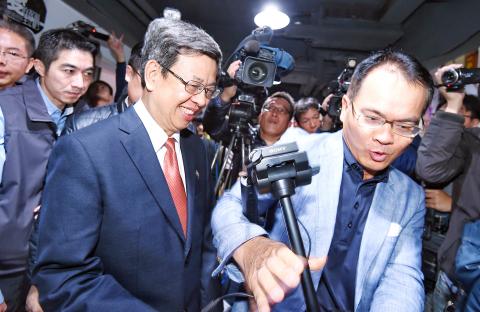
Photo: Liu Hsin-de, Taipei Times
“The president is looking for excuses for something he has not done well,” Chen said during an interview on SuperFM 98.5 with host Cheng Hung-yi (鄭弘儀). “Taiwan has a good environment for developing green energy, but the government has never worked hard to explore it.”
Chen said that the DPP has a set of good policies to develop “green” energy and he is confident that the party could do the job well to prevent Taiwan from having to risk a nuclear disaster.
Taiwan does not have the right conditions to use nuclear energy, Chen said, adding that people mistakenly think that nuclear power is clean and cheap.
“If you take into account the costs for handling nuclear waste, you find out how expensive it is to use nuclear power,” Chen said.
Protests by environmentalists should not be a problem if development projects minimize potential damage to the environment while being transparent and communicating honestly with the public, he said.
For instance, many environmentalists protested the plan to build a science park in Taichung’s Houli District (后里) when he served as National Science Council minister.
“Environmental groups have every right to protest, but the government has to come up with hard evidence to show that a project would not have any impact on the environment,” Chen said. “I initiated public hearings to make public all information. In fact, I was the first [council minister] to hold such a public hearing.”
Chen said that if TSMC runs into opposition when planning a new plant, Chang should do the same.
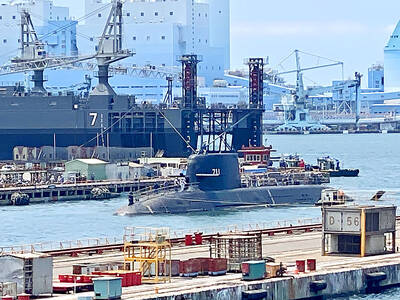
AGING: While Japan has 22 submarines, Taiwan only operates four, two of which were commissioned by the US in 1945 and 1946, and transferred to Taiwan in 1973 Taiwan would need at least 12 submarines to reach modern fleet capabilities, CSBC Corp, Taiwan chairman Chen Cheng-hung (陳政宏) said in an interview broadcast on Friday, citing a US assessment. CSBC is testing the nation’s first indigenous defense submarine, the Hai Kun (海鯤, Narwhal), which is scheduled to be delivered to the navy next month or in July. The Hai Kun has completed torpedo-firing tests and is scheduled to undergo overnight sea trials, Chen said on an SET TV military affairs program. Taiwan would require at least 12 submarines to establish a modern submarine force after assessing the nation’s operational environment and defense

A white king snake that frightened passengers and caused a stir on a Taipei MRT train on Friday evening has been claimed by its owner, who would be fined, Taipei Rapid Transit Corp (TRTC) said yesterday. A person on Threads posted that he thought he was lucky to find an empty row of seats on Friday after boarding a train on the Bannan (Blue) Line, only to spot a white snake with black stripes after sitting down. Startled, he jumped up, he wrote, describing the encounter as “terrifying.” “Taipei’s rat control plan: Release snakes on the metro,” one person wrote in reply, referring
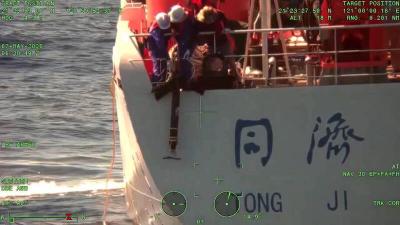
The coast guard today said that it had disrupted "illegal" operations by a Chinese research ship in waters close to the nation and driven it away, part of what Taipei sees a provocative pattern of China's stepped up maritime activities. The coast guard said that it on Thursday last week detected the Chinese ship Tongji (同濟號), which was commissioned only last year, 29 nautical miles (54km) southeast of the southern tip of Taiwan, although just outside restricted waters. The ship was observed lowering ropes into the water, suspected to be the deployment of scientific instruments for "illegal" survey operations, and the coast
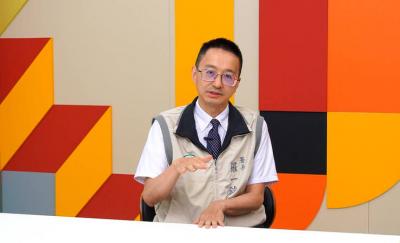
Taiwan’s two cases of hantavirus so far this year are on par with previous years’ case numbers, and the government is coordinating rat extermination work, so there should not be any outbreaks, Centers for Disease Control (CDC) Director-General Philip Lo (羅一鈞) said today in an interview with the Liberty Times (the Taipei Times’ sister newspaper). An increase in rat sightings in Taipei and New Taipei City has raised concerns about the spread of hantavirus, as rats can carry the disease. In January, a man in his 70s who lived in Taipei’s Daan District (大安) tested positive posthumously for hantavirus, Taiwan’s


 RSS
RSS