


Campaigners yesterday accused Chinese Nationalist Party (KMT) Chairman and presidential candidate Eric Chu (朱立倫) of benefiting a corporation owned by his father-in-law through revisions to the Taoyuan Aerotropolis project approved during his tenure as vice premier.
“Our suspicion is that [Chu] used his authority to unnecessarily expand the project in order to turn a piece of wasteland owned by his family into prime real estate that would be coveted by developers,” independent Taoyuan legislative candidate Wang Pao-hsuan (王寶萱) said at a rally in front of the Chinese Nationalist Party (KMT) headquarters in Taipei.
Wang, who has long campaigned against the project, was accompanied by several members of the Taoyuan Aerotropolis Anti-Eviction Alliance and Taoyuan MRT A7 Station Self-Help Organization.
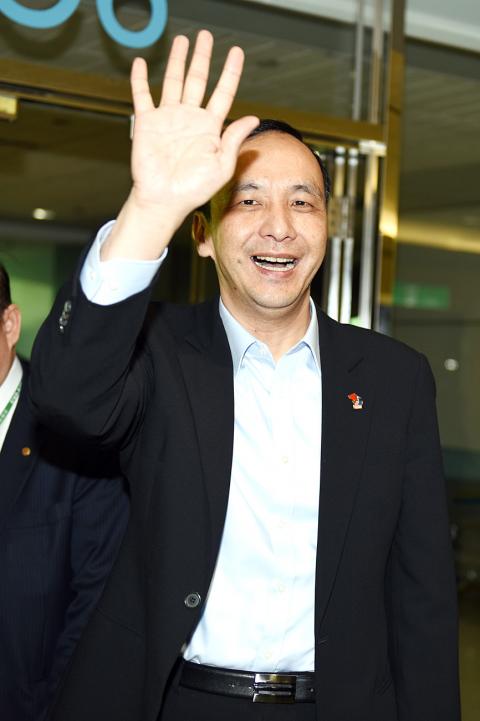
Photo: CNA
The Aerotropolis project’s original plans called mostly for the use of public land, with some private land needed for the construction of Taiwan Taoyuan International Airport’s third runway, Wang said.
Plans to expand the scope of the project to include private land surrounding a nearby free-trade zone were approved by the Construction and Planning Agency during Chu’s tenure as vice premier, she said.
Chu served two terms as Taoyuan commissioner before being appointed vice premier in 2009. He has been the mayor of New Taipei City since 2010.
Wang displayed a zoning map showing that a “finger” of land extending away from the original free-trade zone was included in expansion plans, saying that the tip of the finger included property owned by Everterminal Co.
The corporation is owned by Chu’s father-in-law, Kao Yu-jen (高育仁), and Chu might have used his influence as vice premier to ensure the corporation’s land was included in expansion plans, she said.
“While the original value of the land was extremely low, if it is included in the expansion plans, Aerotropolis landowners would be compensated with land in the most valuable residential and business districts where the MRT is being constructed,” she said, adding that Chu might have sought to illegally profit from his father-in-law’s firm.
The expansion plans, which would triple the size of the free-trade zone, made little economic sense because of the zone’s poor performance over the past 19 years, which has led to the development of less than half of the existing zone, she said.
Wang said she has almost concluded talks on joining the Green-Social Democratic Party Alliance, with an official announcement possible within the next few days.
She ruled out joining forces with the New Power Party (NPP) because of its close relationship with the Democratic Progressive Party (DPP), adding that local DPP politicians had expressed support for the project and she was unwilling to “integrate” with DPP candidate Cheng Yun-peng (鄭運鵬) as required under NPP policy.

AGING: While Japan has 22 submarines, Taiwan only operates four, two of which were commissioned by the US in 1945 and 1946, and transferred to Taiwan in 1973 Taiwan would need at least 12 submarines to reach modern fleet capabilities, CSBC Corp, Taiwan chairman Chen Cheng-hung (陳政宏) said in an interview broadcast on Friday, citing a US assessment. CSBC is testing the nation’s first indigenous defense submarine, the Hai Kun (海鯤, Narwhal), which is scheduled to be delivered to the navy next month or in July. The Hai Kun has completed torpedo-firing tests and is scheduled to undergo overnight sea trials, Chen said on an SET TV military affairs program. Taiwan would require at least 12 submarines to establish a modern submarine force after assessing the nation’s operational environment and defense

A white king snake that frightened passengers and caused a stir on a Taipei MRT train on Friday evening has been claimed by its owner, who would be fined, Taipei Rapid Transit Corp (TRTC) said yesterday. A person on Threads posted that he thought he was lucky to find an empty row of seats on Friday after boarding a train on the Bannan (Blue) Line, only to spot a white snake with black stripes after sitting down. Startled, he jumped up, he wrote, describing the encounter as “terrifying.” “Taipei’s rat control plan: Release snakes on the metro,” one person wrote in reply, referring
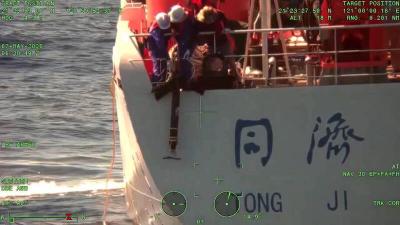
The coast guard today said that it had disrupted "illegal" operations by a Chinese research ship in waters close to the nation and driven it away, part of what Taipei sees a provocative pattern of China's stepped up maritime activities. The coast guard said that it on Thursday last week detected the Chinese ship Tongji (同濟號), which was commissioned only last year, 29 nautical miles (54km) southeast of the southern tip of Taiwan, although just outside restricted waters. The ship was observed lowering ropes into the water, suspected to be the deployment of scientific instruments for "illegal" survey operations, and the coast
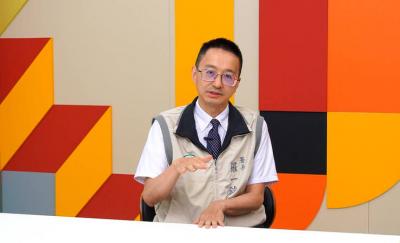
Taiwan’s two cases of hantavirus so far this year are on par with previous years’ case numbers, and the government is coordinating rat extermination work, so there should not be any outbreaks, Centers for Disease Control (CDC) Director-General Philip Lo (羅一鈞) said today in an interview with the Liberty Times (the Taipei Times’ sister newspaper). An increase in rat sightings in Taipei and New Taipei City has raised concerns about the spread of hantavirus, as rats can carry the disease. In January, a man in his 70s who lived in Taipei’s Daan District (大安) tested positive posthumously for hantavirus, Taiwan’s


 RSS
RSS