


Military families, 95-year-old British veteran Ken Pett and a number of international dignitaries yesterday commemorated a day of remembrance at the site of the former Kinkaseki prisoner of war (POW) camp in New Taipei City’s Jinguashi (金瓜石).
Of 14 POW camps Imperial Japan established in Taiwan during World War II, Kinkaseki was the most notorious. More than 1,100 POWs were forced to work in a copper mine at Jinguashi enduring starvation, rampant disease and constant abuse from guards, according to the Taiwan POW Camps Memorial Society.
Pett, an enlisted man in the British Army’s 80th Anti-Tank Regiment, was captured during the Battle of Singapore and said he endured inhuman conditions while on a ship transporting him to Taiwan.
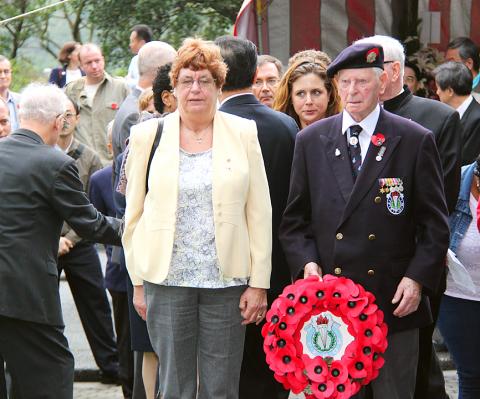
Photo: Lin Hsin-han, Taipei Times
“I remember most of the brutality of the guards,” Pett said, adding that he believes in commemorating fallen comrades at the site of the former camp, because honoring his friends is “the right thing to do, and no one else can do it, if not me.”
“We can forgive, but not forget,” Richard Bartelot Jr said, adding that even though his father — former British Army captain Richard Bartelot, who also served in the 80th Anti-Tank — did not talk about his days at Kinkaseki, he believes his father forgave the wrongs of the past.
Taiwan POW Camps Memorial Society director Michael Hurst said that more than 4,350 POWs were detained in camps in Japan-ruled Taiwan during the war, of whom more than 10 percent died in prison.
The POWs were fed meager rations of rice, despite the intense physical labor they performed, and were routinely brutalized not only by Japanese soldiers, but also by Taiwanese troops, who were “abused by the Japanese” and “treated just better than the prisoners,” Hurst said.
In spite of the guards’ brutality, Kinakseki POWs also remembered local Jinguashi residents, who often smuggled food to the prisoners, Hurst said, adding: “Taiwanese [civilians] usually treated the prisoners with kindness.”
Pett said his three remembrance visits to Taiwan had helped old wounds heal.
“For over 70 years I used to suffer flashbacks and nightmares about my treatment here, and I still do… but I can now also reflect on the good times here, which previously never existed. Now the word ‘Taiwan’ sends thoughts of: ‘When can I go again?’” Pett said.
“What a marvelous place. What amazing people,” he added.
Canadian Trade Office in Taipei executive director Mario Ste-Marie, World Veterans Federation vice president Kao Chung-yuan (高仲源) and representatives from Australia, Britain, New Zealand and Taiwan also attended yesterday’s commemoration ceremony.

The Centers for Disease Control (CDC) yesterday reported the first case of a new COVID-19 subvariant — BA.3.2 — in a 10-year-old Singaporean girl who had a fever upon arrival in Taiwan and tested positive for the disease. The girl left Taiwan on March 20 and the case did not have a direct impact on the local community, it said. The WHO added the BA.3.2 strain to its list of Variants Under Monitoring in December last year, but this was the first imported case of the COVID-19 variant in Taiwan, CDC Deputy Director-General Lin Ming-cheng (林明誠) said. The girl arrived in Taiwan on

South Korea is planning to revise its controversial electronic arrival card, a step Taiwanese officials said prompted them to hold off on planned retaliatory measures, a South Korean media report said yesterday. A Yonhap News Agency report said that the South Korean Ministry of Foreign Affairs is planning to remove the “previous departure place” and “next destination” fields from its e-arrival card system. The plan, reached after interagency consultations, is under review and aims to simplify entry procedures and align the electronic form with the paper version, a South Korean ministry official said. The fields — which appeared only on the electronic form

A bipartisan group of US senators has introduced a bill to enhance cooperation with Taiwan on drone development and to reduce reliance on supply chains linked to China. The proposed Blue Skies for Taiwan Act of 2026 was introduced by Republican US senators Ted Cruz and John Curtis, and Democratic US senators Jeff Merkley and Andy Kim. The legislation seeks to ease constraints on Taiwan-US cooperation in uncrewed aerial systems (UAS), including dependence on China-sourced components, limited access to capital and regulatory barriers under US export controls, a news release issued by Cruz on Wednesday said. The bill would establish a "Blue UAS

The Ministry of Foreign Affairs (MOFA) is suspending retaliation measures against South Korea that were set to take effect tomorrow, after Seoul said it is updating its e-arrival system, MOFA said today. The measures were to be a new round of retaliation after Taiwan on March 1 changed South Korea's designation on government-issued alien resident certificates held by South Korean nationals to "South Korea” from the "Republic of Korea," the country’s official name. The move came after months of protests to Seoul over its listing of Taiwan as "China (Taiwan)" in dropdown menus on its new online immigration entry system. MOFA last week


 RSS
RSS